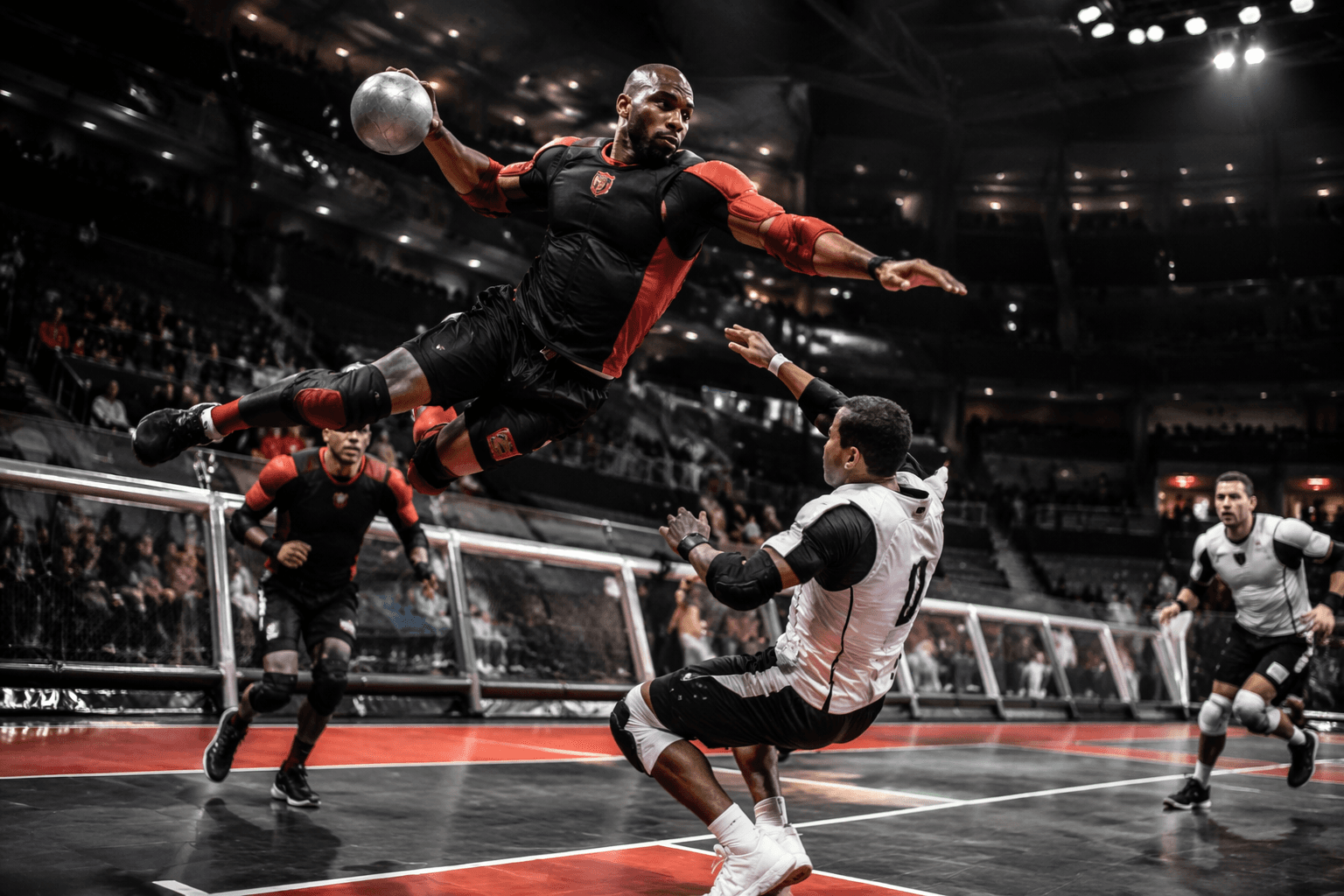
SlamBall Explained: Trampolines, Full Contact, and Unique Scoring Rules
SlamBall puts trampolines under your feet and full contact in your face, with scoring rules that make every possession feel different from anything in conventional basketball.
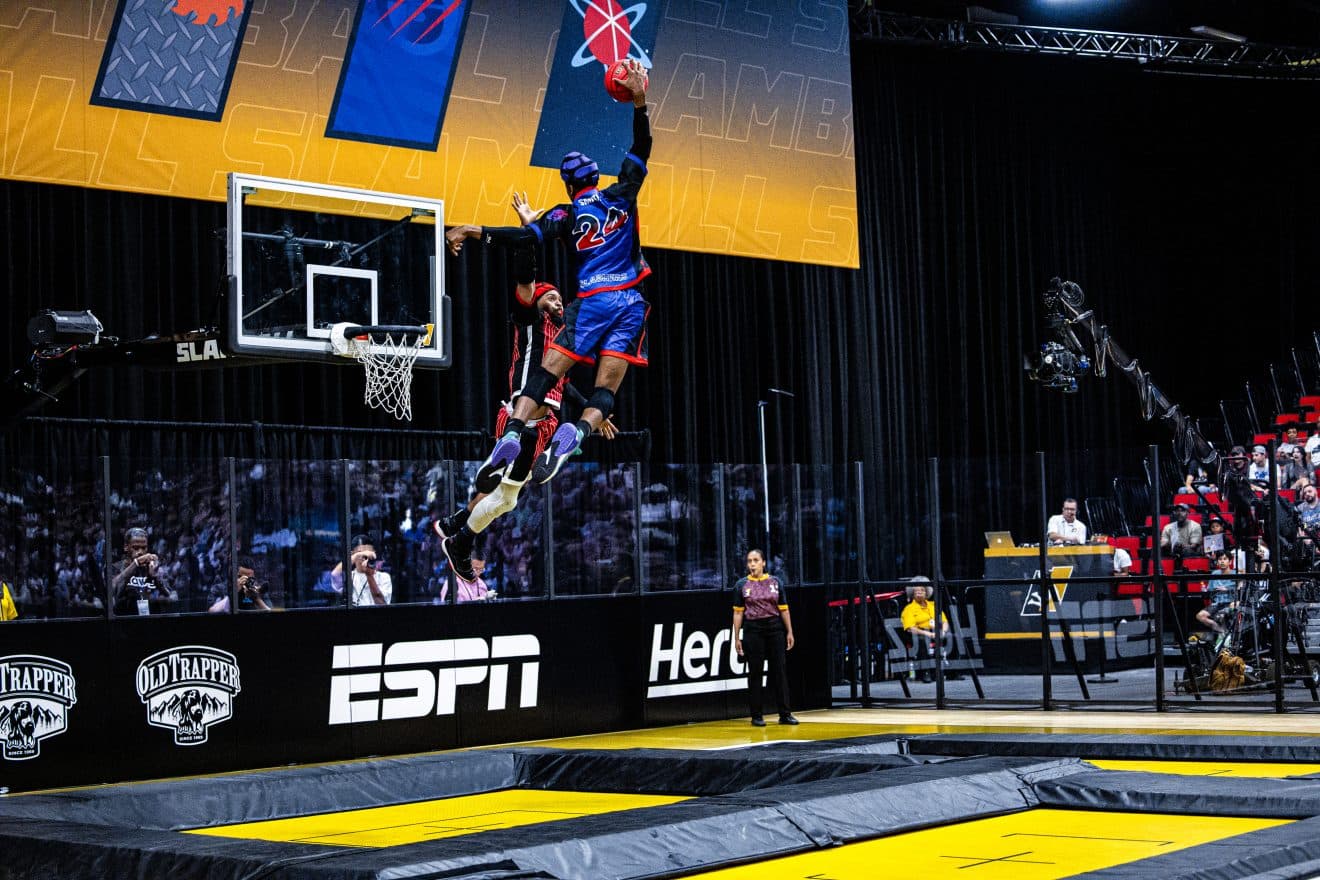
Picture a player launching off a trampoline embedded in the court floor, rising well above the rim, and throwing down a dunk while a defender tries to knock them out of the air. That single moment captures what SlamBall is: a collision sport built on aerial athleticism, where the physical rules of conventional basketball have been stripped back and rebuilt around spectacle and contact. For anyone coming to the game fresh, or trying to follow along during a broadcast without a clear frame of reference, understanding the architecture of SlamBall, its court, its contact rules, and its scoring system, is the fastest way to go from confused observer to genuine fan.
A sport built differently from the ground up
SlamBall is not basketball with trampolines added as a novelty. It is a hybrid sport that treats the trampoline surface as a fundamental design element, not an accessory. The trampolines are embedded directly into the playing surface, positioned in front of each basket in a way that transforms how players attack the rim. Instead of driving and elevating off a hardwood floor, players hit the trampoline beds and launch at heights that turn dunking into the primary offensive weapon rather than an occasional highlight.
The full-contact dimension separates SlamBall even further from its basketball DNA. Players are permitted to hit, block, and physically challenge opponents in ways that would draw immediate fouls in the NBA or any standard basketball league. This is not incidental contact tolerated by officials; it is a designed feature of the sport. The result is a game that plays closer to hockey or rugby in its physicality than to the basketball it visually resembles. A player rising off a trampoline is a legitimate target, and defenders know it.
The court and its trampoline layout
The SlamBall court is a specific piece of engineered infrastructure, not a converted basketball floor. The trampolines are built into recessed sections of the playing surface near each basket, typically arranged in a cluster that gives attacking players multiple launch points depending on their angle of approach. The placement is deliberate: it funnels offensive play toward the rim and creates the aerial collisions that define the sport's identity.
The rest of the surface functions as a more conventional playing area, but the embedded trampolines mean that players must constantly manage the transition between running on a firm floor and hitting a trampoline bed mid-stride. Mistiming that transition at full speed, with a defender closing in, is one of the genuine athletic skills SlamBall develops that no other sport requires.
Scoring rules that change the math of the game
This is where SlamBall diverges most sharply from basketball in a way that directly affects strategy and broadcast comprehension. In conventional basketball, every field goal is worth either two or three points depending on distance, and free throws are worth one. SlamBall uses a different point structure that assigns greater value to the sport's signature play.
A slam, meaning a dunk executed after launching off one of the embedded trampolines, is worth three points. A shot that goes in without a trampoline launch, the equivalent of a conventional field goal, is worth two points. This inversion of standard basketball logic is significant: it means the highest-value play in SlamBall is also the most physically dangerous one to attempt, since rising off a trampoline to dunk puts the offensive player at maximum exposure to a full-contact hit from a defender.

This scoring structure does something strategically important. It makes aerial, contact-heavy play the mathematically optimal choice in most situations, which is why SlamBall offenses are built around creating trampoline-launch opportunities rather than developing perimeter shooting. A team that consistently converts slams is not just playing to the crowd; it is playing the highest-percentage point-per-possession game the sport's math allows.
Clock and substitutions
SlamBall uses a game structure divided into periods, with a running clock managed similarly to other contact sports rather than the stop-start clock management common in late-game basketball. The pace this creates is relentless by design. Without the frequent clock stoppages that slow NBA games to a crawl in the final two minutes, SlamBall maintains its physical tempo from opening tip to final buzzer.
Substitutions follow an active roster system that keeps fresh players rotating through the contact-heavy gameplay. Given that SlamBall demands both basketball skill and the capacity to absorb and deliver full-contact hits while managing trampoline athleticism, player fatigue accumulates quickly. The substitution rules reflect that physical reality, allowing teams to maintain their intensity without players burning out over the course of a game.
What makes it genuinely different
The easiest way to underestimate SlamBall is to categorize it as a stunt version of basketball. The trampolines, the contact, and the altered scoring are not gimmicks layered onto a familiar game; they are a coherent set of design choices that produce a sport with its own strategic logic, its own skill requirements, and its own physical demands.
A SlamBall player needs the court vision and ball-handling of a basketball player, the body preparation to give and absorb contact like a hockey player, and the spatial awareness to time trampoline launches the way a gymnast times apparatus work. Those three skill sets rarely overlap in conventional sports. SlamBall requires all three simultaneously, which is why players who excel at it tend to be genuinely unusual athletes.
The scoring system reinforces this by making the most skill-intensive and physically exposed play, the trampoline dunk into contact, worth more points than the safer alternative. That alignment between risk, skill, and reward is what gives SlamBall its internal logic as a sport rather than as entertainment theater. Once you understand why three points go to the slam and two to the conventional shot, every possession you watch carries a different kind of weight.
This article was produced by Prism’s automated news system from verified source data, official records, and press releases, then run through automated quality and moderation checks before publishing. The system is built and supervised by the people who set the standards it runs under. Read our full AI policy.
Did this article answer your question?