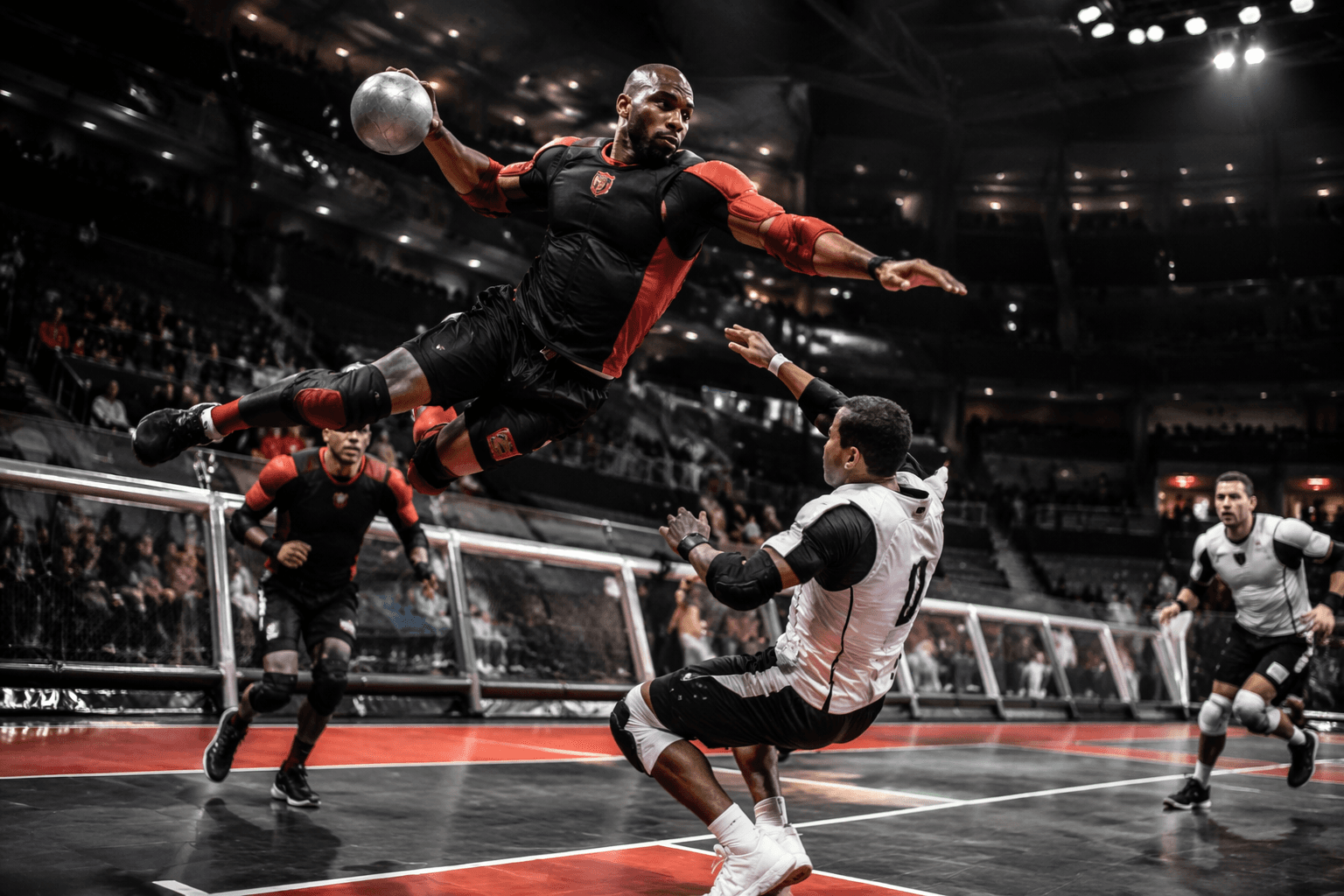
Slamball Has Transformed Dramatically Since Its Late-1990s Origins
From trampoline courts to tactical overhauls, Slamball's journey from late-1990s concept to structured sport is wilder than most fans realize.

Few sports can claim an origin story as deliberately engineered as Slamball. This wasn't a game that evolved organically from a sandlot pastime or a regional tradition. It was conceived, constructed, and launched with a specific vision: take basketball's vertical game and blow the ceiling off it, literally, by sinking trampolines into the court surface and letting athletes become projectiles. That foundational idea, dreamed up in the late 1990s, set the sport on a trajectory of continuous reinvention that hasn't stopped since.
The Late-1990s Blueprint
The original concept behind Slamball was as simple as it was audacious. Basketball already rewarded athleticism and leaping ability, but the physical limits of the human body capped how spectacular the game could get. The solution was engineering: embed trampoline pads around the basket areas, give players the mechanical advantage to reach heights no unaided athlete could, and suddenly the dunk, the sport's most electrifying play, becomes a weapon available on nearly every possession. The late-1990s conception wasn't just about adding trampolines to a court, though. It required rethinking player safety, contact rules, team structure, and broadcast presentation from the ground up. What emerged was something that looked familiar enough to hook casual basketball fans but played differently enough to demand its own rulebook.
Equipment Evolution
The trampolines themselves have undergone significant development since those original designs. Early court setups were functional but rough, prioritizing novelty over consistency. Over time, the equipment was refined to standardize the bounce characteristics across all four trampoline pads on each end of the court, meaning players could develop repeatable techniques rather than adjusting to unpredictable surfaces. The court boundaries, padding configurations, and the boards surrounding the playing surface have all been upgraded as the sport learned from live game conditions. Each iteration of the equipment addressed real problems that showed up during actual play, making the evolution of Slamball's hardware less about aesthetics and more about making the game faster, more consistent, and safer for athletes operating at serious velocity.
Safety as a Structural Priority
The safety dimension of Slamball's evolution deserves particular attention because it shaped the sport's viability more than almost any other factor. When you combine trampoline-assisted athletes with full-contact rules and a hard court environment, the injury calculus is genuinely complicated. Early versions of the game exposed gaps in protective equipment standards, and those gaps had to be addressed for the sport to function at a competitive level long-term. Protective gear requirements became more rigorous, and the safety padding integrated into the court structure was redesigned to reduce the consequences of hard landings and collisions. This wasn't just player welfare work in the abstract; it was the difference between a sport that could sustain a professional roster across a full season and one that burned through athletes faster than it could develop them.
Tactical and Structural Development
As the equipment and safety framework matured, so did the strategic sophistication of how Slamball is actually played. The early years were heavy on improvisation, with players and coaches figuring out on the fly what worked in this strange hybrid environment. Over time, distinct tactical systems emerged. Teams began developing set plays designed specifically around the trampoline positions, recognizing that controlling access to the pads was as important as controlling the ball. Defensive schemes evolved to account for aerial threats from multiple angles, not just the straight-line drives that basketball defense traditionally prioritized. The game also developed positional specialization at a deeper level, with roles defined not just by size or ball-handling skill but by how players used the trampolines: who was a primary launcher, who played off the bounce to clean up, who served as the physical enforcer in contested airspace.
Broadcast and Cultural Growth
The structural evolution of Slamball also played out in how the sport was presented and consumed. A game built on high-flying collisions and gravity-defying dunks was inherently television-friendly, and the sport leaned into that reality. Camera placements, production styles, and broadcast framing all adapted to capture the vertical dimension of the game that made it distinctive. This wasn't cosmetic. The way a sport is broadcast shapes the way fans understand its tactics, its stars, and its moments, and Slamball's willingness to treat broadcast design as part of the game's overall architecture helped it develop a dedicated audience that understood what they were watching rather than just reacting to the spectacle.
Where the Sport Stands Now
The through-line from Slamball's late-1990s conception to its current form is a story of a sport taking itself seriously enough to keep improving. The original idea had obvious entertainment value, but entertainment value alone doesn't build a sustainable sport. It took iterative work on equipment standards, safety protocols, tactical depth, and structural organization to transform a flashy concept into something with genuine athletic credibility. TheSportsReviewer's detailed examination of this evolution in "The Evolution of Slamball: How the Sport Has Changed Over Time" captures how much ground the sport has covered since those first trampoline pads were bolted into a court surface.
The sport that exists today retains the core DNA of that original vision: basketball's scoring logic, amplified athleticism, and sanctioned physical contact in an arena designed to make human flight look routine. But it's been stress-tested, refined, and rebuilt in ways the original architects likely couldn't have fully anticipated. That's not a criticism of the founding concept; it's actually the highest compliment. An idea flexible enough to survive contact with reality and come out better on the other side is an idea that was worth having in the first place.
This article was produced by Prism’s automated news system from verified source data, official records, and press releases, then run through automated quality and moderation checks before publishing. The system is built and supervised by the people who set the standards it runs under. Read our full AI policy.
Did this article answer your question?