SlamBall homepage pushes stars, highlights and full-game replays
SlamBall’s homepage is built around people, not packaging: Gage Smith, athlete tryouts, and replayable games turn curiosity into real fandom.
A homepage built around personalities, not just inventory
SlamBall’s front door is doing more than pointing fans to games. It is putting a face on the league, and that face is Gage Smith, the reigning Series 6 MVP, Defensive Player of the Year, and champion. That matters because SlamBall has always sold best when it feels like a collision of myth and muscle, not a curiosity act, and the homepage leans hard into that idea by giving Smith’s fan letter top billing while also teasing athlete tryouts, an award mention, partnership news, and season action.
The smartest part of the layout is how little it wastes your time. If you want clips, the highlights are there. If you want the whole thing, the full-game archive is there. If you want context, player pages, team pages, standings, stats, league leaders, box scores, podcasts, and photo galleries are all within reach. The league is not asking visitors to admire the concept from a distance. It is trying to convert them into repeat viewers by making every layer of the sport easy to sample, revisit, and argue about.
Gage Smith is the league’s clearest anchor
SlamBall knows exactly what kind of star it wants Smith to be. The homepage’s “A Letter to the Fans” framing is a smart move because it turns the champion into a direct messenger, not just a line in a standings table. That is the right call for a league that still has to prove its personalities can carry the sport as well as its hits and rebounds do.
Smith’s player bio backs up the spotlight with real basketball credentials. He is listed at 6-foot-6, 225 pounds, from Elizabeth, Colorado, and born December 25, 1999. His Concordia University career totals are not decoration, either: 899 rebounds, 282 assists, and 1,355 points over five years. Those numbers tell you why the league frames him as more than a trampoline specialist. He looks like a legitimate all-around force, which gives SlamBall a central character fans can track from replay to replay.
The homepage also uses Smith the way strong sports properties use their best player: as a shorthand for the product itself. If he is the reigning MVP, the defensive player of the year, and the champion, then he is not just a star. He is the league’s proof of concept.

The site is built to make replay culture feel like the main event
SlamBall’s content structure is remarkably clean for a league still building its mass audience. The schedule page keeps the calendar visible, the teams page shows the current eight-franchise setup, and the full-games archive is the real tell. That archive says the league understands its value does not end when the final whistle sounds. In a sport built on a small set of explosive, repeatable actions, a full replay is not filler. It is the product.
The highlights page extends that logic by surfacing moments and ideas that explain the sport to a newcomer without dulling it for a regular. Free throws, sudden-death overtime, and a rules explainer sit next to spotlight pieces on Gage Smith and Tony Crosby II. That mix is shrewd: the league is teaching the mechanics while also feeding the personality pipeline. The message is simple, and it is the right one: learn the rules, then watch the players make those rules look dangerous.
The archive’s focus on Series 6 game-days and postseason content reinforces the idea that SlamBall wants to be remembered through competition, not just clips. Championship game, semifinals, day-by-day recaps: that is a league writing its own season history in real time, and it is doing it in a way that invites fans back for the next possession.
The comeback story still carries the sport’s mythology
The broader context is what gives the homepage its edge. SlamBall says it was invented in 1999 by Mason Gordon and first played in Los Angeles, which gives the league a homegrown origin story that feels almost too strange to be real. Then comes the pause: the league says it was dormant in the United States for 15 years before returning in 2023 for its sixth season in Las Vegas. That gap matters because comebacks only work when the absence is part of the legend.
The 2023 relaunch was not a soft reset. SlamBall revealed eight team names, logos, coaches, and seven-man rosters on June 27, 2023, and the season itself was built as a month-long run with playoffs. ESPN said the action began July 21 and ran through the Aug. 17-19 playoff window at Cox Pavilion in Las Vegas, with all games played there. More than 30 hours of live SlamBall programming aired across ESPN, ESPN2, and ESPN+, which is the kind of distribution that turns a niche return into a real sports event.
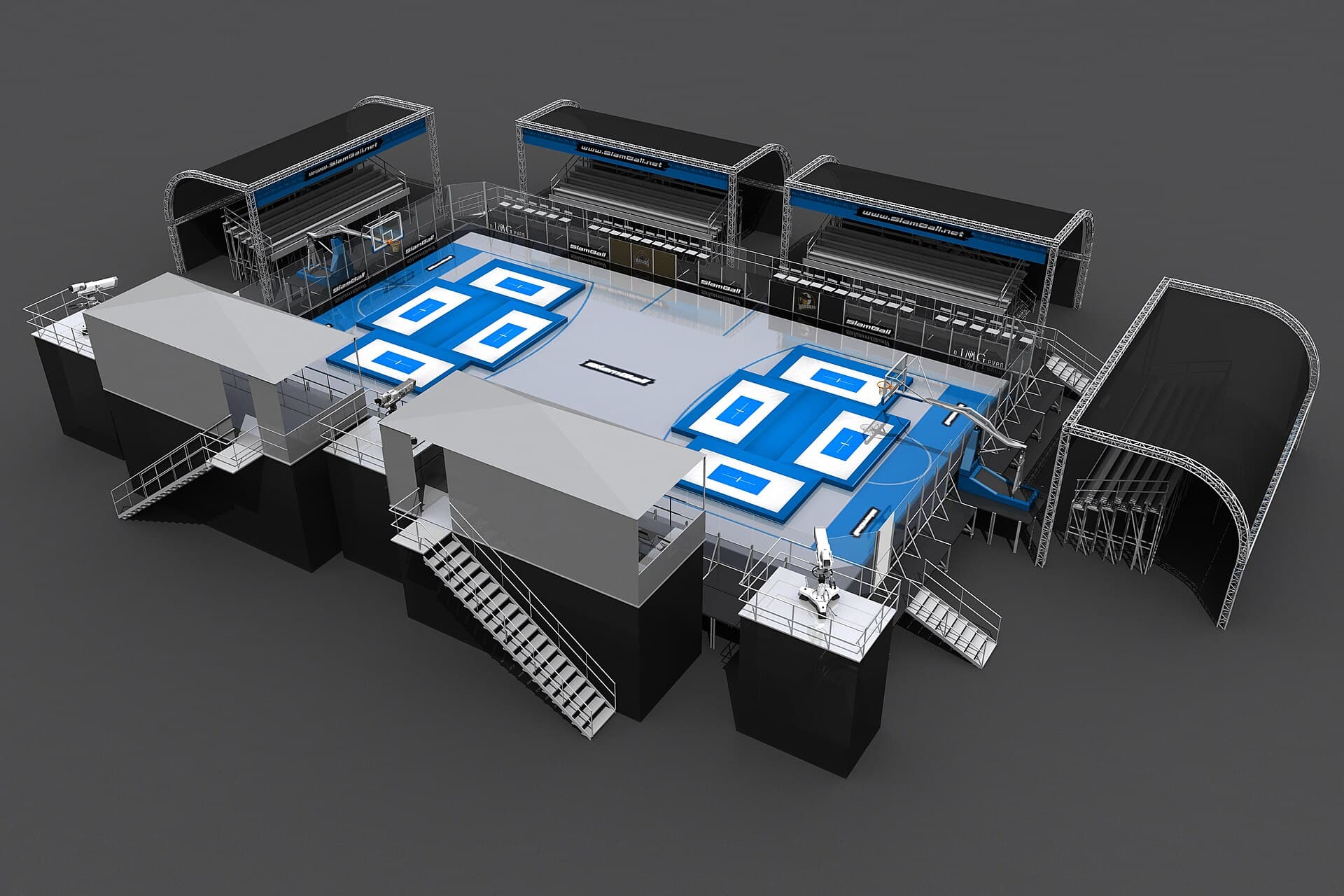
That structure also explains why the current homepage still feels so season-forward. SlamBall is not pretending to be static. It is presenting itself as a league with a living calendar, a current roster of eight franchises, and a replay library that lets every weekend matter twice.
The off-court signals are part of the same sales pitch
The news hub makes one thing obvious: SlamBall wants to be read as a growing sports property, not a novelty with a few viral clips. The Pabst Blue Ribbon partnership is highlighted for the 2024 and 2025 worldwide seasons, and the ProhiBet deal adds a compliance angle that says the league is serious about structure. There is also a nod to Business Insider as one of the “Top 25 Promising Sports Startups to Watch,” which helps place SlamBall in a broader growth conversation without losing the sport’s identity.
Still, the most revealing part of the homepage may be the simplest: “Want to Become a SlamBall Athlete?” That line shows the league is not only selling fandom, it is selling participation. When a sport is trying to deepen its base, the best move is often to make the barrier between watcher and player feel thinner. SlamBall does that by pairing the invitation to try out with the visual evidence of what the league rewards: star power, physical risk, and real competitive stakes.
Tony Crosby II fits that exact frame. His spotlight is not abstract hype. It is tied to a concrete breakout: 38 points and 10 dunks in two victories during the Slashers’ first Main Event win of the season. That is the kind of line that gives a homepage bite. It is also the kind of production that helps a league build new names fast, because the numbers are too loud to ignore.
SlamBall’s homepage is not trying to explain why the sport exists. It is showing you who matters, what happened, and where to watch it again. In a league where identity is still being written, that is how you turn curiosity into allegiance.
Know something we missed? Have a correction or additional information?
Submit a Tip

