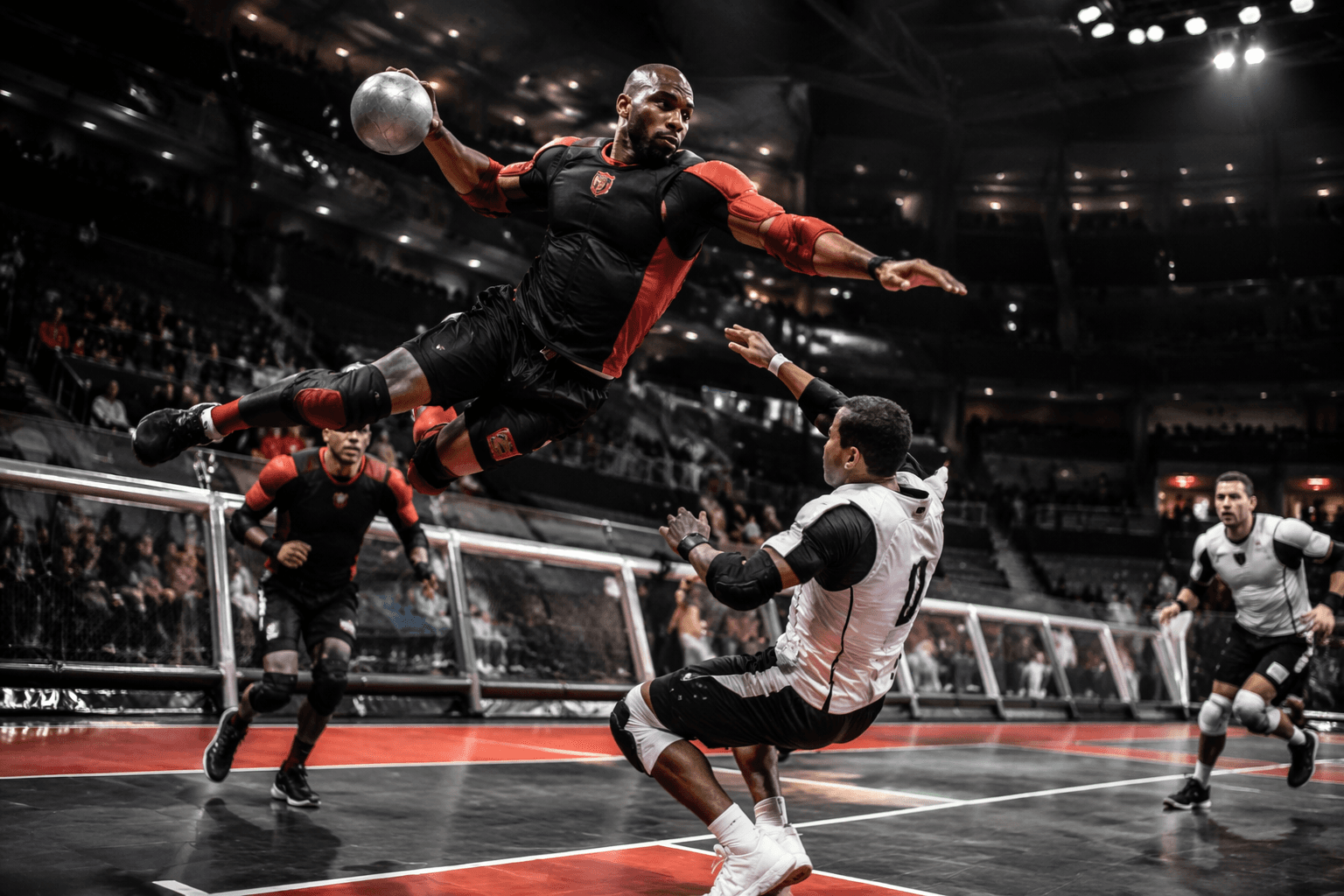
SlamBall rulebook reshapes game with live subs, face-offs, and no-contact zones
A SlamBall possession can flip from basket to face-off in seconds, and the rulebook is what makes that chaos deliberate.
The rulebook is the real engine
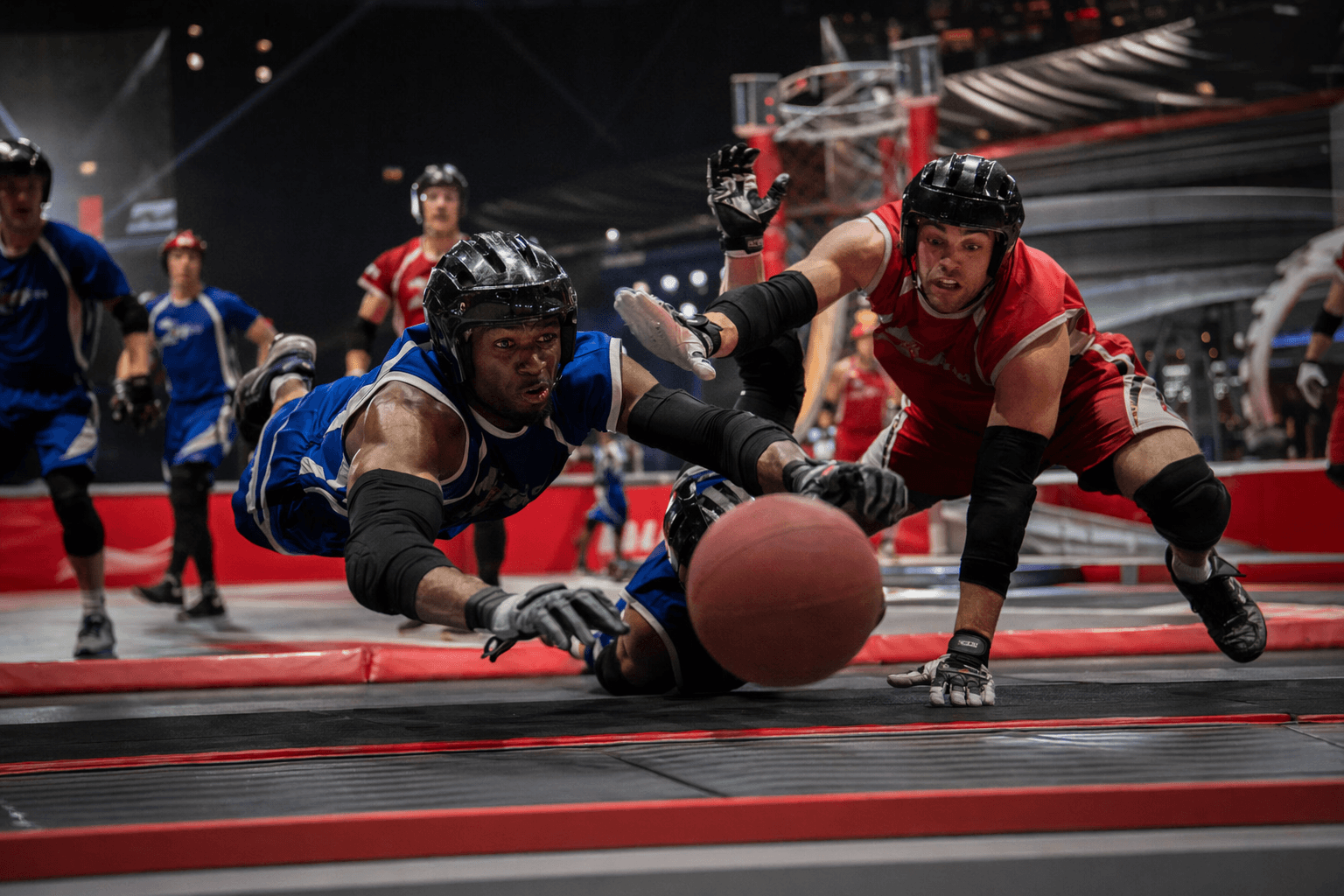
SlamBall looks like basketball at first glance, but the rulebook is what makes it feel faster, stranger, and more strategic than ordinary court sports. Every possession is squeezed through a system built for pressure: a 96-foot-by-64-foot court, plexiglass around the edges, 10-foot rims, springbeds at each end, and only four players on the floor for each team at a time. The result is not just vertical spectacle. It is a game that forces constant calculation.
A single possession can branch into several outcomes almost immediately:
1. The ball is thrown up in a throw down, not a traditional tip-off, and both teams fight for position.
2. A team can push the ball live while substitutions happen hockey-style, so the lineup can change without the clock stopping.
3. An attack through the island, the padded space between the springbeds, has to be handled carefully because it is a no-contact zone.
4. The possession can end in a scoring chance, a face-off, or a turnover that becomes its own restart problem.
That is the sport’s core appeal. It does not merely reward the finish. It rewards the decision that comes before the finish.
How one possession becomes a branching decision
The cleanest way to understand SlamBall is to follow one trip down the floor. After the throw down, a guard pushes into space and the offense tries to decide whether to attack the rim, pull up into a set shot, or use the island as a lane to create separation. Because the roster is only seven active players and just four can play at once, every substitution matters. A fresh attacker might come in for one burst, then leave before the defense can set its shape.
If the ball handler enters the island, the defense is constrained. Meaningful contact there triggers a face-off, and the rules limit how defenders can engage an offensive player moving through that area. So the offense is not just reading open court, it is reading the consequences of contact. The possession can become a scoring chance, a reset through a face-off, or a dead-end if the ball is lost before the attack reaches the bed.
That is where SlamBall’s scoring geometry gets interesting. The official stats glossary tracks two-point field goals, three-point opportunities, four-point opportunities, rim attacks, layups, three-point slams, offensive face-offs, defensive face-offs, loose-ball recoveries, steals, turnovers, blocks, hits, penalty points and violations. Those labels tell you the sport is not built around one kind of basket. It is built around a menu of outcomes, each one carrying different value and different risk.
Why the clock keeps the pressure on
SlamBall’s clock rules are part of the trap. Games are four five-minute quarters, and the clock runs in nearly every situation except face-offs and timeouts, with stop time in the final minute. That means the game does not pause every time the action gets messy. It keeps moving, which turns each possession into a race against the clock and against the next substitution.
Teams get only one timeout per game, and it comes only in the fourth quarter. That is a tiny margin for error in a sport where the pace can already feel like a sprint through a moving obstacle course. Overtime, if the game is tied after regulation, is settled by face-offs, with designated attackers and defenders sent out to decide it. In other words, the last part of the game does not strip away the sport’s oddness. It doubles down on it.
The island changes everything
The island is the detail that most clearly separates SlamBall from basketball. In a normal court game, contact is something you absorb, seek out, or avoid. In SlamBall, contact in the wrong space can change the possession entirely. The no-contact zone forces both teams to think about where the ball is, where bodies are, and where the risk of a face-off begins.
That is why the sport often feels like a tactical puzzle wrapped around a highlight reel. The offense wants to attack vertically, but the defense wants to steer the play into the island at the wrong moment or deny it altogether. Because live substitutions are allowed during play, coaches can respond to those shifts on the fly, swapping in a defender for a jumper or an attacker for a finisher without waiting for a whistle. The tempo becomes a chess match played at full speed.
A rulebook built for a different kind of athlete
SlamBall’s origin story explains why the rules feel so intentional. Mason Gordon invented the sport in 1999, and it was first played in Los Angeles. Gordon and Mike Tollin launched it as a hybrid of basketball, football and hockey with trampolines, not as a simple remix of a familiar court game. That design choice still shows up in every part of the rulebook, from the springbeds to the face-offs to the constant movement.
The modern league’s relaunch made that identity more visible again. ESPN and SlamBall agreed to an exclusive two-year national broadcast partnership for the 2023 and 2024 seasons, and the 2023 return began July 21 in Las Vegas. The season ran over five weekends and ended with playoffs and a championship game at Cox Pavilion. For a sport built to survive gravity, contact and television, that setting fit the project perfectly.
The league also made a point of showing who was playing. The 2023 opening rosters featured eight teams and 56 players, with 66 percent from basketball backgrounds, 23 percent from football and 11 percent from track and field. The average player was 26.9 years old, 6-foot-4 and 210 pounds. That mix matters because SlamBall is not a one-sport pipeline. It pulls from different athletic traditions and asks them to solve the same strange problem: how do you score when every inch of space can change the possession?
The league’s history still lives on the floor
The revival also leaned on its old guard. Three legacy teams, the Mob, Rumble and Slashers, returned alongside five new clubs, giving the comeback a direct line to the league’s first era. Ken Carter remains one of the most recognizable figures in that history. He coached the Rumble to a championship in the inaugural 2002 season and also coached in 2003 and 2008, with the team posting a 25-6 combined regular-season record across those seasons.
That continuity matters because SlamBall sells itself not just as a stunt, but as a playable sport with its own logic and its own lineage. The rulebook is doing more than keeping order. It is manufacturing the chaos that makes the game watchable, the strategy that makes it sticky, and the scoring choices that make every possession feel like a decision tree at full speed.
This article was produced by Prism’s automated news system from verified source data, official records, and press releases, then run through automated quality and moderation checks before publishing. The system is built and supervised by the people who set the standards it runs under. Read our full AI policy.
Did this article answer your question?