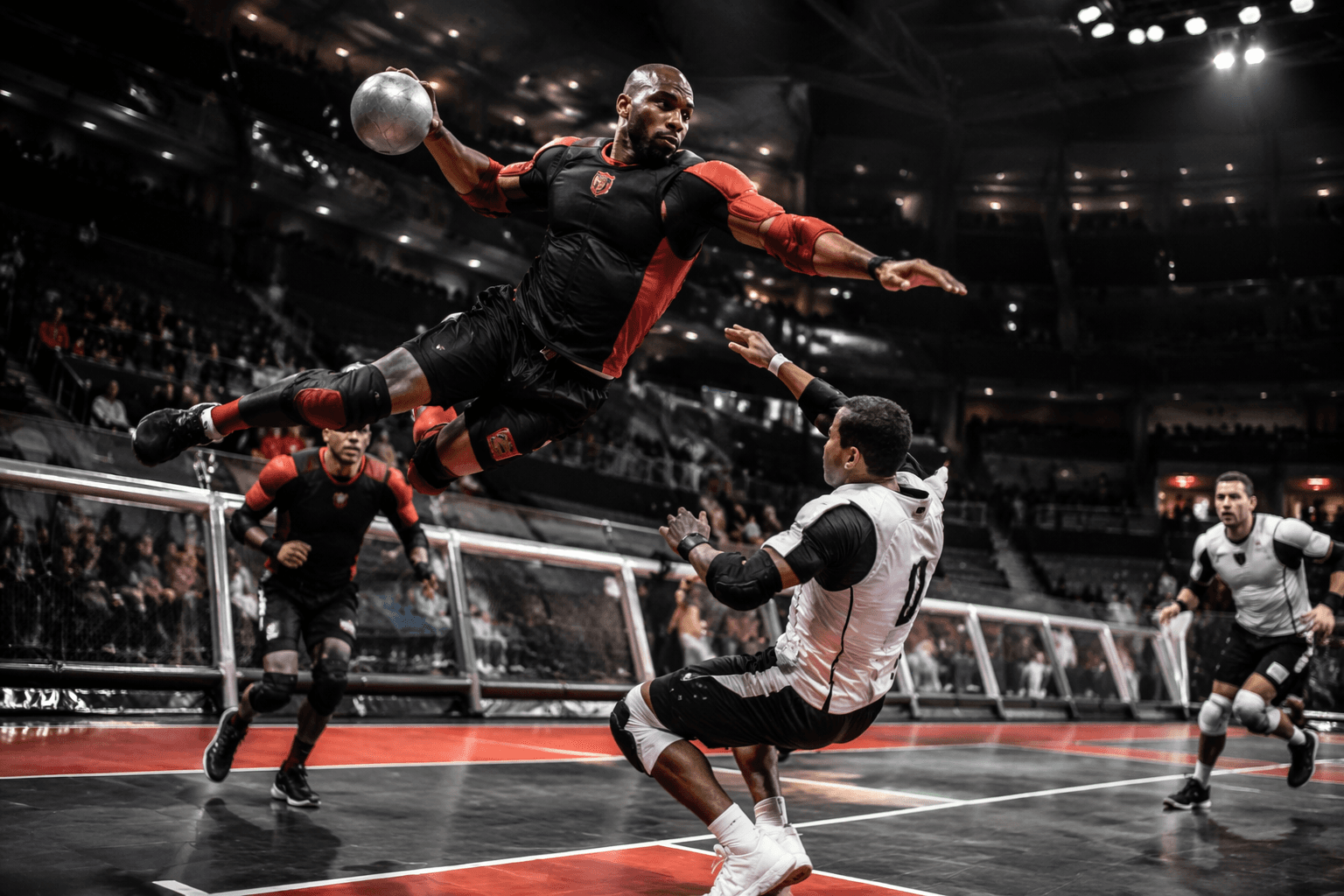
SlamBall Training Blends Plyometrics, Trampoline Drills, and Impact Conditioning
SlamBall athletes train for midair contact the same way linemen train for collisions; the system that builds repeatable vertical power starts on a trampoline.
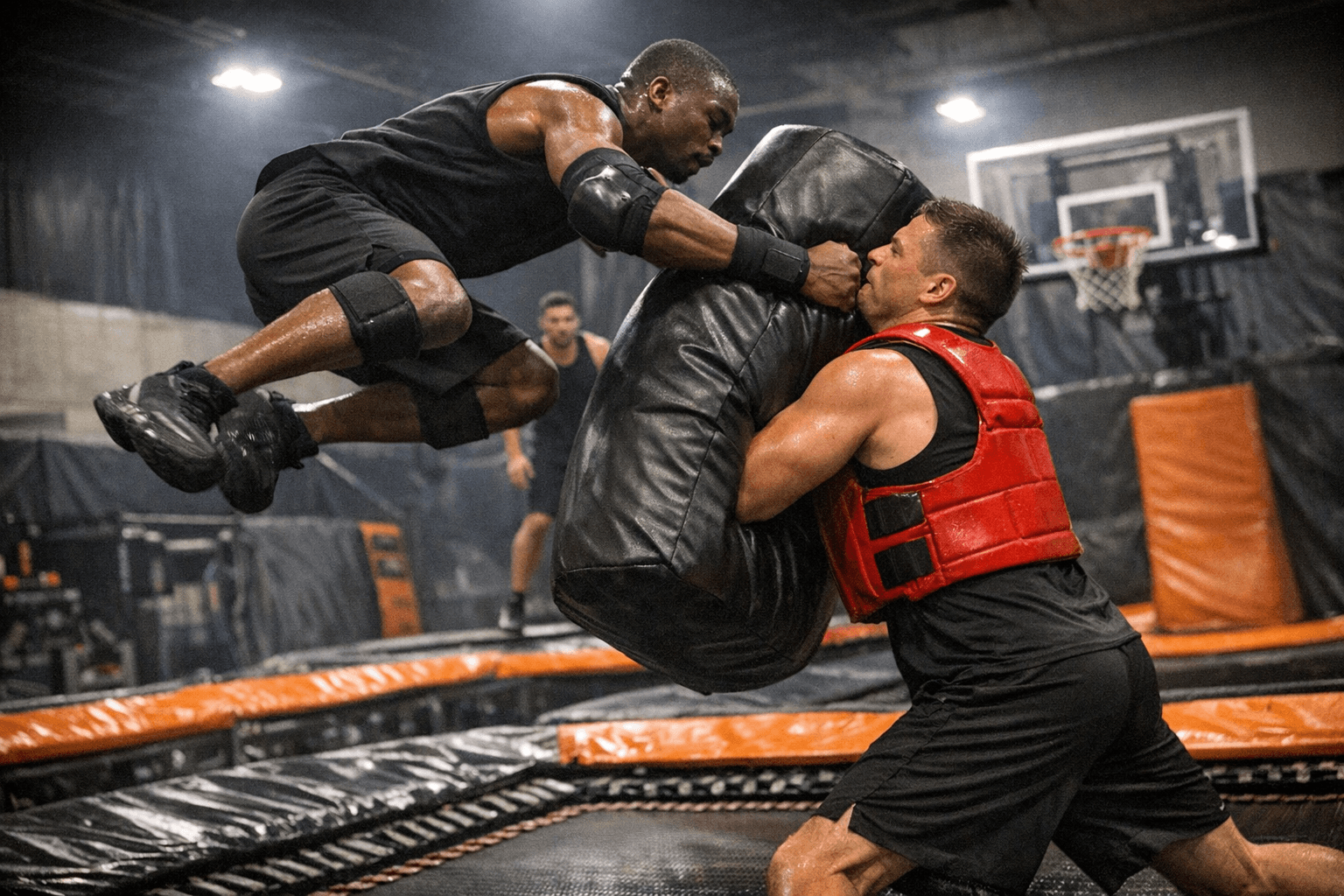
Watch the clip back at half speed and that dunk still undersells what just happened. The athlete launches off a trampoline panel, catches at the apex of a trajectory that peaks several feet above the rim, absorbs a mid-flight shoulder from a defender, and converts the contact into a clean finish rather than a crash landing. The play looks like athleticism. It is, underneath the spectacle, the product of a three-discipline training system that most basketball programs never touch.
Modern SlamBall conditioning teams track jump volume the same way distance coaches track mileage: accumulate too much, too fast, and tendons fail before the season does. Session RPE, jump-counts, and neuromuscular fatigue assessments run alongside wearable data to manage cumulative impact loads that, across a single game, routinely combine multiple near-maximal vertical efforts with collision contacts that approximate football-level exposure. That workload is the starting point for understanding why SlamBall preparation looks nothing like a standard basketball strength program.
Why the sport demands a different training model
SlamBall's combination of trampoline-derived verticality, high-contact aerial collisions, and rapid change-of-direction demands creates an athletic profile that conventional basketball or football conditioning doesn't address in full. The sport needs athletes who are explosive but also possess precise mid-air control, advanced core-driven rotational stability, and the capacity to absorb impact after high-velocity aerial plays. Addressing all three of those qualities simultaneously is what separates SlamBall preparation from anything adjacent to it.
Mike Golub's conditioning primer describes core integration as the "epicenter of flight" for SlamBall athletes, and the language is deliberate. Core strength here isn't about aesthetics or even force production in isolation; it drives safety and in-flight decision-making when an athlete is several feet above the trampoline panel and about to take contact from a closing defender.
Plyometrics built for repeatable vertical output
The foundation of SlamBall's explosive demand is the stretch-shortening cycle, and that's where plyometric work begins. Depth jumps, box jumps, lateral bounds, and single-leg hops train neuromuscular responsiveness in patterns that directly mirror a trampoline-surface takeoff and landing sequence. VerticalJumpCenter's progressions move athletes from low-intensity reactive hops through to weighted depth jumps, a loading ladder that maps cleanly onto SlamBall's need to launch repeatedly from a spring-loaded surface and regain balance immediately on descent.
The sets are structured with brief rest intervals and high-intensity output windows to replicate the game's short-burst rhythm. A SlamBall possession isn't a slow-build sequence; it's a series of near-maximal vertical efforts compressed into a tight window, and the conditioning work mirrors that compression to build the neuromuscular endurance the late stages of a game demand.
Air control: rotating and reorienting under pressure
Getting up is one thing. What happens in the air is something different entirely. SlamBall's aerial game requires athletes to twist, grab, and reorient mid-flight while avoiding collisions and positioning for offensive or defensive follow-up, all within a fraction of a second at height.
Training protocols address this with rotational core work, anti-rotation holds, Pallof presses with dynamic extensions, cable-resisted rotational throws, and medicine-ball chops. The goal is to build the capacity to change body orientation in the air and absorb contact on descent without losing position or ball control. These aren't accessory movements tacked onto the end of a session; they are the mechanical underpinnings that determine whether a contested catch converts into a scoring play or a fumbled possession.
Trampoline timing and rebound sequencing
Plyometrics on firm ground transfer, but they don't fully replicate a spring-loaded surface. Trampoline-specific timing work is a non-negotiable component of SlamBall preparation, practiced on regulation trampolines or lower-stretch springbeds engineered to mimic the court's panel behavior.
Progressive drill libraries start with controlled tuck jumps and pike progressions, then advance into rhythm-based rebounding sequences that pair catch-and-release passing with immediate second-jump reactions. The progression trains takeoff timing, mid-air catch mechanics, and controlled landing form under accumulated game fatigue. Australia's SlamBall drills guide provides a structured set of trampoline-to-court progressions specifically designed for athletes transitioning from traditional basketball into SlamBall-specialized roles, which is precisely where timing gaps are most pronounced. The drills force athletes to rehearse not just the ascent, but the catch and the return, building a complete aerial sequence rather than isolated vertical output.
Contact conditioning and collision resilience
Basketball doesn't prepare athletes for what SlamBall's contact tolerances demand. The sport permits heavier mid-air collision loads than traditional basketball, which means neck, shoulder, and upper-body resilience work has to be built deliberately into the program rather than assumed from prior athletic backgrounds.
That means isometrics, resisted shrug patterns, and banded scapular control work designed to protect players on collision landings. Integrated contact conditioning, including sled pushes, controlled partner collisions, and deceleration training, readies athletes for repeated high-force impacts across a full game. Mike Golub's training design frames this component as safety-driven rather than performance-driven, though in a collision sport the line between the two collapses quickly when a player absorbs a mid-air hit without a prepared shoulder girdle.
The sample microcycle
A three-day training block organizes these demands into distinct but complementary sessions:
Day 1: Explosive Power
Olympic-derivative lifts anchored by hang cleans, box jumps (3x6, heavy), depth jumps (4x5), slam-ball rotational throws (4x10), and short sprint work (6x30m) form the session. The emphasis is force production and its direct conversion to vertical output.
Day 2: Air Control and Core
Cable anti-rotation complexes, single-leg Romanian deadlifts (3x8), Pallof press progressions, and med-ball mid-air catch-to-tuck drills on a low-stretch rebound surface define the session, closed out with proprioceptive stabilizer work. Every exercise reinforces mid-air control and safe landing mechanics, the qualities that keep an athlete on the court rather than in the training room.
Day 3: Reactive Endurance and Contact Prep
Lateral bounds circuits, sprint-resisted approach work, contact absorption drills with pads, neck and shoulder isometric holds, and progressive partner-checked landings make up the final session of the week. The emphasis is resilience under repeated impacts, which is the precise quality the fourth quarter of a SlamBall game tests hardest.
Slam balls and medicine balls as force-transfer tools
The weighted medicine-ball exercises embedded throughout the program develop the rapid force-transfer pattern athletes need when converting aerial momentum into post-landing power. TRX's slam-ball training documentation covers exercises that improve total-body explosiveness, posture under load, and the ability to drive force through the torso into the extremities. That chain reaction is critical to both offensive slams and contested rebounds, and the exercises replicate the trunk-driven mechanics athletes use when catching at height and converting immediately to second-phase motion, whether that's an outlet pass or a continuation finish under contact.
Injury management and load monitoring
The vertical forces and collision exposures SlamBall generates are extreme by any sport's standards. Progressive return-to-jump protocols after lower-limb injuries prioritize eccentric control, tendon strengthening through slow heavy loading, and carefully graduated trampoline rebound exposure before athletes return to full contact work.
Controlling rotations and landing mechanics is not just a performance priority; according to Mike Golub's training framework, it is the deciding factor in long-term athlete availability. Teams that treat landing quality as a tracked KPI alongside vertical output build rosters that survive full seasons intact. The programs that produce durable, high-performing SlamBall athletes combine trampoline-specific progressions with established vertical-jump and plyometric models, and they monitor cumulative load with the same rigor a track program applies to weekly mileage. Raw explosiveness gets an athlete into the air. Everything built in those three training disciplines is what gets them back down in one piece, ready to go again.
This article was produced by Prism’s automated news system from verified source data, official records, and press releases, then run through automated quality and moderation checks before publishing. The system is built and supervised by the people who set the standards it runs under. Read our full AI policy.
Did this article answer your question?