2026 SEO stats show AI visibility and click efficiency matter more
Google still dominates U.S. search, but the bigger SEO story is where clicks happen, not just how many rankings you hold. AI visibility, citation placement, and landing-page efficiency now drive the business case.
Google still owns the lane, but the lane has changed
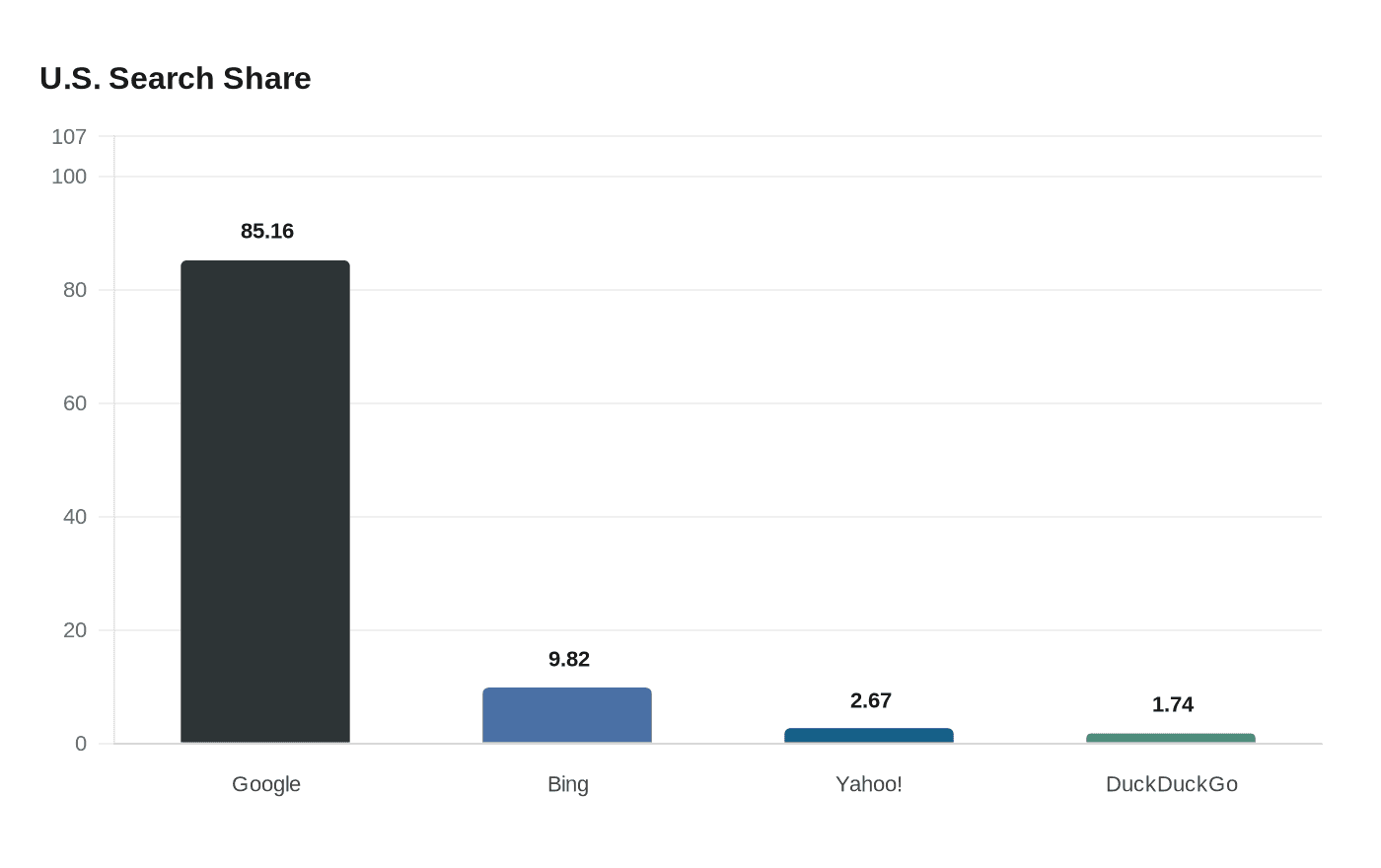
Google’s U.S. search share sat at 85.16% in April 2026, with Bing at 9.82%, Yahoo! at 2.67%, and DuckDuckGo at 1.74% on a chart built from more than 3 billion monthly page views. That kind of dominance matters, but it no longer tells the whole story of search performance. The useful question for agencies is not simply whether a brand ranks. It is whether the brand shows up in the places that now shape discovery, earns the click when users are offered one, and converts that attention into leads, pipeline, or sales.

The shift is visible in the way search itself is being packaged. Traditional blue links now compete with ads, AI modules, shopping features, local results, and answer surfaces that intercept attention before a user ever reaches a site. That is why the most useful SEO stats in 2026 are the ones that help justify spend, protect budgets, and explain why the work belongs in planning conversations instead of being treated as a maintenance line item.
AI visibility is becoming a KPI, not a curiosity
The cleanest way to think about modern SEO is that rankings are still necessary, but they are no longer sufficient. Thrive Agency’s roundup points to a new operating reality: mentions, citations, and inclusion inside AI answers are now part of visibility. In practical terms, that means your reporting needs to show whether a brand is being selected by AI systems, not just whether it appears on page one.
The numbers back up the urgency. Semrush found that AI Overviews appeared for 6.49% of keywords in January 2025, climbed to nearly 25% in July, and settled at 15.69% in November. That is not a one-off experiment. It is a large-scale change in how search results are assembled, and it now reaches beyond informational queries. Semrush also reported that navigational searches triggering AI Overviews rose from 0.74% in January to 10.33% in October, which is a strong sign that AI search is now shaping brand-finding behavior, not just research behavior.
By November 2025, the industries seeing the most AI Overviews were Science, Computers & Electronics, and People & Society. That matters for pitch decks and quarterly reviews alike because it shows AI visibility is not confined to broad how-to questions. It is touching technical, commercial, and identity-driven searches where agencies have long relied on organic search to create demand capture.
Click efficiency now matters more than raw impression volume
The era of easy CTR assumptions is over. BrightEdge data reported in May 2025 showed Google search impressions up 49% year over year while CTRs fell 30%, which is exactly the kind of spread that turns a traffic report into a business problem. More searches are happening, but fewer of those impressions are turning into visits. For agencies, that means winning the argument is less about showing the graph that goes up and more about explaining where the clicks went.
Google’s own guidance reinforced that point in August 2025. The company said overall organic click volume from Google Search to websites was relatively stable year over year, even as behavior changed. It also said people are increasingly clicking sites with forums, videos, podcasts, and posts for authentic, first-hand perspectives. That is an important clue for content strategy: format and lived experience matter more now, especially in AI-shaped journeys where generic copy is easy to skip.
Pew Research Center’s March 2025 browsing-tracker study makes the click problem even starker. Only 1% of users clicked a link in an AI summary, and users who saw an AI summary were less likely to click through overall than users who saw only a standard search result. That does not mean AI answers are worthless. It means the click economy has become much tighter, so the value proposition for organic has to shift from traffic volume to high-intent, high-quality traffic.
Citation placement can be as important as rank position
One of the most useful strategic takeaways in the current search environment is that visibility inside AI Overviews is not binary. A page can be cited, omitted, or displaced by another source entirely, and those differences affect the click path. Search Engine Land reported in 2025 that pages cited in AI Overviews can receive more clicks than pages on the same results page that are not cited. That suggests citation placement is starting to function a little like a new kind of position zero.
BrightEdge’s report adds a more surprising layer: 89% of AI Overview citations came from beyond the top 100 organic listings. For agencies, that is a budget argument worth repeating. It says strong content, structured clarity, and topical authority can earn inclusion even without a classic top-ranked URL. It also means a site’s opportunity set may be broader than legacy rank tracking suggests.
The practical message for account teams is simple: stop reporting SEO only as rank movement. Track whether the brand is being cited, surfaced, and selected in AI-generated answers, then connect that visibility to downstream behavior such as branded search lift, assisted conversions, and sales-qualified traffic.
Technical SEO is getting tighter, not looser
When search results become more competitive, technical friction hurts more. Thrive Agency’s roundup flags crawling, rendering, and indexing constraints as quiet performance killers, and the broader web signal supports that caution. Search Engine Land reported in April 2026 that 2025 Web Almanac data showed HTTPS adoption above 91%, title-tag adoption near 99%, and canonical adoption above 67%. Those are healthy baseline numbers, but they also show how high the floor has become. The technical work that used to be optional is now table stakes.
That matters because content performance can stall even when the page itself is strong. If rendering blocks discovery, if canonicalization is sloppy, or if page architecture makes it harder for search systems to understand the primary version of a page, AI and organic visibility can both suffer. Agencies that want to protect retainers should be able to explain how technical fixes improve crawl efficiency, index consistency, and the likelihood of being selected across search surfaces.
Brand strength is becoming a search asset
A second strategic shift is the growing gap between branded and non-branded behavior. AI-driven search environments reward names people already know, trust, and repeat. That is why the most resilient SEO programs are increasingly tied to brand demand, not just keyword capture.
Google’s August 2025 comments about first-hand content are part of this story too. Forums, videos, podcasts, and posts are attractive because they feel real, not templated. That favors brands with recognizable voices, creators with recognizable expertise, and companies that can show lived experience instead of only polished copy. In an AI-heavy results page, the brand that sounds like an authority is easier to cite, easier to click, and easier to remember.
Measurement now has to span search engines and AI assistants
The old reporting stack is not enough anymore. Teams now need to measure performance across search engines and AI assistants that influence discovery and referral patterns. That means building dashboards that combine classic metrics with newer indicators such as AI citations, mention share, branded search growth, assisted conversions, and landing-page engagement.
- Google still controls the largest share of U.S. search, so organic strategy remains central.
- AI Overviews are materially reshaping what users see and what they click.
- CTR pressure is real, which makes landing-page efficiency more important.
- Technical SEO can suppress performance even when content quality is high.
- Brand and first-hand expertise are now competitive advantages in AI-shaped discovery.
For agencies, the strongest QBR talking points are the ones that connect these signals to business outcomes:
IBISWorld’s recent attention to digital advertising agencies and its separate SEO and internet marketing consultant coverage are another reminder that SEO is still a distinct service category inside a larger agency economy. That creates room for specialists who can translate these shifts into revenue logic, not just traffic charts.
The agencies that win in 2026 will not be the ones clinging to the old promise of more blue links. They will be the ones proving that visibility across search and AI surfaces, paired with cleaner clicks and stronger landing pages, is the fastest path from discovery to demand.
This article was produced by Prism’s automated news system from verified source data, official records, and press releases, then run through automated quality and moderation checks before publishing. The system is built and supervised by the people who set the standards it runs under. Read our full AI policy.
Did this article answer your question?