Agency leader outlines AI agent framework to scale teams safely
Shann Holmberg’s framework turns agency AI into an operating model: one central knowledge layer, specialist agents by function, and locked-down client pods to grow without adding headcount at the same pace.
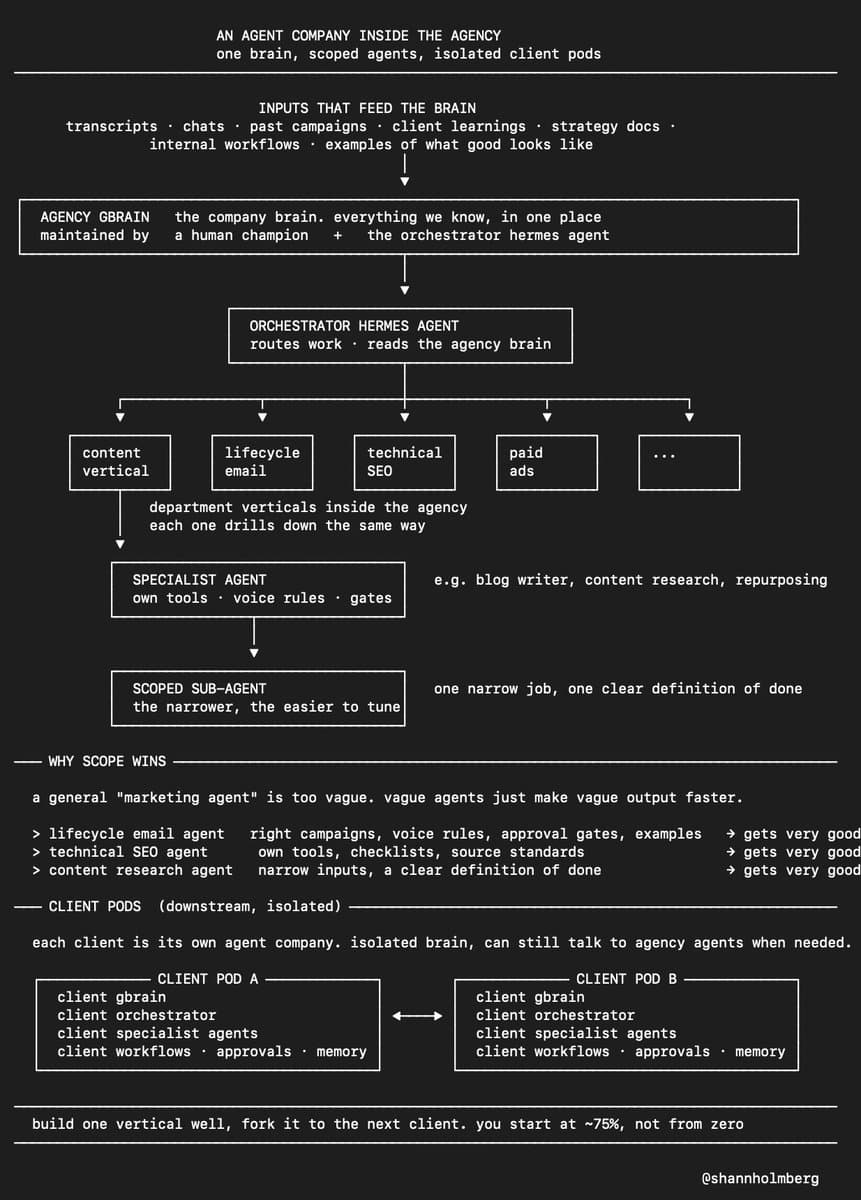
A growing number of agencies are learning that AI works best when it behaves less like a novelty and more like an operating system. Shann Holmberg’s framework takes that idea seriously, laying out a structure built around a central knowledge brain, department-specific specialist agents, and isolated client pods designed to keep data from leaking across accounts.
That matters because the real promise here is not flashy automation for its own sake. It is capacity: more output, tighter quality control, and a path to scale without expanding the team linearly. Holmberg’s model puts the question directly in front of agency founders, how do you increase throughput while keeping work safe, repeatable, and profitable?

The agency structure starts with a shared brain
At the center of Holmberg’s approach is a central knowledge system he describes as the gBrain. In practical terms, this is the institutional memory layer that holds the agency’s core standards, preferred workflows, brand rules, and reusable know-how so every agent does not have to relearn the same lessons from scratch.
That distinction matters for agencies because not every task should be solved locally inside a team pod. Strategy decks, operating playbooks, client onboarding rules, and internal best practices belong in the central layer, where they can be reused across accounts and departments. By contrast, the gBrain should not become a dumping ground for everything, since the value comes from keeping shared knowledge clean, searchable, and consistent.
Specialist agents handle the work closest to the function
Holmberg’s next layer is department-level specialization. Instead of asking one general-purpose agent to do everything, the model assigns specialist agents to specific functions, which mirrors the direction OpenAI has taken in its own guidance on agents, where systems plan work, call tools, collaborate across specialists, and keep enough state to finish multi-step tasks.
That design is especially useful for agencies because different departments need different checks, tools, and decision paths. A growth agent may be built to draft campaigns and analyze performance data, while an operations agent may focus on task routing, QA, and delivery pacing. The point is not just automation, it is orchestration, with guardrails, tracing, and handoffs so work moves through a governed system instead of a black box.
OpenAI’s recent AgentKit push reinforces that logic. Its toolset, which includes an Agent Builder, a Connector Registry, and ChatKit, is aimed at helping teams move from prototype to production more efficiently, which is exactly the kind of leap agencies need if they want these systems to become part of day-to-day delivery rather than isolated experiments.
Client pods are the safeguard that keeps the model client-safe
The most operationally important part of Holmberg’s framework is probably the one that sounds the least glamorous: isolated client pods. These pods create account-level separation so information from one client cannot bleed into another, a basic but essential safeguard if the agency wants to handle multiple brands without risking confidentiality or cross-contamination.
That separation is what turns the model from an efficiency idea into a client-safe operating system. Every pod can have its own scoped workflows, its own approved inputs, and its own human review points, while still drawing from the central gBrain and the broader specialist-agent architecture. For founders, that means the agency can standardize the backbone without flattening every client into the same process.
Why human oversight still sits in the middle
Holmberg’s framework is not a proposal to replace account teams with a swarm of unsupervised bots. The notes point to scoped workflows and human oversight as the mechanism that keeps quality high while team size needs fall. That is the right instinct for agency work, where small mistakes can become client-facing failures quickly.
A strong implementation would put humans at the decision points that matter most: approving strategy, checking outputs before delivery, reviewing exceptions, and handling anything that falls outside the expected workflow. The agents do the repeatable labor, but the team still owns judgment, client nuance, and final accountability.
The market is already testing this at scale
Holmberg’s framework lands in a market that is already moving fast. SOCi said in November 2025 that it had deployed 150,000 AI agents across more than 500 brands, claiming 750,000 hours of manual work saved and nearly $2 billion in annualized local marketing value recaptured. That is a significant signal for anyone watching how agent systems are being productized in real commercial environments.
Automation Anywhere has made a similar argument from the enterprise side, saying in June 2024 that its AI + Automation Enterprise System could drive up to 10x business impact across workflows. The exact number will vary by use case, but the broader message is consistent: when agents are applied to mission-critical processes, the upside can be measured in output, not just novelty.
OpenAI has also publicly pointed to customer examples such as Klarna and Clay as evidence that agents can reshape support and growth workflows. That is the same category of work Holmberg is targeting in an agency setting, where speed, repetition, and structured decision-making matter just as much as creative judgment.
Holmberg’s move from agency operator to builder explains the timing
Holmberg is publicly listed as a managing partner at Lunar Strategy, the Lisbon-based agency that says it has a 30-plus person team, has supported 250-plus crypto projects, and has been operating for more than seven years. That background matters because it places him inside a real services business, not just in a lab or a demo environment.
A profile in April 2026 said he joined Espressio AI to lead agent product development and had spent seven years at Lunar Strategy, where the systems he built became the basis for Espressio AI. His recent Substack posts in May 2026, including “build log #03 - from one agent to a whole company” and “build log #04 - two types of agents. one path between them.”, show that this is being developed in public as a working architecture, not a one-off concept.
What the model asks of founders
The practical lesson for agency leaders is clear: split the stack into three layers. Keep institutional knowledge centralized in the gBrain, assign work to specialist agents by department, and isolate each client into a protected pod with clear rules, tracing, and human review. That gives the business a way to scale delivery without scaling headcount at the same rate.
That same idea has also been echoed in Holmberg’s 2026 Lunar Strategy webinar, which framed AI agents as a way for growth teams to operate at “10x the speed” with the same headcount. The headline number is less important than the operating principle behind it: the agencies most likely to win are the ones that can turn agent systems into repeatable, governed workflows that stay profitable without becoming risky.
This article was produced by Prism’s automated news system from verified source data, official records, and press releases, then run through automated quality and moderation checks before publishing. The system is built and supervised by the people who set the standards it runs under. Read our full AI policy.
Know something we missed? Have a correction or additional information?
Submit a Tip