Ahrefs marketer builds AI traffic dashboard in 15 minutes with vibe coding
Louise Linehan turned Ahrefs data into a live AI traffic dashboard in 15 minutes, showing agencies how vibe coding can ship client value before a dev ticket is filed.

Ahrefs’ latest vibe coding showcase is less about a flashy prototype than a new operating model for marketers. Louise Linehan, who describes herself as a marketer with little to no coding experience, used Ahrefs’ own AI stack to build a dashboard that ties AI prompts to real traffic, and she did it fast enough to make the old backlog mindset look glacial.
The new shape of marketer-led building
The striking part of Linehan’s example is not that she made something useful, but that she made something useful from inside a serious production environment. Ahrefs says its marketing agent, Agent A, has direct access to the full Ahrefs dataset and runs on a stack built for real work: Postgres for state, Flask for interfaces, OpenRouter with 300-plus models, web fetch with full-page parsing, PDFs, OCR, scheduled jobs, and native connections to Slack, HubSpot, GitHub, Notion, Linear, Mailchimp, Resend, SendGrid, Stripe, Gong, WordPress, Airtable, Apify, and Semrush.
That matters for agencies because it changes the definition of “possible.” A strategist no longer has to wait for a developer to validate a reporting idea, a lead magnet, a calculator, or an internal workflow assistant. If the data access is there, the marketer can move from concept to working tool in the same afternoon, then refine the idea once real users start touching it.
What Linehan built in 15 minutes
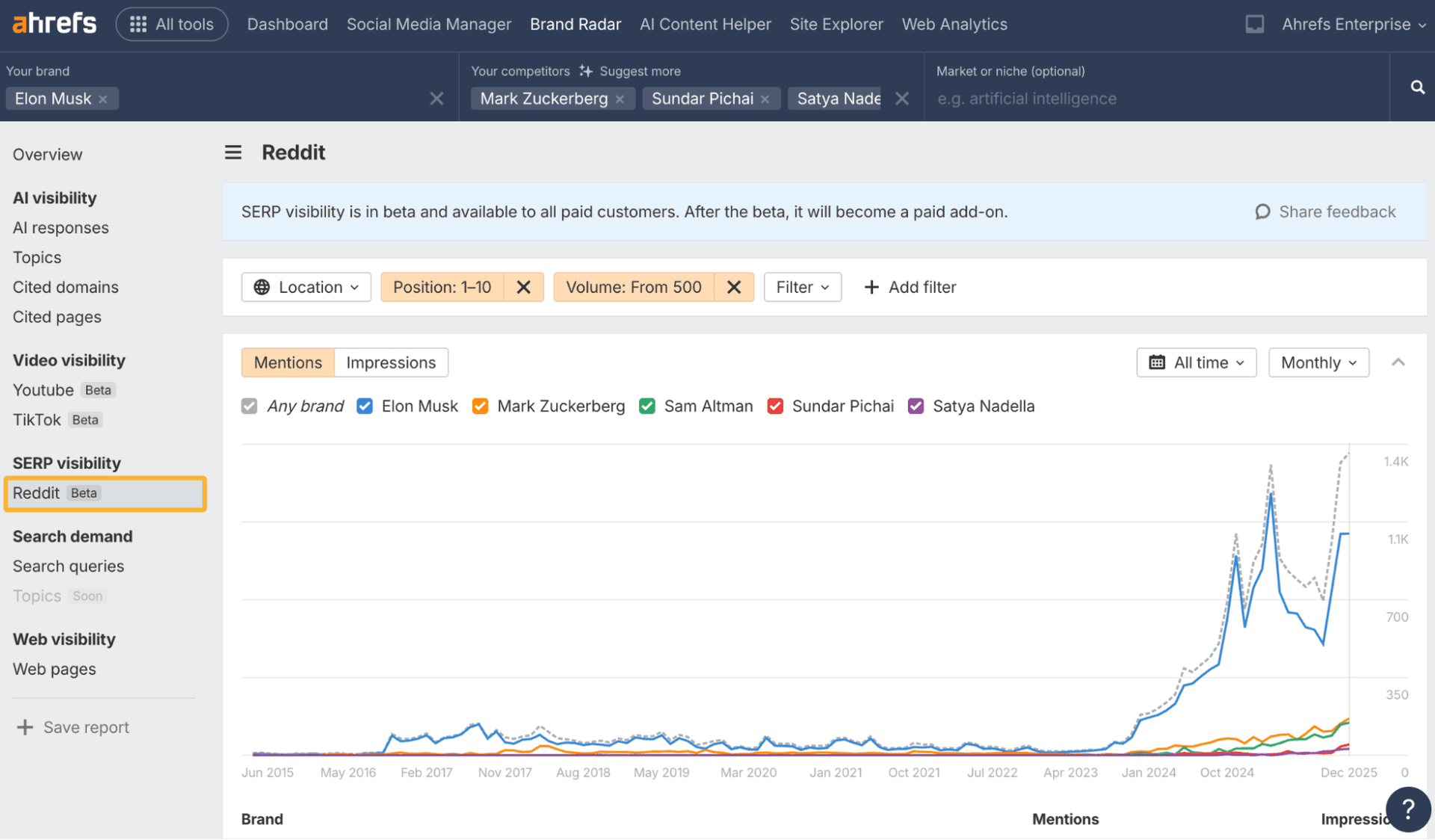
The centerpiece of the story is a dashboard that connects AI prompts to actual AI traffic inside Ahrefs’ Brand Radar and Web Analytics. Linehan says she was able to tie AI prompts to real AI traffic and compare AI traffic with citation trends, which turns AI visibility from a fuzzy talking point into something closer to a measurable acquisition channel.
Her prompt asked for one dashboard with the percentage of Ahrefs citations leading to actual traffic, historical data, a date picker, traffic-over-time charts, and separate views by each AI system tracked in Brand Radar. That is a classic agency-grade need: show the client not just that they are being mentioned, but whether those mentions are translating into visits and momentum.
The speed is the point. The core of the app was built in literally 15 minutes, which is fast enough to reframe how teams think about productization. Instead of pitching a bespoke dashboard as a future development project, a marketer can build a rough version immediately, show it to a client, and decide whether it deserves a place in the service stack.
Why this is more than an internal demo
Ahrefs says the nine examples in the article were built via Agent A by the team, with a couple vibe coded by Linehan herself. That mix is telling: the company is not presenting vibe coding as a toy for non-technical people, but as a practical layer between marketing ideas and working software.
For SEO agencies, the most commercially useful applications are the ones that create visible client value quickly. A vibe-coded tool can become a lead magnet if it answers a sharp question in a branded way. It can become an audit tool if it surfaces a niche insight faster than a spreadsheet template can. It can become a calculator if it helps a prospect estimate opportunity. It can become an internal automation if it removes repetitive handoffs from reporting, research, or content ops.
The business advantage is not just speed. It is differentiation. If every agency is buying the same off-the-shelf software, the deliverables start to look alike. If a strategist can spin up a small, proprietary tool around a client problem, the agency can offer something that feels tailored without rebuilding its entire tech stack.

Why Brand Radar is the right proving ground
The Ahrefs context also helps explain why this experiment lands so well. Brand Radar is positioned as a large-scale AI visibility product with a 387M-plus monthly prompt database, and Custom Prompts are available as an add-on for all free and paid Ahrefs users. Ahrefs’ pricing page lists Brand Radar starting from $199 per month.
That combination makes the dashboard example especially relevant for marketers trying to sell AI-era reporting. If the product can monitor brand visibility across AI answers, YouTube, and Reddit, then a dashboard that links citations to traffic gives the agency a way to talk about impact instead of exposure alone. In client terms, that is the difference between “we saw your brand mentioned” and “we can show you whether the mention produced demand.”
It also lowers the barrier for experimentation. Agencies do not need to build a full platform before they can start packaging value. They need enough infrastructure to test a useful hypothesis, prove that the hypothesis matters, and then turn that proof into a repeatable deliverable.
The larger vibe coding shift behind the story
The timing explains why this story resonates. The term “vibe coding” is commonly traced to Andrej Karpathy, and TechCrunch reported in March 2025 that one-quarter of startups in Y Combinator’s latest batch relied on AI to generate 95% of their codebases. By June 4, 2025, Mistral had already launched Mistral Code, a vibe-coding client.
That arc shows how quickly the idea moved from slang to workflow. What started as a loose description of hands-off coding with LLMs is now showing up as a practical business capability: a marketer can ask for a dashboard, a workflow assistant, or a niche reporting layer and get something functional fast enough to influence the offer itself.
For growth teams, that creates a new competitive edge. Faster experiments mean faster learning. Faster learning means more credible client reporting. And once a team can reliably turn a pain point into a small internal tool or a client-facing utility, vibe coding stops looking like a novelty and starts looking like an engine for pipeline, retention, and differentiated service design.
What agencies can take from the example
The deepest lesson in Linehan’s dashboard is not technical at all. It is about who gets to prototype. When marketers can build directly on top of rich data, they can test ideas before they become briefs, and they can shape the product conversation instead of waiting for it.
That is especially powerful in SEO, where the best opportunities often come from narrow, specific problems: a messy reporting gap, a localization workflow that drags, a competitor-monitoring pain point, or a client who needs a custom metric they can actually understand. Vibe coding makes those ideas cheaper to explore, and that changes the economics of agency creativity.
This article was produced by Prism’s automated news system from verified source data, official records, and press releases, then run through automated quality and moderation checks before publishing. The system is built and supervised by the people who set the standards it runs under. Read our full AI policy.
Did this article answer your question?