AI content wins unlabeled tests, but disclosure erodes trust
AI copy can beat human writing when it’s unlabeled, but disclosure flips the reaction fast. Agencies need edit gates, voice rules, and trust guardrails.
The volume trap
AI content is not failing because it cannot write. It fails when the audience learns how it was made and starts to question the hand behind it. That is the pressure point agencies have to solve if they want the efficiency gains without sanding down brand trust.
The numbers make the temptation obvious. Validity’s data says 74% of marketers are already deploying or testing AI-generated content, and 43% plan to increase investment this year. That is not a fringe experiment anymore. It is a production strategy, and the real question is no longer whether AI can help, but what happens to credibility when it becomes visible.
Disclosure changes the result
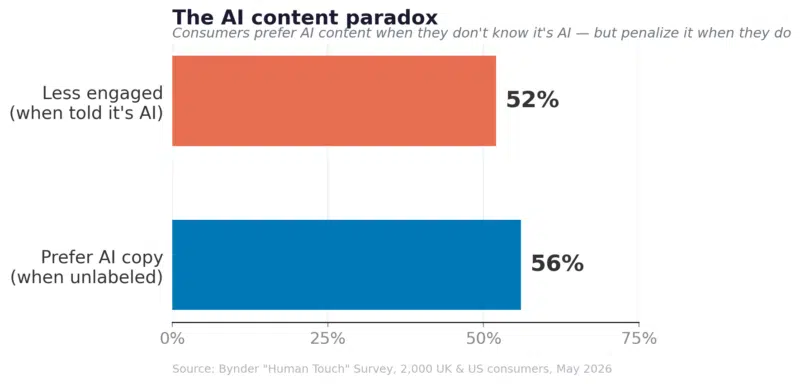
The sharpest evidence comes from a Bynder test with 2,000 U.K. and U.S. consumers. When the article was unlabeled, 56% of respondents who had a preference chose the AI-generated version as more engaging. Once the same piece was identified as AI-made, 52% said they felt less engaged. Same copy, same basic reading experience, different reaction the second the source was named.
That pattern shows up elsewhere too. A 2025 arXiv field experiment found participants generally preferred AI-generated responses, but that preference dropped significantly when the AI origin was disclosed. The lesson for agencies is blunt: disclosure is not cosmetic. It changes how people judge the work, and that means the publishing decision is part of the creative decision.

Yahoo and Publicis Media saw a similar split in a survey of more than 1,200 U.S. consumers and more than 350 U.S. advertisers. Fully 77% of advertisers viewed AI positively, while only 38% of consumers did. The same research found that when AI-generated ads carried noticed disclosures, ad appeal rose 47%, trustworthiness rose 73%, and overall trust in the company rose 96%. In other words, the hidden version is not always the safer version. Sometimes the honest version performs better because it feels less sneaky.
Email is where trust gets expensive
Email is the channel where the trust problem gets painfully practical. Validity’s survey of 500 U.S. marketers and 1,000 U.S. consumers found that 40% of consumers would trust a retailer’s marketing emails less if they knew those emails were written by AI. Only 25% said knowing an email was AI-authored would increase their trust. That is a huge warning for teams using AI to crank out subject lines, previews, and lifecycle campaigns at scale.
The same research adds another wrinkle: 55% of consumers now make inbox decisions based on AI-generated email summaries without reading the full message, and 14% have made a purchase based solely on an AI email summary. So AI is already shaping behavior in the inbox, but not always in a way that invites scrutiny. That makes subject lines, preview text, and summary snippets especially sensitive, because they can accelerate action while also heightening suspicion if they feel too generic or too machine-polished.
The agency playbook is not more AI, it is better control
This is where agencies need to stop selling AI as a simple volume multiplier. If the output is faster but the audience distrusts it once the origin is known, then the agency still has to supply judgment, editing, and brand control. The winning pitch is not “we can make more stuff.” It is “we can make more stuff without making your brand sound fake.”

A workable system needs a few hard rules:
- Put a human editor between the model and the client.
- Create a disclosure policy before anyone starts publishing. Decide when AI use is visible, when it is summarized, and when it stays behind the scenes as a drafting tool.
- Draw a bright line around high-risk copy. AI can help with ideation, outlines, and first drafts, but it should be tightly controlled in customer-facing email, branded thought leadership, product claims, crisis messaging, and any copy that depends on authority or lived experience.
- Build voice rules that are more specific than “sound human.” Give the model the brand’s preferred phrases, banned clichés, proof points, and tone limits.
- Review performance with trust metrics, not just clicks. Complaints, unsubscribes, reply quality, time on page, and repeat engagement tell you more than a short-term open-rate bump.
That is the real production advantage. Not raw output, but output that survives contact with the audience.
Consumers will use AI, but they still want proof of humanity
There is no clean anti-AI story here. A March 2026 MarTech summary of Klaviyo research found that 60% of nearly 8,000 consumers use AI tools at least weekly, but only 13% completely trust AI. A February 2026 MarTech summary of Optimove’s 2025 AI Marketing Trust and Engagement Report found that 57% of consumers trust brands more when AI is part of the experience. Those two findings can live together just fine. People will accept AI when it adds utility, relevance, and speed, but they still want a clear sense that a real brand is in charge.
That is why the best agencies will use AI as a backstage engine, not a substitute for editorial standards. The more AI scales production, the more valuable the human layer becomes. The agencies that win this phase will be the ones that move faster, edit harder, and protect the feeling that a client’s voice still belongs to a person who knows what that brand is promising.
This article was produced by Prism’s automated news system from verified source data, official records, and press releases, then run through automated quality and moderation checks before publishing. The system is built and supervised by the people who set the standards it runs under. Read our full AI policy.
Know something we missed? Have a correction or additional information?
Submit a Tip