AI search trust falls, agencies must build multi-platform authority
AI search is losing trust fast, and agencies now need proof across reviews, media, schema, and owned content, not just keyword wins.
AI search stopped being a simple visibility game the moment trust started sliding. The newest Fractl data says the old playbook, chase keywords, win a citation, move on, is no longer enough because consumers are checking more places before they believe a brand or buy the product. If you are selling SEO today, the real product is credibility across surfaces.
Trust is now the bottleneck
The headline number is hard to ignore: in 2025, 82% of consumers said AI-powered search was more helpful than traditional search. By 2026, that figure had dropped to 54%, a 28-point fall in a single year. At the same time, the skeptic camp jumped from 3% to 17%, which is the kind of move that tells you sentiment has turned from curiosity into scrutiny.
That is the part agencies need to take personally. AI search is still being used, and in fact 70% of consumers said they are using AI tools for search more than last year, while just 3% said their usage decreased. But usage and trust are not the same thing anymore. People are leaning on AI more often while becoming more selective about when they believe it.
The study also shows how fractured the decision path has become. Consumers now check an average of 2.4 platforms before validating a purchase, which means the answer has to survive more than one environment. A brand can no longer count on a single AI mention, a single ranking, or a single piece of content to carry the sale.
What the survey says people trust
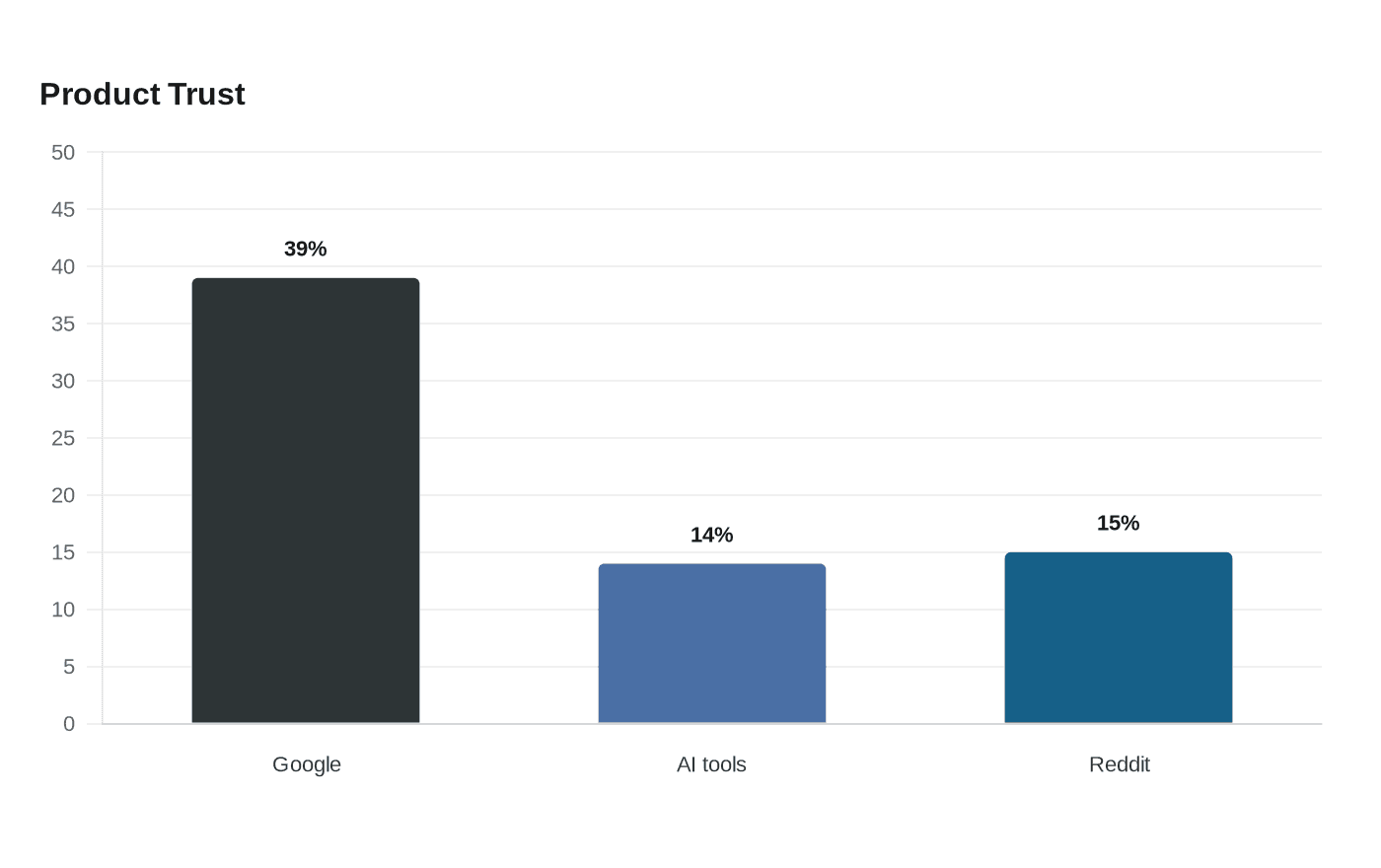
The trust hierarchy is still brutally familiar. Google leads AI tools three to one for trusted product recommendations, with 39% consumer trust versus 14% for AI tools and 15% for Reddit. That gap matters because it shows consumers are not handing over judgment to chatbots. They are using AI as part of the research stack, then checking the result against places they already know.
There is also a generational wrinkle that agencies should not flatten into one neat “young users love AI” story. In this study, baby boomers said they find AI more helpful than Gen Z, 63% to 47%. That does not mean boomers are more gullible. It suggests different cohorts are using the same tools with different expectations, and it is another reminder that trust is now layered, not linear.
Then there is brand risk. Fully 39% of consumers said heavy AI use would reduce their trust in a brand, up from 20% in 2025. That is not a niche concern. If your content pipeline is pumping out generic AI copy with weak sourcing, the audience may not call it out publicly, but they are registering the drift in confidence.
Why authority beats tactics
Kelsey Libert’s warning cuts through the noise: declining trust is being driven by hallucinations, and publishing without disclosure or scaling without clear quality signals is now a reputational variable. That is exactly where a lot of agency work gets sloppy. Teams optimize for output volume, then wonder why the client’s brand looks thin in AI results and fragile in human review.
The June 2025 Fractl study already pointed to the answer: GEO depends on the same authority signals Google has rewarded for years, including trusted media mentions, schema markup, first-party research, and expert quotes. That matters because it reframes AI visibility as an entity problem, not just an on-page problem. You are not just trying to get crawled. You are trying to make the brand legible, corroborated, and worth repeating.
That logic also fits the broader direction of search itself. Search is not disappearing; it is fracturing across AI, social, and the SERP. The agency mistake is treating that fragmentation like a channel mix issue when it is really a trust architecture issue. If the same claim does not show up consistently across earned media, your site, review platforms, and community surfaces, AI systems have less to work with and users have less reason to believe the result.
What agencies should change now
The practical shift is straightforward: stop selling AI visibility as a one-off optimization and start packaging it as multi-surface credibility. The new deliverable set should include reputation, source quality, and message consistency, not just titles, headings, and metadata. If the brand cannot stand up across platforms, the AI answer will wobble too.
In content strategy, that means building assets that look and feel like proof, not filler. First-party research, expert commentary, explainers with named specialists, and schema-enriched pages all give models and people more to trust. If your content calendar is still mostly blog posts with no original data and no subject-matter voice, you are feeding the machine something easy to ignore.
In digital PR, agencies need to think less like link chasers and more like corroboration builders. Mentions in trusted publications matter because they create external validation, and the June 2025 framework makes that explicit. One clean placement is useful; repeated presence across credible outlets, with consistent brand language and clear expertise, is much better.
Entity building also needs a lot more discipline. That means tightening how the brand appears across the web, making sure core facts are consistent, and reducing confusion around names, services, and proof points. When AI systems see fragmented identity signals, they have less confidence in the answer. When users see the same brand echoed in reliable places, the brand starts to feel established instead of assembled.
A simple agency roadmap looks like this:
- Audit where the brand is mentioned, and whether those mentions come from trusted sources or thin directories.
- Strengthen pages that can carry authority, especially those with original research, expert input, and schema markup.
- Build earned-media coverage that adds independent confirmation, not just backlinks.
- Clean up message consistency across the site, review platforms, and community mentions.
- Add disclosure and quality controls to any AI-assisted publishing workflow.
Why this matters for the next year of search
The timing of all this is not theoretical. SMX Advanced 2026 ran June 3-5 in Boston, and the research landed in the middle of an industry already obsessed with GEO metrics and AI-crawler optimization. Then Anthropic warned on June 5 that AI may soon be able to improve itself without human intervention, which only sharpened the larger concern around reliability. If the systems are getting more capable while trust is getting shakier, then credibility becomes the moat.
The strongest signal in the whole study is not that AI search is growing. It is that people are getting more demanding about where the answer comes from. That pushes agencies toward a harder, more useful kind of SEO, one that earns visibility by building authority everywhere the brand can be checked, compared, and believed.
This article was produced by Prism’s automated news system from verified source data, official records, and press releases, then run through automated quality and moderation checks before publishing. The system is built and supervised by the people who set the standards it runs under. Read our full AI policy.
Know something we missed? Have a correction or additional information?
Submit a Tip