Claude Code helps agencies turn scattered notes into action
Claude Code is being used as a second brain for agencies, turning scattered notes into drafts, handoffs, and action while preserving client memory as teams grow.

Agencies lose time in the cracks between Slack, Gmail, Fireflies, CRMs, and open docs. Claude Code is being framed as a second brain that does more than store those scraps, it turns them into a draft, a summary, or the next action a team can actually use.
Why the second brain idea matters for agencies
The core problem is not a lack of information. It is that agency knowledge lives in too many places, and mornings disappear while people rebuild yesterday from fragments. That is the context-switching tax: the quiet cost of jumping from inbox to meeting notes to client systems just to remember what happened and what needs to happen next.
The article’s warning is useful because it names three ways these setups fail. Some systems become passive storage, holding notes without changing the work. Others reduce retrieval but still force people to manually stitch everything together. The biggest miss is the absence of an action layer, which means the team can find information but still cannot move faster with it.
For agencies, that gap hits revenue and margin at the same time. SEO, content, and account management are rarely owned by one person, so weak handoffs weaken the work. A second brain that keeps institutional memory portable across the team is not a novelty, it is infrastructure.
What Claude Code changes in the workflow
Claude Code matters because it is not positioned as a simple chat window. Anthropic describes it as an agentic assistant that runs in the terminal and works through a gather-context, take-action, verify-results loop. It can search files, edit across a codebase, run tests, and handle command-line workflows beyond coding, which makes it more like a workflow engine than a note-taking tool.
That distinction is what makes the agency use case compelling. If the system can pull context from multiple places, synthesize the important signals, and return a useful starting point, the team spends less time reconstructing account history and more time on strategy. Anthropic also says that at its own company, the majority of code is now written by Claude Code, a signal that the tool is already being used as execution infrastructure, not just as a helper.
Anthropic’s product framing goes one step further. It says engineers can focus on architecture and orchestration while Claude Code handles routine execution. That is exactly the split agencies should care about: humans own the judgment calls, while the system handles the repetitive work that clogs the day.
The stack that makes the second brain work
A real second brain is not one feature, it is a stack. The proposed setup combines memory, search, MCP integrations, and custom AI skills so the system can do more than retrieve notes. Memory gives continuity. Search gives access. MCP and skills turn that access into action.
MCP, or the Model Context Protocol, is Anthropic’s open standard for connecting AI agents to external systems. It launched in November 2024, and by November 2025 Anthropic said the community had built thousands of MCP servers. That matters because agencies live inside tool sprawl, and every extra system usually adds friction. Anthropic argues that code execution with MCP can reduce token and context overhead when agents have to work across many tools.
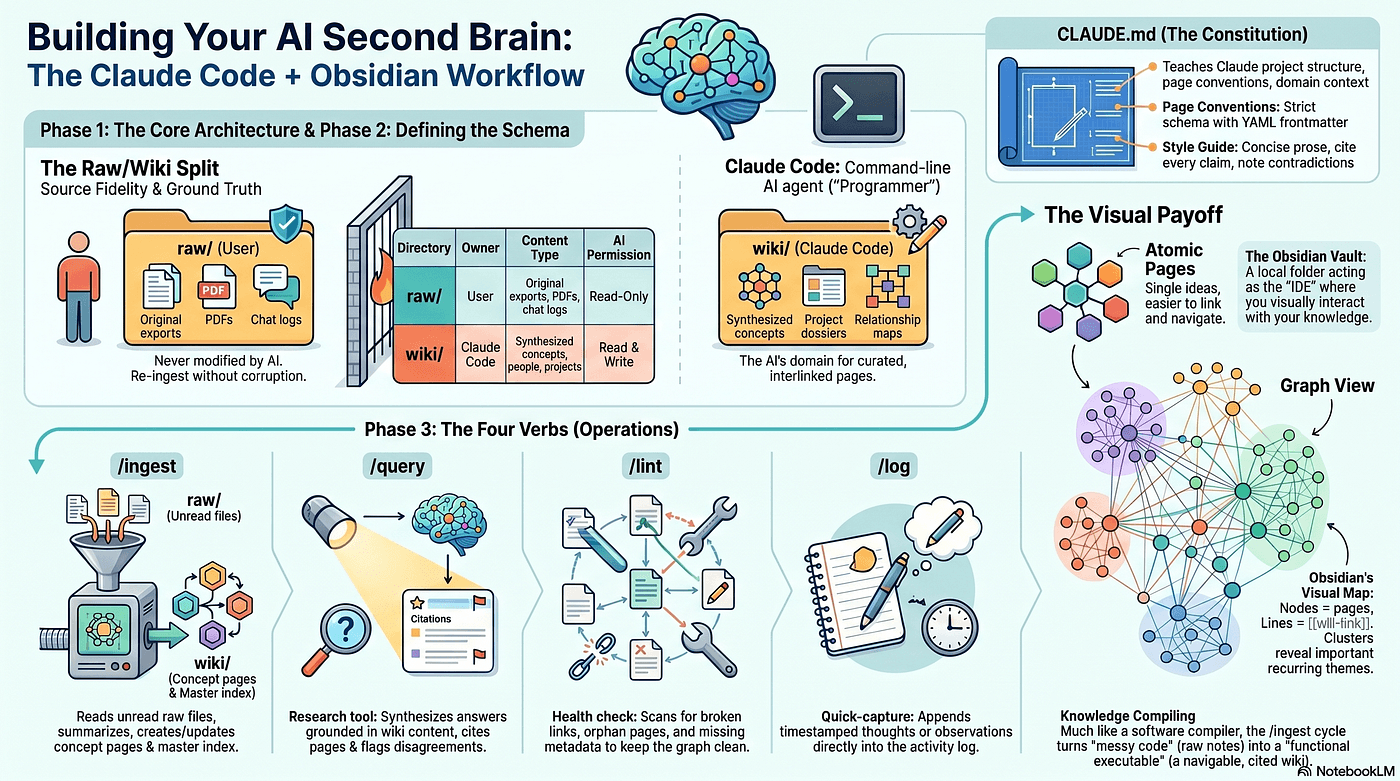
Skills add another layer of practicality. Anthropic’s skills repository describes them as self-contained instructions used for workflows that include enterprise communications and branding. For agencies, that is the difference between a system that merely remembers what happened and one that can help produce the next client update, brand review, or internal summary in the right format.
Where the time savings are real
The best way to pressure-test this workflow is to ask what it actually saves time on. The strongest candidates are the tasks that repeat across accounts and roles: summarizing meeting notes, reconstructing client history, pulling together open issues, drafting status updates, and onboarding new teammates into an account’s backstory. Those are the places where context switching silently drains hours.
It also helps when handoffs are messy. A second brain can preserve what the last account manager knew, what the SEO lead flagged, and what the strategist meant to revisit after the call. That kind of memory reduces the chance that teams repeat old mistakes simply because the right context was buried in a thread or a forgotten doc.
Still, human review has to stay in the loop. Strategy, tone, client politics, and final approval are not mechanical tasks. The point is not to let the system speak for the agency, but to make sure the agency arrives at the decision faster and with better context.
The questions that separate moat from tool clutter
This is where agencies need to be ruthless. Does the workflow remove a genuine bottleneck, or does it just add another layer to maintain? If Claude Code is becoming the second brain, it should reduce the time spent piecing together context across accounts, not create a new dependency that only one person knows how to manage.
- Which repeatable tasks lose the most time today?
- How often does the system produce a usable starting draft without heavy cleanup?
- Where does human judgment still dominate the workflow?
- Does the setup make onboarding faster by preserving institutional knowledge?
- Does it create a defensible operating advantage, or just another shiny interface?
The right pressure test is simple:
That last question matters because the market is already full of AI enthusiasm. In a January 2025 survey of 547 U.S.-based marketing agency decision-makers, NinjaCat found that 91% were already using AI in some form, 92% said it boosts day-to-day productivity, and 96% said it is key to scaling their business. AgencyAnalytics’ 2025 benchmark report, based on 220-plus agency leaders, found that 73% said generative AI has changed SEO and 57% were worried about AI-driven content saturation.
McKinsey’s 2025 survey tells a similar story at the enterprise level. It found that 88% of respondents said their organizations use AI in at least one business function, but nearly two-thirds had not yet begun scaling AI across the enterprise. That is the real opening for agencies: not just using AI, but wiring memory, search, and execution into a system that actually changes how work moves.
The opportunity is bigger than productivity theater. Anthropic cites Stripe deploying Claude Code across 1,370 engineers and Ramp cutting incident investigation time by 80% after integrating it, proof that the value shows up when execution gets faster and context gets cleaner. For agencies, the same logic points to a sturdier business: less lost time, fewer handoff errors, faster onboarding, and a knowledge base that stays useful even as the team grows.
This article was produced by Prism’s automated news system from verified source data, official records, and press releases, then run through automated quality and moderation checks before publishing. The system is built and supervised by the people who set the standards it runs under. Read our full AI policy.
Did this article answer your question?