Claude tutorial shows agencies how to scale content audits
Claude turns content audits from ad hoc cleanup into a repeatable service line. Agencies can start with one article, then productize the workflow into a scalable SOP.

Audit one article first. Claude makes content audits easier to start, but the real agency opportunity is turning that first pass into a repeatable operating system. Instead of treating every review as a one-off prompt, teams can then reuse the same skill across clients, content types, and account teams.
Start with one article, not the whole library
The most practical way to begin is also the least intimidating: audit a single page. That first article gives you a controlled test case for voice, accuracy, topical coverage, and freshness, while also showing where your prompt needs more structure. Once the output is useful, the prompt stops being a draft and becomes a reusable skill that can be handed to another strategist or folded into a standard operating procedure.
Content libraries do not stay still. Brand voice evolves, staff changes, products shift, and editorial standards loosen over time, so even well-managed libraries drift away from the original brief. A Claude-based workflow gives you a faster way to catch that drift, but the larger benefit is consistency, because every audit starts from the same logic instead of a new analyst’s judgment.
Use the six workflow ideas as audit categories
The six workflow ideas organize common agency problems into practical workflows, which makes the work easier to delegate and easier to repeat. The recurring issues are familiar to any content team: brand voice consistency, topical gaps, outdated information, and broader content drift.

Each issue demands a different kind of review. Brand voice checks look for tone, terminology, and whether the article still sounds like the client. Topical gap analysis asks whether the page covers the questions searchers now expect, while freshness checks focus on facts, examples, and references that have gone stale. Content drift is the catch-all category, where a page may still be accurate on paper but no longer matches the site’s strategy, product scope, or editorial standard.
The same review can be done on 20 articles with similar rigor, instead of 20 slightly different interpretations of what “good” means.
Turn the audit into a product, not a task
For agencies, audit work is easy to oversell as strategic insight and hard to deliver efficiently at scale. Claude is most useful when it is treated as process infrastructure rather than a shortcut. A well-designed workflow lowers the friction of getting started, but the agency value appears when that workflow becomes a lasting service layer clients can buy again and again.
A one-off content review is labor, but a standardized audit program can become a margin-friendly service because the steps are known, the inputs are familiar, and the outputs are easier to compare across accounts. It also speeds onboarding, since new team members can follow the same SOP instead of learning each client’s content standards from scratch.
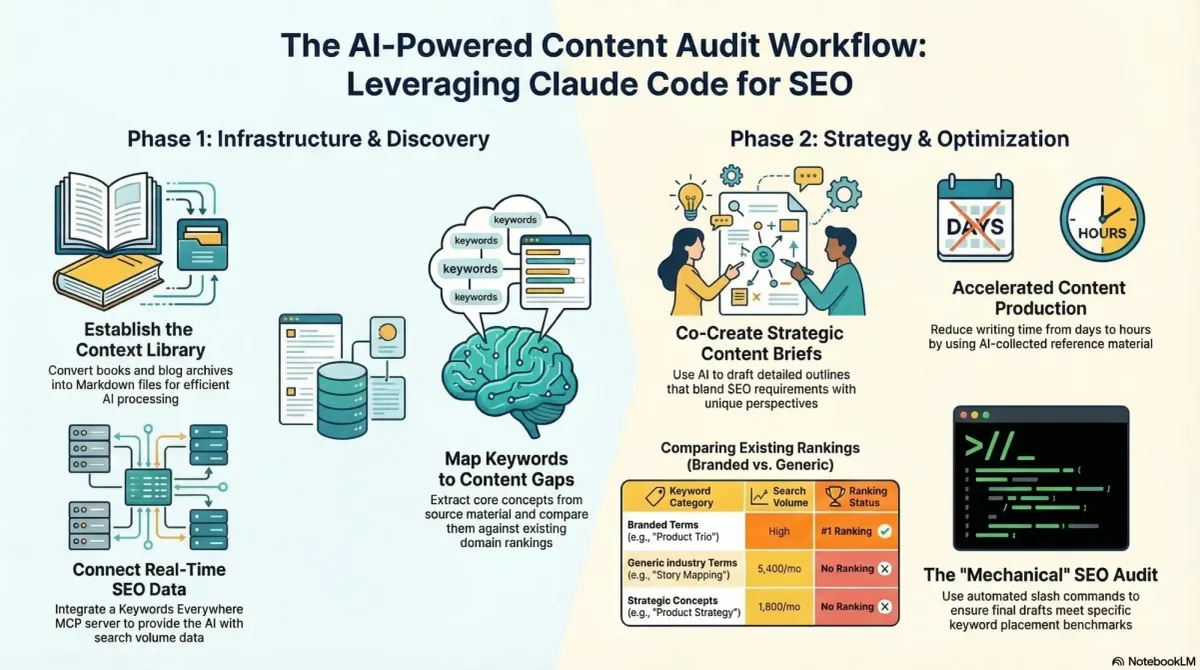
Client reporting also improves. When the audit framework stays consistent, monthly or quarterly reviews stop feeling like isolated snapshots and start reading like a living optimization program. Account teams can show how pages are moving through the same workflow, not just how many issues an analyst found in a given week.
Why repeatability matters more than speed alone
AI is already shrinking the time needed for basic content review, which means raw speed is no longer the differentiator. The agencies that benefit most will be the ones that turn that speed into a durable process instead of a one-time shortcut. If Claude helps a strategist finish an audit faster, that is helpful; if it helps the agency standardize how audits are scoped, executed, and handed off, that changes the service line.
Content audits should not sit in the “cleanup” bucket and appear only when something looks broken. When the workflow compounds over time, each audit improves the next one, because the team is refining the same prompts, checks, and decision rules instead of starting over from zero.
This article was produced by Prism’s automated news system from verified source data, official records, and press releases, then run through automated quality and moderation checks before publishing. The system is built and supervised by the people who set the standards it runs under. Read our full AI policy.
Did this article answer your question?