GEO and AEO Capabilities Now Essential for White-Label SEO Reseller Programs in 2026
White-label SEO reseller programs that skip GEO and AEO are already falling behind as AI search reshapes how clients' customers discover brands.
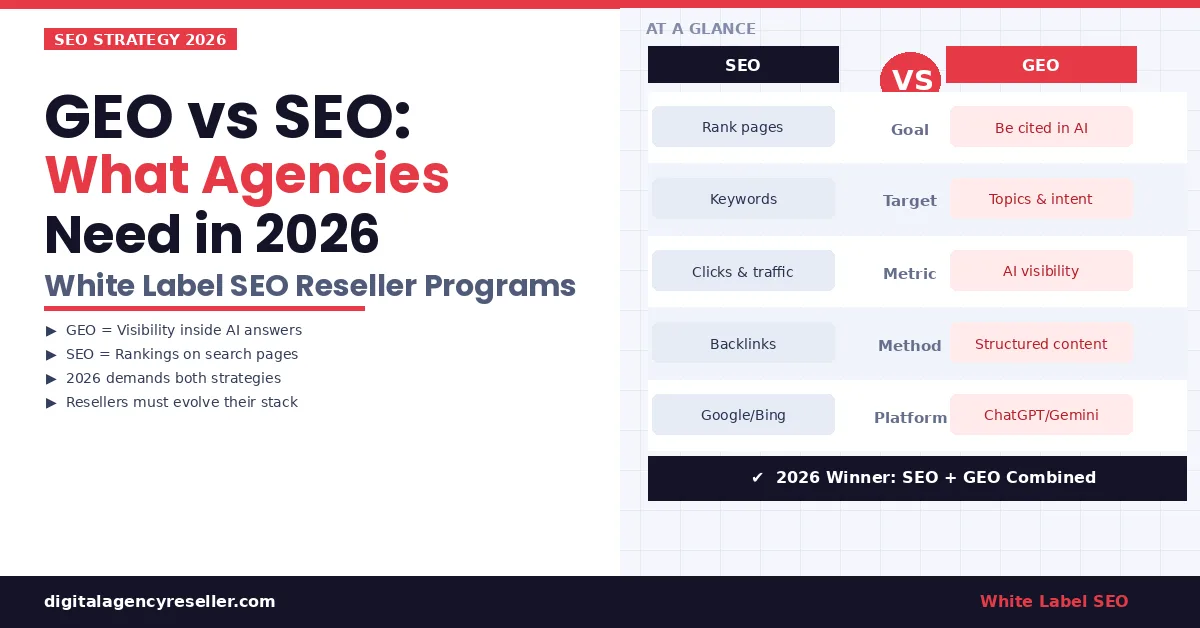
Classic SEO — the discipline of ranking blue links on Google — built the white-label reseller market into what it is today. But the model that powered a decade of agency growth is being stress-tested by a search landscape that no longer runs on a single track. The search landscape now operates on two parallel tracks: traditional SEO, optimizing for link-based rankings on Google and Bing, and AEO (Answer Engine Optimization), optimizing for citation in AI-generated answers from ChatGPT, Copilot, Gemini, and Perplexity. For white-label SEO reseller programs, the practical implication is blunt: a fulfillment offering that only covers the first track is already incomplete.
DigitalAgencyReseller's March 26, 2026 practitioner-focused analysis put the challenge directly to the reseller community, arguing that white-label SEO programs must now include capabilities beyond classic organic ranking tactics, specifically citing Generative Engine Optimization (GEO) and Answer Engine Optimization (AEO) as the disciplines that can no longer be treated as optional add-ons.
What GEO and AEO Actually Mean
The terminology in this space is still consolidating, but the underlying practices are not. Generative Engine Optimization (GEO) is the practice of optimizing content to appear as sources and citations in AI-generated responses, also known as AEO (Answer Engine Optimization), LLMO (Large Language Model Optimization), GSO (Generative Search Optimization), and AIO (AI Optimization). For practical purposes in reseller program design, if a distinction is made: AEO emphasizes being cited in answer-focused platforms like Perplexity and Google AI Overviews; GEO emphasizes being referenced in generative platforms like ChatGPT, Claude, and Gemini.
The most important thing to understand is how these disciplines differ from traditional SEO at the outcome level. The fundamental difference between SEO and GEO lies in the end goal: SEO optimizes for clicks from search engine results pages, while GEO optimizes for citations within AI-generated responses. A page can rank #1 in Google but never get cited by ChatGPT if it lacks the structural elements AI engines prioritize. This is not a marginal edge case. Research shows that 60% of sources cited by AI are not in Google's top 10 results. High rankings and AI visibility are overlapping sets, not the same set — and reseller programs that only measure one are leaving half the picture invisible to clients.
Why the Market Shifted So Fast
The urgency isn't theoretical. AI-referred sessions jumped 527% year-over-year in the first five months of 2025, according to Previsible's 2025 AI Traffic Report, signaling a seismic shift in how people find information. That kind of growth rewrites client expectations faster than most agency service menus can keep up with. As Gartner's VP Analyst Alan Antin notes, "Generative AI solutions are becoming substitute answer engines," forcing companies to rethink their entire marketing approach, with AI Overviews reaching nearly a billion searchers and tools like Google AI Mode, ChatGPT, Perplexity, and Claude reshaping how people find information.
The digital marketing landscape has undergone a seismic transformation in 2026: as artificial intelligence reshapes how people discover information, agencies face unprecedented challenges in delivering effective SEO services, with Google's AI Overviews now dominating search results and ChatGPT having become a primary research tool for millions. Reseller programs that haven't updated their fulfillment stack are now walking into client conversations without answers to the questions clients are actually asking.
How ALM Corp Is Packaging It
ALM Corp's January 5, 2026 white paper offers a clear view of how a vendor-side white-label provider is responding to this shift. The foundational model remains unchanged: ALM Corp's white label services span AI answer engine optimization including structured data implementation, content restructuring, and citation building, alongside traditional SEO, local SEO, and e-commerce optimization. The behind-the-scenes delivery structure that made white-label SEO work — "ALM Corp functions as that behind-the-scenes provider, handling audits, strategy, implementation, and reporting while you manage the client relationship" — now extends directly into GEO territory.
ALM Corp's white-label category list is instructive as a snapshot of where the industry is heading. Beyond traditional offerings, the catalogue now explicitly includes White Label Generative Engine Optimization (GEO) SEO, White Label LLM SEO, White Label Google AI Overviews, White Label Google AI Mode, and White Label Search Everywhere Optimization — a term that captures the broader imperative of earning visibility across every surface where a potential customer might look for an answer. ALM Corp represents the evolution of white label SEO partnerships, combining comprehensive traditional optimization expertise with cutting-edge AI-era capabilities, with a track record of generating over $7 billion in sales and more than 1 million leads for clients.
According to ALM Corp, the total cost for comprehensive technology access exceeds $50,000 annually, including page speed monitoring, Core Web Vitals systems, proprietary AI answer engine tracking, competitive intelligence, and automated reporting. That figure underscores why the white-label model makes sense for most agencies: building this stack in-house is cost-prohibitive, but reselling it under your own brand is not.
Who Needs This Most
White-label SEO reseller programs serve a well-defined set of agency types, and each has a distinct reason to prioritize GEO and AEO capabilities now. ALM Corp's guide identifies four core audiences:
- Web design and development agencies that want to add recurring revenue — for these agencies, GEO-enabled SEO becomes a high-value upsell to existing client relationships.
- PPC or paid-social agencies seeking to round out their channel mix — clients increasingly ask why their AI search visibility isn't keeping pace with their paid results.
- Branding and creative firms whose clients ask for SEO beyond their current capabilities — GEO's emphasis on brand authority and citation signals maps naturally onto the work these firms already do.
- Consultants and freelancers who prefer to stay lean and outsource technical work — the white-label model's core value proposition is unchanged; the service menu simply needs to be wider.
Digital agencies face growing client demand for AI search visibility without the internal expertise to deliver it. White label AEO services solve this gap, enabling agencies to offer answer engine optimization under their own brand while specialized providers handle execution, expanding service offerings, increasing revenue per client, and positioning agencies as complete solutions providers.
What a 2026-Ready Reseller Program Actually Delivers
In 2026, white label SEO has evolved far beyond basic keyword optimization and link building. Today's white label providers must excel across multiple optimization channels, from traditional Google search to AI-powered discovery platforms, including mastering GEO for platforms like ChatGPT and Perplexity, optimizing content for Google's AI Overviews, and ensuring visibility across the growing ecosystem of AI-driven search tools.
At the fulfillment level, a modern reseller program should cover:
- Technical SEO + AI readability: Technical SEO now includes AI readability optimization, structured data implementation for AI parsing, and schema markup designed to enhance machine understanding.
- AEO content work: AEO is the on-site and content work that helps a business become the best answer, not just another result.
- GEO citation and authority building: GEO is about improving how often a brand is cited, mentioned, or recommended inside AI answer engines.
- AI visibility tracking: Organizations must measure AI visibility as rigorously as SEO visibility, tracking citations and mentions as core KPIs while aligning AEO/GEO and SEO strategies to ensure content earns presence across both traditional and generative results.
- Branded reporting that covers both surfaces: A complete reseller program delivers rankings and AI Overviews visibility alongside AI referral attribution in analytics, LLM brand visibility and citations across major AI platforms, and automated weekly and monthly reporting — all fully under your brand.
In 2026, succeeding in search isn't about SEO vs AEO vs GEO — it's about integrating all three into one cohesive strategy. A multi-faceted search program will capture organic traffic through SEO, zero-click and voice searches through AEO, and visibility in AI-generative responses through GEO.
The Reseller Opportunity
Agencies using white-label AI visibility platforms are adding $500 to $2,000 per month per client for AEO services, often as a premium add-on to existing SEO retainers. That is not a niche product category for early adopters; it is the next recurring-revenue line for every reseller program with existing SEO clients. If you're already selling SEO services, adding AEO as a white-label offering is a seamless way to provide more value, future-proof client visibility, and increase agency revenue, without building an AEO service from scratch.
The window for being early in this conversation is closing. Gartner predicts a 50% decline in conventional search traffic by 2028, with that volume migrating to generative engines. Companies investing in GEO strategies capture disproportionate visibility during the critical 2026-2028 transition period. For white-label reseller programs, the question is no longer whether to add GEO and AEO to the fulfillment stack. It is how quickly the transition can be completed before clients start asking why their current program isn't covering it.
This article was produced by Prism’s automated news system from verified source data, official records, and press releases, then run through automated quality and moderation checks before publishing. The system is built and supervised by the people who set the standards it runs under. Read our full AI policy.
Did this article answer your question?