Google Expands Merchant Center for Agencies Worldwide, Centralizing Client Product Data
Google widened Merchant Center for Agencies worldwide, giving agencies one dashboard for client feeds, alerts and product opportunities across Google surfaces.
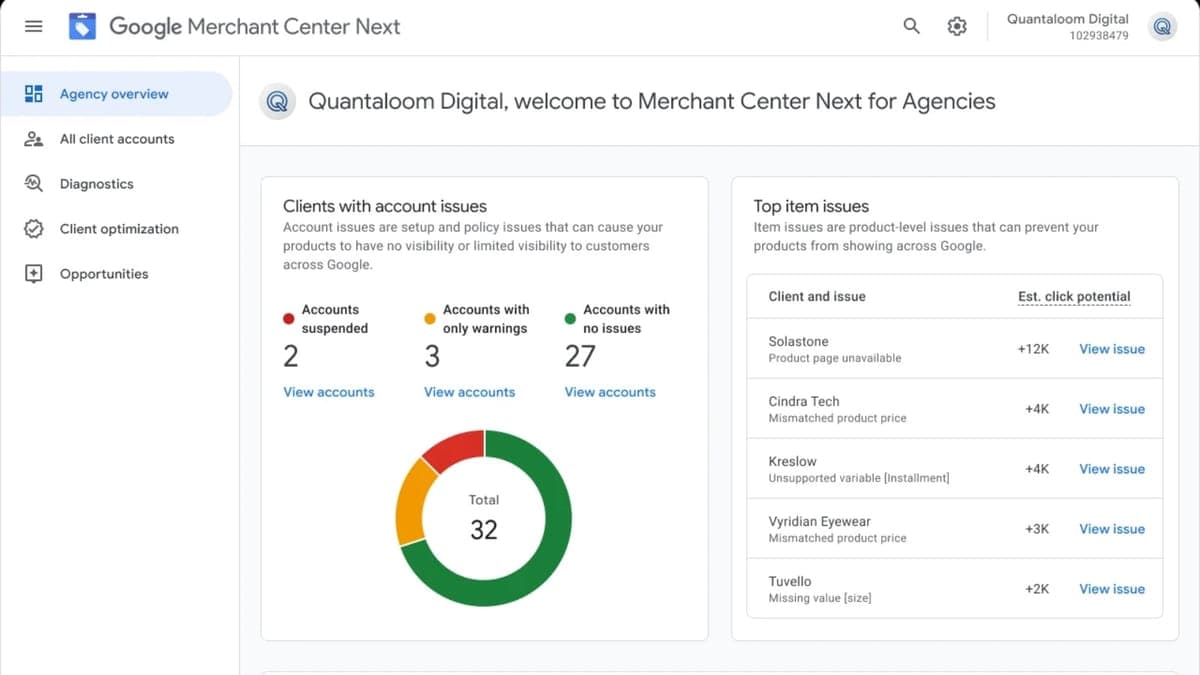
Google’s expansion of Merchant Center for Agencies worldwide turns product data from a scattered housekeeping job into a centralized agency workflow. The tool gives teams a dedicated command center for an entire client portfolio in one place, with a single-view interface, central dashboard oversight and the ability to monitor onboarding status, critical alerts and product opportunities across multiple merchant accounts.
The rollout follows the earlier general availability launch in the United States and Canada in March 2026. For agencies managing retail and ecommerce portfolios, that matters because Merchant Center products can show across Google Search, Maps, YouTube and other surfaces, so one feed problem can ripple far beyond a single account. Google has been pushing Merchant Center toward a more visible, more actionable operating model, with a central overview of product data health and steps for improvement.

The first three processes agencies should consolidate now are feed management, approvals and performance reporting. Feed management becomes easier when one team can see how products are being reviewed for issues after upload, then control whether those items appear across Google once approved. Approvals also become a workflow problem instead of an account-by-account scramble, especially when onboarding new clients and cleaning up merchant setup across a portfolio. Performance reporting is the third pressure point, since the new dashboard is designed to surface business insights, product visibility and high-potential items that are still underexposed.
Google’s alerting system adds another layer of operational control. By default, it triggers notifications when there is a significant drop in active products for a target country and Google surface. That gives agencies an early warning before a client notices missing inventory in Shopping-related experiences, and it creates a cleaner handoff between account managers, feed specialists and paid media teams.
Human QA still matters, though. The system can flag a drop in active products, but it cannot decide whether the cause is a feed error, a stock issue or a merchandising change. It can surface products with strong potential but low visibility, yet teams still have to judge whether the fix belongs in the feed, in the campaign or in the catalog itself. That is where agency margin starts to improve: less time spent chasing fragments, more time spent making product data work like a growth channel.
This article was produced by Prism’s automated news system from verified source data, official records, and press releases, then run through automated quality and moderation checks before publishing. The system is built and supervised by the people who set the standards it runs under. Read our full AI policy.
Did this article answer your question?