Local SEO in 2026 Spans Google Maps, AI Search, and Chatbot Channels
The local search stack just tripled in complexity: Google Maps, Gemini-powered Ask Maps, AI Overviews, and chatbot channels now all require synchronized inputs to win local visibility.
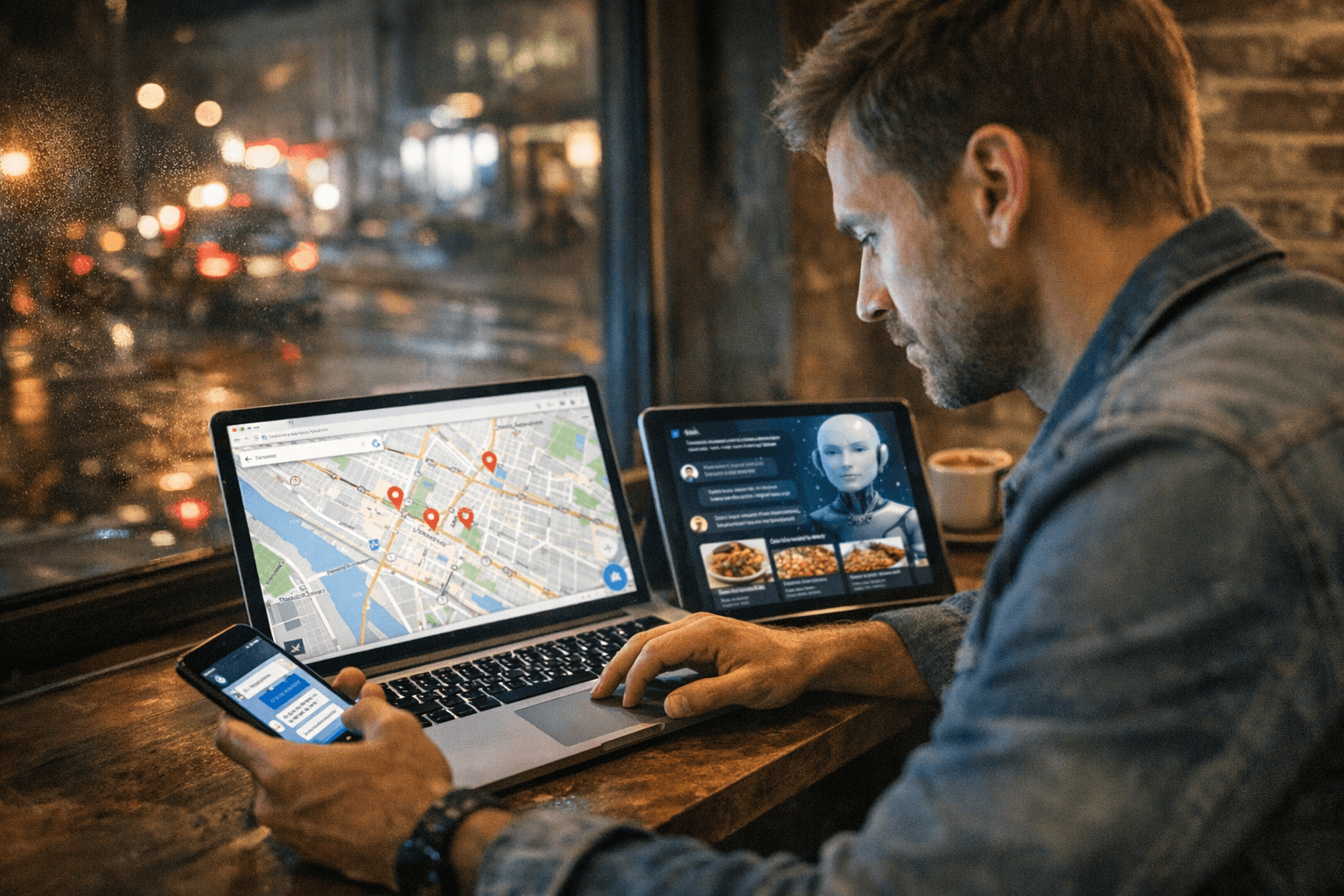
The agency that sold local SEO in 2024 as "optimize the GBP, build some citations, get reviews" is now a liability to its clients. Ask Maps, Google's Gemini-powered conversational search feature built directly into Google Maps, launched on March 12, 2026, and it changed the operating model for local discovery. It connects signals across Google Business Profiles, reviews, attributes, and content, then weighs them against intent before deciding what to show. That decision used to be an algorithmic ranking. Now it's an AI recommendation, and the difference has real consequences for how agencies structure, price, and deliver local SEO.
The practical framing for 2026 is this: local visibility is a four-channel problem. Google Maps (the Local Pack), Ask Maps, Google AI Overviews, and AI chatbots like ChatGPT and Perplexity all draw from structured local signals, and a client who's invisible in one channel is leaving real discovery volume on the table. Agencies that can build a synchronized input system across all four channels will win the multi-location retainers. Everyone else is selling a partial product.
The Six Signals That Drive Everything
Before mapping deliverables, understand what the channels actually consume. GBP completeness is the single highest-impact optimization for Ask Maps visibility, and it cascades into every other channel. The six critical signals are: GBP profile completeness, review volume and keyword density, proximity (still a hard factor for traditional Maps), technical accuracy (NAP consistency across directories), structured attributes, and local content freshness. Review keyword density for specific attributes is now a direct local ranking signal in Ask Maps, which means generic "great service!" reviews are worth less than reviews that mention specific offerings, locations, or experience attributes. That changes how you coach clients on review acquisition.
Selecting primary and secondary business categories with precision matters because the primary category carries the most weight. A 750-character business description that weaves in target keywords, complete service and product listings with descriptions, and all relevant attributes need to be treated as copywriting tasks, not data-entry tasks. The GBP is no longer just a listing; it's the structured content layer that AI systems parse when compiling recommendations.
The Priority Stack for Optimization Work
The practical sequence for a new client engagement runs in three tiers. Start at the GBP: profile completeness, category selection, services, attributes, and images come first because they feed all four channels simultaneously. Weekly posts incorporating local keywords, service descriptions, and event updates signal ongoing activity to Google; it's a lighter-weight signal but easy to systematize at scale across a client portfolio.
Tier two is the citation and review flow. Citation building averages $120 monthly in SaaS and labor combined per location, and that baseline cost should anchor how you price multi-location programs. Review acquisition should be systematized through post-transaction touchpoints, not one-off asks, and clients should be coached on the attribute-specific language that lifts Ask Maps visibility. A review that mentions "quiet corner booths" or "same-day emergency appointments" is structurally more valuable than a five-star rating with no text.
Tier three is schema markup and local content for AI Overviews. Generative engine optimization (GEO) and answer engine optimization (AEO) involve structuring content so it gets extracted and surfaced by AI systems including ChatGPT, Google AI Overviews, and Perplexity. For local clients, this means local landing pages with properly implemented LocalBusiness schema, FAQ sections structured for conversational extraction, and content freshness maintained through a managed calendar. Between 40% and 60% of cited sources change month-to-month across Google AI Mode and ChatGPT, which means AI citation visibility is not a set-and-forget deliverable; it requires active monitoring and refresh cycles.
The Five-Module Agency Delivery System
Productizing local SEO for multi-location clients means breaking the work into repeatable modules that can be scoped, staffed, and white-labeled without reinventing the engagement every time. The five-module framework works as follows:
1. Discovery and audit: Map multi-channel visibility across all four channels for every location.
GBP violation audits, profile suspension risk identification, NAP citation audits across major directories and aggregators, and a baseline AI citation footprint report all belong in this phase. This becomes the proposal foundation and the pre-engagement benchmark.
2. GBP optimization package: Profile completeness, category and subcategory selection, services and products, attribute completion, photo uploads (minimum 10-15 images covering exterior, interior, team, and services), and the Q&A layer with pre-populated answers.
This is a one-time setup deliverable with a monthly maintenance component for posts and photo refreshes.
3. Review acquisition and reputation flow: A systematic process for requesting, monitoring, and responding to reviews, with guidance on the specific language patterns that improve Ask Maps attribute matching.
Reputation management belongs inside the same retainer, not as a separate add-on that gets deprioritized.
4. Local content calendar: A structured publishing schedule that feeds both the GBP (posts, offers, events) and the location landing pages (updated content, FAQs, schema).
This is where AI Overview visibility gets built over time. Content should be scoped at the location level for multi-location clients, not syndicated from a single generic template.
5. Reporting templates: Monthly white-labeled reports that surface map pack rank tracking, citation growth, review performance, and, critically, AI citation footprint across ChatGPT, Perplexity, and Google AI Overviews.
GEO/AI visibility optimization deliverables should include content creation, freshness maintenance, FAQ structuring, and AI citation tracking. Clients paying for local SEO in 2026 need to see evidence that they're showing up in chatbot recommendations, not just traditional Maps rankings.
Packaging and Pricing for Multi-Location Retainers
The cost structure for multi-location programs should reflect how many locations are actually being promoted, because each address needs its own citations, reviews, and geo-targeted landing page work. A flat-rate retainer that doesn't account for location count will erode margin at scale. The workable model is a per-location baseline fee covering citation maintenance, GBP upkeep, and review management, with a sliding multiplier for market competitiveness. Markets over 500,000 residents typically warrant a 30% uplift because of harder review work and map pack defense. Where multiple locations share a single CMS, a shared-asset efficiency credit can be applied to content production costs.
White-labeling is the scale play. Agencies building repeatable SOPs for each module, along with white-label dashboards that surface map pack movement and AI citation data, can service multi-location programs without growing headcount in proportion to revenue. The critical discipline is standardization: every location onboarded should go through the same discovery audit, the same GBP completeness checklist, and the same 90-day review ramp before the retainer moves into a steady-state maintenance cadence.
What Triggers an Escalation
Not all signals move at the same pace. GBP suspensions, NAP inconsistencies introduced by data aggregator overwrites, and sudden review velocity drops all require immediate response and should be defined as escalation triggers in any agency SOP. The month-to-month volatility in AI citation sources means that a client who was appearing in AI Overview results for a core query in month one may have dropped out by month three without any obvious cause; monitoring tools like Otterly.AI that track brand mentions across Google AI Overviews, ChatGPT, Perplexity, and Gemini make this visible before the client notices it.
Agencies that treat local SEO as a static optimization rather than a managed channel will get caught flat-footed as Ask Maps matures and AI chatbot local recommendations become a measurable share of new-customer discovery. The operational rigor required now is closer to paid media management than to traditional SEO: monthly optimization sprints, structured reporting against defined KPIs, and clear escalation paths when a channel goes dark. That's the product worth selling in 2026.
This article was produced by Prism’s automated news system from verified source data, official records, and press releases, then run through automated quality and moderation checks before publishing. The system is built and supervised by the people who set the standards it runs under. Read our full AI policy.
Know something we missed? Have a correction or additional information?
Submit a Tip