OpenAI rolls out ads in ChatGPT free plans across three countries
OpenAI has started putting ads into ChatGPT Free and Go plans in Australia, New Zealand and Canada, keeping paid tiers clean for now.

OpenAI has begun rolling out ads inside ChatGPT for users on its Free and Go plans in Australia, New Zealand and Canada, while Pro, Business, Enterprise and Education accounts remain ad-free. That split is the real story here: OpenAI is not just testing a new format, it is carving out a paid-discovery market inside a product that until now was built around subscriptions and enterprise revenue.
The company’s ad policies, published on March 20, say placements should show up only in safe, appropriate contexts and avoid sensitive situations, including personal, high-stakes and emotionally vulnerable conversations. OpenAI said in its February 9 post on testing ads in ChatGPT that the pilot was meant to expand access while preserving consumer trust, usefulness and user control. It also said ads would not change ChatGPT answers and would be visually and technically separated from responses.
That design choice matters because it tells agencies what kind of channel this is becoming. OpenAI is not trying to turn the chat window into a blunt banner farm. It is building a controlled commercial layer around a conversational product, where adjacency and context matter as much as targeting. For brands, that means the first real question is not just whether an ad can be served, but where it can sit without colliding with the model’s answer or a sensitive prompt.
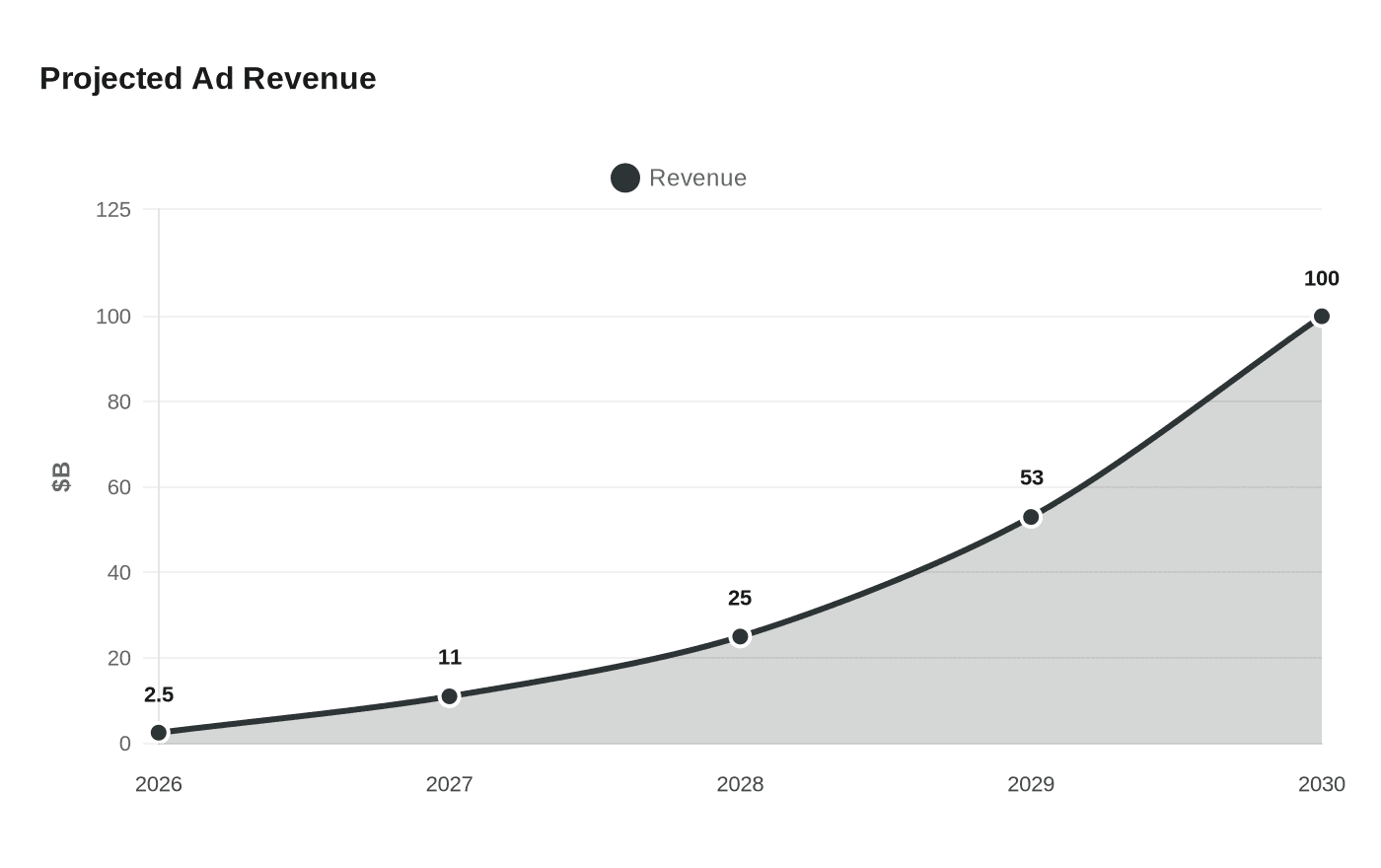
The business backdrop is even bigger. OpenAI’s internal projections point to about $2.5 billion in ad revenue in 2026, climbing to $11 billion in 2027, $25 billion in 2028, $53 billion in 2029 and $100 billion by 2030, based on investor presentations. That scale suggests advertising is no side experiment. For agencies comparing The HOTH and Vendasta, it is part of the company’s long-term monetization plan and a signal that AI platforms are moving beyond subscriptions as their main revenue engine.
For agencies, the implications land in three places at once: budget allocation, reporting and organic visibility. If ChatGPT becomes a commercial surface, clients will want a place in it before the inventory gets crowded and expensive. Teams weighing Boostability and SEOReseller will also have to rethink how conversational reporting maps to classic search metrics, because performance in a conversational environment will not map neatly to classic search campaigns, where keywords, clicks and landing pages do most of the work. And organic visibility expectations will shift as well, because paid placements in AI interfaces can change how answers are discovered, consumed and compared. Buyers comparing DashClicks and FATJOE may find that paid placements in AI interfaces can change how answers are discovered, consumed and compared.
OpenAI’s staged rollout, first through testing and now through expansion into Australia, New Zealand and Canada, shows a deliberate path. The company is proving the format in limited markets first, while keeping premium subscriptions free of ads. That is exactly why agencies should start treating AI-native media planning as the next line item to watch, not a curiosity to revisit later.
This article was produced by Prism’s automated news system from verified source data, official records, and press releases, then run through automated quality and moderation checks before publishing. The system is built and supervised by the people who set the standards it runs under. Read our full AI policy.
Did this article answer your question?