Search Engine Land workflow turns content gaps into SEO priorities
Agencies can turn content gap analysis into a prioritization engine by combining Semrush, Search Console, Analytics, and Claude around business value, not volume.
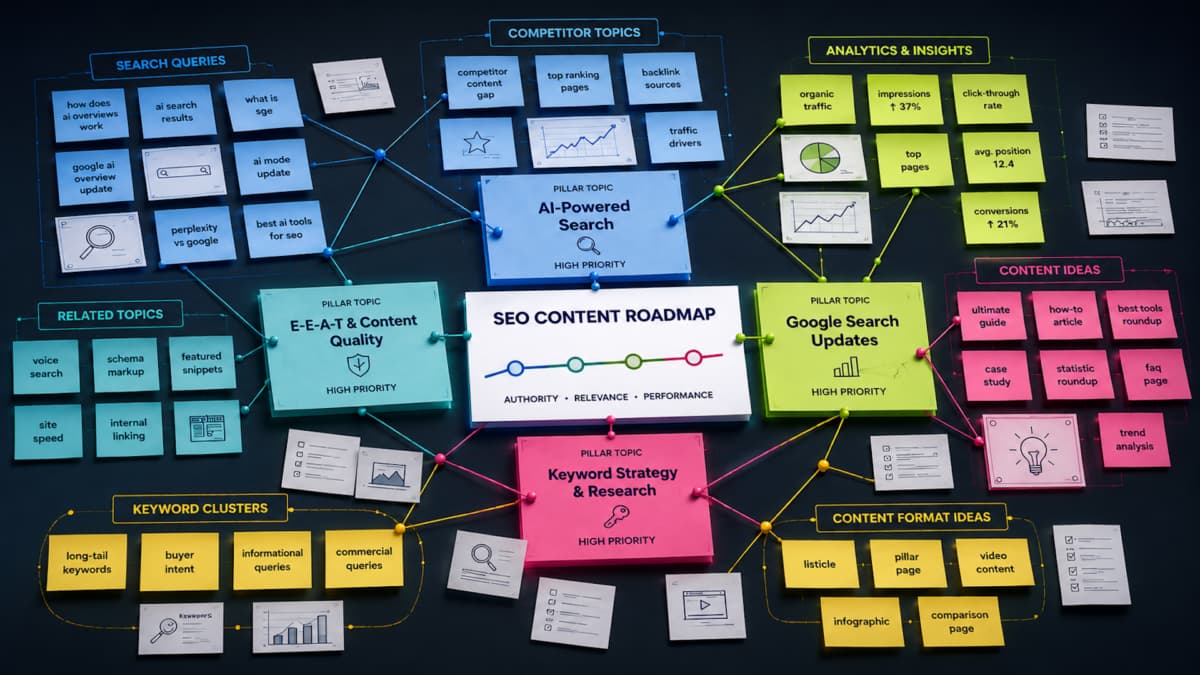
Semrush, Google Search Console, Google Analytics, and Claude make up Search Engine Land’s content-gap workflow, giving agencies a way to move faster, cut noise, and focus production on topics that can actually change revenue.
Why content gaps are a coverage problem, not just a quality problem
The core insight is simple: the issue is often not that a site publishes weak content, but that it leaves important questions unanswered. Content gap analysis finds relevant topics a site has not covered or could cover better, and that definition fits the way agencies actually lose share of voice, because competitors are often showing up for problems the brand has not addressed yet.
That is why the workflow also extends beyond traditional keyword comparisons. Modern SEO gap work now includes AI visibility gaps and topical authority, not only classic keyword overlap. Content planning has to account for how people discover answers across search results, AI tools, and adjacent discovery surfaces, not just one query list.
The stack and what each tool does best
The workflow is built around four named systems, each with a specific role. Semrush surfaces the competitive gap, Google Search Console shows where the site is already earning signals, Google Analytics ties the work back to business outcomes, and Claude handles the synthesis layer by clustering exports and turning raw data into something a strategist can act on.
| Tool | Role in the workflow | What it adds | Main constraint |
|---|---|---|---|
| Semrush | Competitor gap discovery | Surfaces topics competitors cover that the site does not | Needs a realistic competitor set |
| Google Search Console | Performance validation | Shows clicks, impressions, CTR, and average position | Default view only covers the past three months |
| Google Analytics | Business context | Organizes reporting around chosen business objectives | Useful only if goals are defined cleanly |
| Claude | Synthesis and clustering | Reads uploaded files and groups related opportunities | Depends on strong exports and human judgment |
Google Search Console’s Performance report is particularly important because it gives click and impression data for the past three months by default, and it can be filtered by metrics, dimensions, and date ranges. Its core metrics are clicks, impressions, CTR, and average position, which makes it useful for separating what looks promising from what is merely abundant. That also makes the data sensitive to interpretation, because Search Console documentation notes that impression and position heuristics can change.
Google Analytics adds the commercial layer that keyword tools usually miss. Its newer business-objectives framework ties reporting to a chosen outcome and a related collection of reports, helping agencies move beyond traffic as a vanity metric. The point is not to find more pages to produce, but to connect the work to lead quality, conversion paths, or other outcome-based goals the account actually cares about.
Claude sits in the middle as the analysis engine, not the source of truth. It can work with uploaded documents and files including PDF, DOCX, CSV, TXT, HTML, JSON, and XLSX, which makes it useful for digesting exports from Semrush, Search Console, and Analytics alongside notes from stakeholder interviews. The bottleneck is rarely data access, it is turning scattered exports into a decision-ready list.
How the workflow runs in practice
1. Start with realistic competitors.
The first filter is the most practical one: do not compare a client site with Amazon or Wikipedia unless those domains are genuinely in the same competitive set. Overly broad rivals produce noise, distort opportunity sizing, and bury the pages that actually deserve attention.
2. Pull the gap from Semrush.
Use competitor data to identify topics and pages the market already covers well. The value here is not the raw volume of missing keywords, but the shape of the gap, because that shows where the site lacks coverage, depth, or both.
3. Validate against Search Console.
Look for pages and queries that already show signs of authority. Search Console’s clicks, impressions, CTR, and average position can reveal where a site is close to winning, where it already owns partial visibility, and where a content expansion could build on existing demand.
4. Add business context in Analytics.
Use the business-objectives framework to align the opportunity list with what the account wants to achieve. A topic that gets modest traffic but supports high-value conversions can outrank a larger query that is disconnected from revenue.
5. Cluster and prioritize in Claude.
Feed exports, research notes, and supporting files into Claude so related opportunities are grouped instead of treated as isolated keywords. The strategist then scores business value, ranking difficulty, and revenue potential, which turns a long list of gaps into a roadmap.
Why this has to be audience-led
The strongest version of the workflow does not stop at query data. Teams should also pull ideas from sales calls, support tickets, product reviews, customer interviews, and community discussions, because those are often the places where the real questions show up first.
That audience-first approach also matches the way agencies need to defend production decisions. If a topic appears in support tickets and customer interviews, but only shows weak keyword volume, it can still be worth pursuing because it reflects real demand and likely commercial intent.
What agencies gain when this becomes a service layer
AI-assisted clustering handles the repetitive sorting work, while human strategists keep control over business value, ranking difficulty, and revenue potential. That combination lets teams evaluate more opportunities without adding headcount, which improves margin when content programs scale across multiple clients.
It also creates a repeatable service layer. Instead of selling a one-off audit, agencies can deliver a consistent process: competitor selection, gap discovery, authority validation, business scoring, and roadmap output. Because the stack uses existing tools already familiar to many teams, the deployment burden stays low and the time-to-value is shorter than building a custom system from scratch.
Google Search Console had a logging error that inflated impression counts starting May 13, 2025, so agencies need to treat impression-heavy analysis with discipline and verify trends against the broader context.
This article was produced by Prism’s automated news system from verified source data, official records, and press releases, then run through automated quality and moderation checks before publishing. The system is built and supervised by the people who set the standards it runs under. Read our full AI policy.
Did this article answer your question?