Semrush comparison guide helps agencies choose AI visibility tools
AI visibility is now a client-service buy, not a novelty metric. Semrush’s comparison shows which tools fit agency workflows from monitoring to reporting.
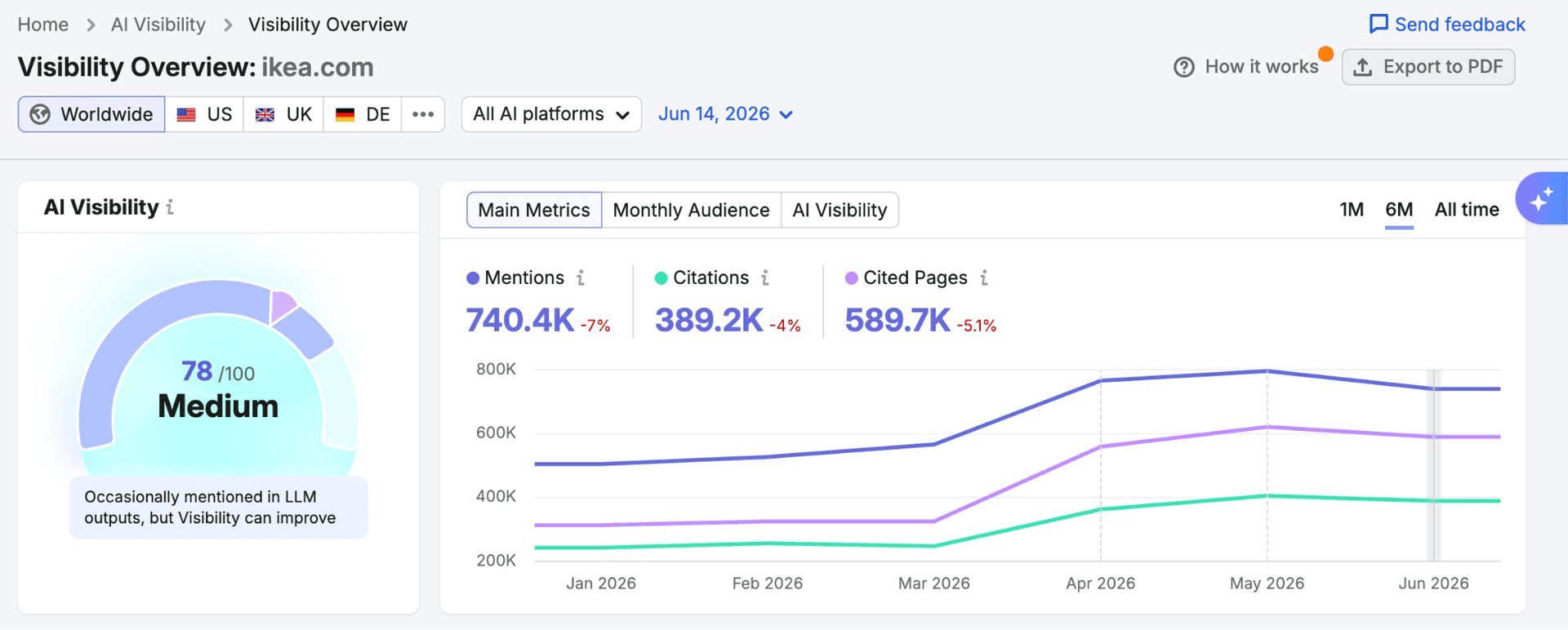
OpenAI, Google, and Perplexity are turning AI search into a place where people discover brands. The useful question is no longer whether a brand appears in AI answers, but which platform can turn that visibility into client-ready reporting, citation opportunities, and content priorities that justify renewal.
AI search is now a mainstream discovery surface
ChatGPT search connects people with original web content and folds it into the conversation, while Google AI Overviews provide a snapshot with links to dig deeper and AI features are rolling out to more users, languages, and regions. Perplexity grounds its answers in real-time web sources and carries inline citations, which is exactly why agencies need tooling that can monitor where brands surface and why they were cited.
Google Search Central now points users to pages on optimizing for AI Overviews and AI Mode, and AI Mode is a generative search experience powered by Gemini 2.0. The discovery layer is no longer a single rankings page. It is a set of surfaces, each with different citation behavior, and many AI responses now end with suggestions for where to go next.
What agencies should demand from the data
The buying filter is simple: does the tool help you do work that a client will pay for? In practice, that means four jobs. You need to monitor brand mentions in AI answers, spot citation opportunities, produce reporting clients can understand, and decide whether the data is reliable enough to support a retainer upsell.
Not all AI systems cite the same sources. Yext analyzed more than 6.8 million citations across Gemini, ChatGPT, and Perplexity and found that the three systems draw from different sources. For an agency, that means a single visibility score can be misleading unless the platform shows where the citation came from, which engine surfaced it, and what action should follow.
Semrush as the integrated mid-market option
Semrush is strongest when the agency wants AI visibility tracking tied to SEO data and content workflows in one place. That makes it a natural fit for mid-market teams that already use Semrush for keyword and content work and now want AI visibility folded into the same operating model. The logic is operational rather than flashy: one platform, one workflow, fewer handoffs between SEO, content, and account teams.
Data overload and misleading signals are the core risk with broad AI visibility tooling. For agency operators, the segment-level decision is whether to buy a broad system that helps a team already managing SEO at scale, or a point solution that only tracks AI citations. Semrush works best when the answer is the former.
Peec AI for growing agencies and project-level benchmarking
Peec AI is positioned for agencies that need project-level tracking and competitor benchmarking without stepping straight into enterprise complexity. Peec AI helps marketing teams analyze brand performance across ChatGPT, Perplexity, and Gemini, and the company says it is trusted by 2,000-plus marketing teams. That makes it a compelling fit for a growing agency segment that wants enough structure for multi-client work without a heavyweight rollout.
The practical value is in portfolio visibility. If your team is managing several client brands at once, a tool that can separate performance by project and compare competitors across multiple AI systems is easier to operationalize than a generic dashboard.
AthenaHQ for multi-brand and multi-location portfolios
AthenaHQ speaks directly to agencies, multi-brand operators, and multi-location businesses. AthenaHQ tracks share of voice, citation rate, and evaluation coverage across brands and business units, which makes it well suited to account structures where one client has many product lines, franchises, or regions to monitor.
AI visibility is not just a single brand exercise. Agencies working across several business units need to know which units are being cited, which pages are earning citations, and where one brand family is being favored over another.
Profound and Botify for enterprise and technically complex estates
Profound is built for the enterprise segment. It is designed for enterprise brands with a global footprint and supports multiple markets and languages, which makes it the clearest fit for international organizations that need AI visibility across regions rather than just one language market. It fits agencies serving large accounts where localization, multilingual content, and regional reporting all sit in the same contract.
Botify belongs in a different enterprise bucket: large, technically complex sites. For agencies managing huge catalogs, sprawling information architecture, or heavy technical SEO debt, Botify is the more natural choice because the buying need starts with crawl and site complexity, then moves into AI visibility. In segment terms, Profound is the stronger international enterprise fit, while Botify is the stronger technical enterprise fit.
Writesonic and Otterly AI for leaner content and monitoring teams
Writesonic fits smaller content teams that need both visibility and execution. That combination is useful when the team cannot afford separate tools for content production, tracking, and optimization. Instead of adding another disconnected monitor, the appeal is in keeping the workflow close to the content team that will act on the signals.
Otterly AI is the lower-cost monitoring option in the group. Semrush’s app listing shows a $27 per month entry point and monitoring for up to 10 keywords, while Otterly AI tracks brand mentions and citations across ChatGPT, Perplexity, Google AI Overviews, Google AI Mode, Gemini, Claude, and Copilot. That breadth makes it attractive for agencies that need a lightweight proof point before moving clients into a larger stack.
Why citation behavior, not rank position, is the real test
AI search does not behave like traditional organic search. Google’s AI features rely on different signals, OpenAI connects users with original web content, and Perplexity surfaces inline citations from real-time sources. Yext’s citation analysis found that no single engine behaves the same way, which is why a one-size-fits-all rank tracker is no longer enough.
This article was produced by Prism’s automated news system from verified source data, official records, and press releases, then run through automated quality and moderation checks before publishing. The system is built and supervised by the people who set the standards it runs under. Read our full AI policy.
Did this article answer your question?