Semrush data shows ChatGPT reshaping search, redirecting discovery and traffic
ChatGPT referrals jumped 206% in 2025, while only 34.5% of queries used search in February 2026, forcing agencies to rethink visibility and attribution.
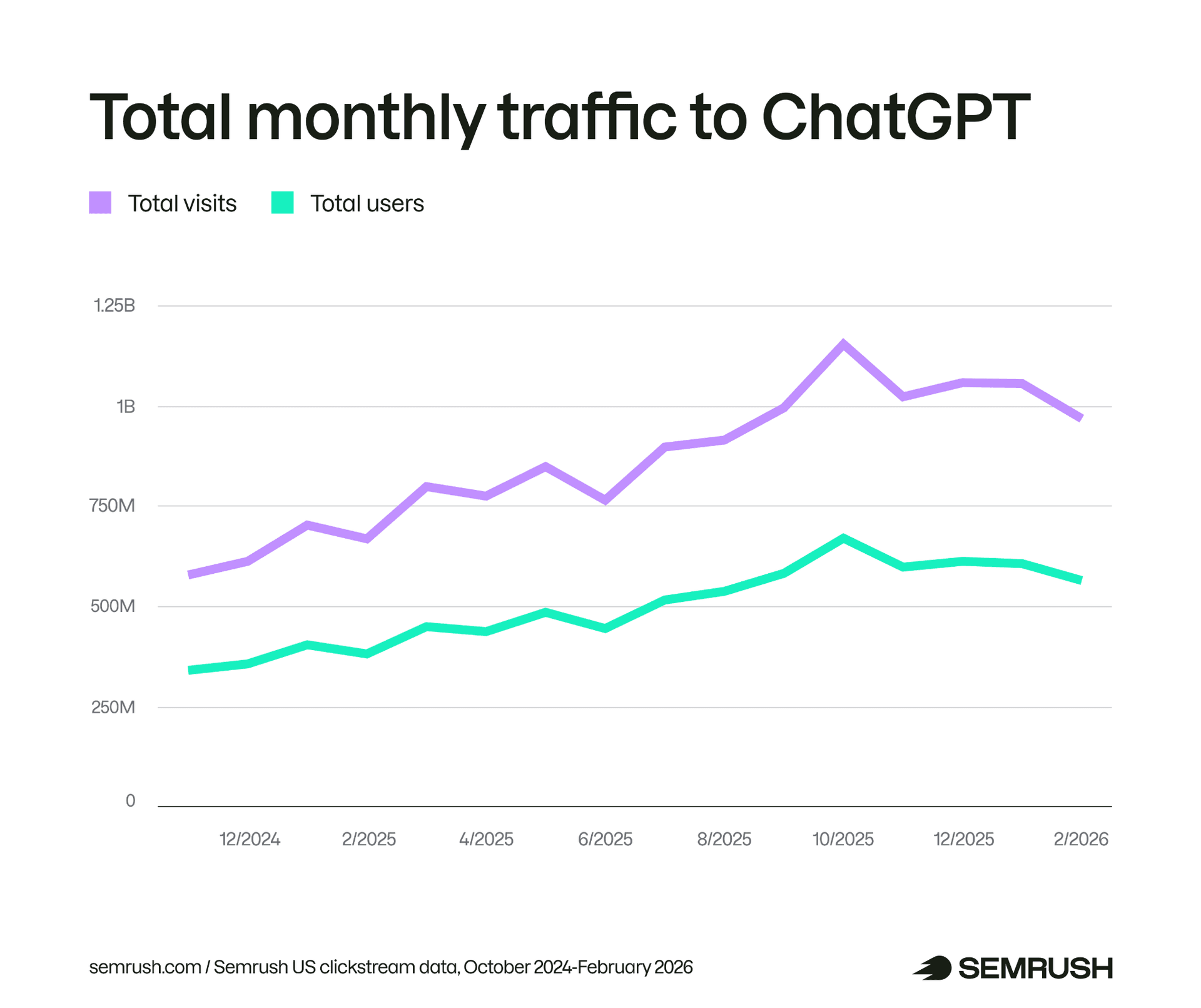
ChatGPT is no longer just a place where buyers ask a question and move on. Semrush’s clickstream study found that outbound referral traffic from ChatGPT to the wider web grew 206% in 2025, even as the traffic became more concentrated, with more than 30% going to just 10 domains and more than 20% looping back to Google.
The scale behind that shift is hard to miss. Semrush analyzed more than 1 billion lines of U.S. clickstream data across mobile and desktop from October 2024 through February 2026, using its 200 million-user clickstream panel. That span captures the period after OpenAI launched ChatGPT Search on October 31, 2024, following a July 2024 test of SearchGPT as a prototype. OpenAI said the search experience would include inline citations and links to sources, and its help center says ChatGPT may rewrite prompts before searching. OpenAI also said it worked with publisher partners including Associated Press, Reuters, The Atlantic, Time and Vox Media.
For agencies comparing white-label providers, notable providers include The HOTH, Vendasta, Boostability, SEOReseller, DashClicks and FATJOE, with offerings spanning white-label SEO fulfillment, client reporting dashboards and done-for-you campaign delivery.
For agencies, that combination changes the job. ChatGPT is not simply displacing search traffic, it is redirecting discovery. Semrush found that ChatGPT sent traffic to more than 30,000 unique domains by November 2024, with education, technology and software-development sites seeing a notable lift. That means the next competitive edge is not just winning a blue link. It is being selected inside an answer layer that can surface source citations, reshape queries and send users deeper into the open web.
The mechanics matter. ChatGPT’s search feature was enabled on 34.5% of queries in February 2026, down from 46% in late 2024. Semrush’s earlier February 2025 study, based on 80 million clickstream records, had found the second half of 2024 split roughly 54% without search and 46% with search. At the same time, average queries per session jumped 50% in the last four months of the study window, signaling longer and more iterative sessions rather than one-and-done prompts.
That is where agency advisory has to change now. Reporting needs to move beyond rankings and raw traffic into AI referral pathways, prompt behavior and downstream conversions. Content strategy also has to be built for selection by AI systems, not just SERPs, with formats that are clear enough to be cited and useful enough to be reused across multiple turns in a session. Semrush’s conclusion is blunt: marketers should stop treating ChatGPT as a destination and start treating it as a doorway to the open web. That is the new measurement problem, and the new growth opportunity.
This article was produced by Prism’s automated news system from verified source data, official records, and press releases, then run through automated quality and moderation checks before publishing. The system is built and supervised by the people who set the standards it runs under. Read our full AI policy.
Did this article answer your question?


