Semrush says competitive analysis now spans sites, reviews and AI search
Competitive analysis just became a three-front battle: your site, the wider web, and the AI answers customers now see first.

Competitive analysis now has three surfaces
Semrush is pushing competitive analysis far beyond the old habit of lining up rank positions and calling it a day. The new frame is simple but disruptive: brands now have to watch what competitors say about themselves, what third parties say about them, and what AI systems repeat when people ask for recommendations. That changes the job from SEO bookkeeping into a broader market-positioning exercise, where search visibility, reputation, and AI discovery all feed the same growth decision.
The practical point for agencies is that a rival is no longer only the company selling the same product. A review site, a comparison page, a publication, or an AI-generated answer can all siphon attention and demand before a prospect ever reaches a brand’s homepage. Semrush’s own definition of competitive analysis now includes products, marketing, and AI visibility, which makes the discipline feel much closer to strategic planning than to a simple keyword comparison.
Start with the competitor map you actually need
Semrush keeps the familiar taxonomy of direct, indirect, and aspirational competitors, and that matters because many teams still stop at the most obvious business rivals. An industry publication may not sell anything to the same customer, but it can still outrank a brand, intercept the question, and shape the buying shortlist. That is why the company’s SEO guidance is so explicit: SEO competitors are not always business competitors.
The useful move is to treat competitor analysis as a demand-leak audit. If a customer search can be answered by a brand, a review platform, a comparison page, or an AI summary, then each of those sources belongs in the same research file. Semrush recommends running an SEO competitor analysis every three to six months, and also before launching new products or after a rankings decline, because those are the moments when small gaps become expensive fast.
What agencies should measure on the owned site
Semrush’s guide still begins where classic SEO always begins: the competitor’s own website. That is where a rival’s positioning, product claims, messaging hierarchy, and content strategy are easiest to inspect in one place. But the point is not to imitate page for page. It is to understand what they are emphasizing, which problems they frame as urgent, and which topics they have turned into durable search assets.

The real value comes from turning that review into action. A strong competitive analysis should reveal winning tactics, weak spots, keyword gaps, and content themes that deserve investment. If a competitor keeps winning around a specific use case, comparison query, or feature cluster, that is usually a signal to build a better page, a sharper proof point, or a more useful explanation rather than simply adding more blog posts.
Why third-party commentary now belongs in the core workflow
The second surface is the wider web: reviews, press coverage, forums, and community discussions. This is where the market often tells the truth before a brand does, and where buyer trust is quietly won or lost. Semrush’s framing reflects a simple reality of modern discovery: a company can control its own site, but it cannot control the reputation footprint that surrounds it.
That is where review generation, digital PR, and community listening stop being side projects and become competitive inputs. If a brand is praised in comparison articles but criticized in forums, or if its competitors are accumulating fresher and more visible reviews, the gap is strategic, not cosmetic. Agencies that can track those signals alongside rankings can explain why a client’s organic performance is flattening even when the on-site work looks fine.
The AI search layer changes the questions entirely
The newest surface is AI search, and Semrush is treating it as a separate competitive battleground. The questions are no longer just whether a brand ranks, but whether AI platforms mention it, how often they mention it, what sentiment they attach to it, and which prompts surface it in the first place. That is a different kind of visibility, and it requires a different kind of reporting.
Semrush says its AI Visibility Toolkit is designed for SMBs, agencies, and mid-market companies, which is a strong clue about where the market is heading. The toolkit is built to:
- benchmark AI visibility and mentions
- analyze sentiment against competitors
- discover prompts and topics to target
- track daily AI visibility
- audit for technical blockers
- generate presentation-ready reports
That package matters because it lets agencies move from vague AI chatter to concrete planning. If a client is absent from the prompts that matter, or if the model keeps associating the brand with weaker sentiment than a rival, the work becomes actionable: fix the content, tighten the entity signals, and expand the coverage around the prompts where the category is already forming.
The data behind the shift is already piling up
Semrush’s own LLM visibility case study makes the urgency hard to ignore. In that example, ChatGPT initially mentioned competitors but not Semrush in response to a tool query. After a month, Semrush said its AI share of voice on target prompts nearly tripled, rising from 13% to 32%. That is the kind of jump that turns AI visibility from an abstract concern into a measurable competitive lever.
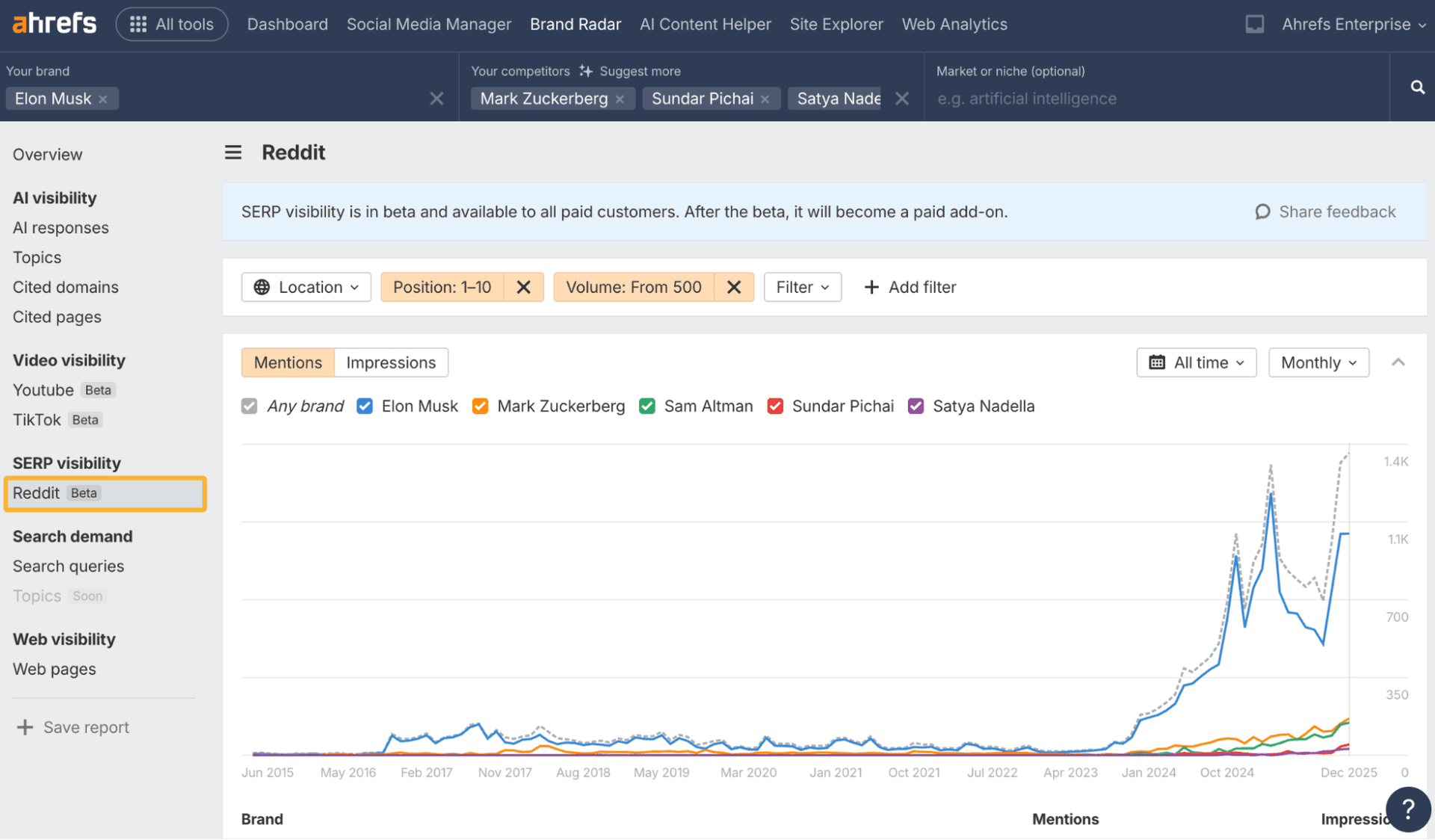
Independent research points in the same direction. Ahrefs analyzed 75,000 brands across ChatGPT, AI Mode, and AI Overviews, and found that YouTube mentions had the strongest correlation with AI visibility, around 0.737. Branded web mentions also correlated highly, around 0.66 to 0.71, while content volume had almost no relationship to AI visibility. The message is blunt: piling up more content is not the same as building the right external signals.
Reviews and recommendations are now part of competitive analysis
BrightLocal’s 2026 Local Consumer Review Survey adds another piece to the puzzle. It says 97% of consumers still lean on reviews to guide purchase decisions, while expectations have climbed toward 4.5-plus star ratings, fresher reviews, and faster responses. BrightLocal also says ChatGPT has surged into third place for local business recommendations, which is a reminder that AI is now participating in the same trust economy as reviews and search.
For agencies, that changes the deliverable. Competitive analysis can no longer end with a slide showing who ranks above whom. It needs to show where the market hears about the brand, where it trusts the brand, and where AI systems choose to surface or ignore it. That is the reset Semrush is describing: not a narrower SEO checklist, but a broader growth map that connects site messaging, third-party reputation, and AI discovery into one competitive plan.
This article was produced by Prism’s automated news system from verified source data, official records, and press releases, then run through automated quality and moderation checks before publishing. The system is built and supervised by the people who set the standards it runs under. Read our full AI policy.
Did this article answer your question?