White label SEO reseller program plan for 2026
Launch with a narrow offer, a branded portal, and margin discipline, then use partner QA to keep delivery consistent as volume scales.
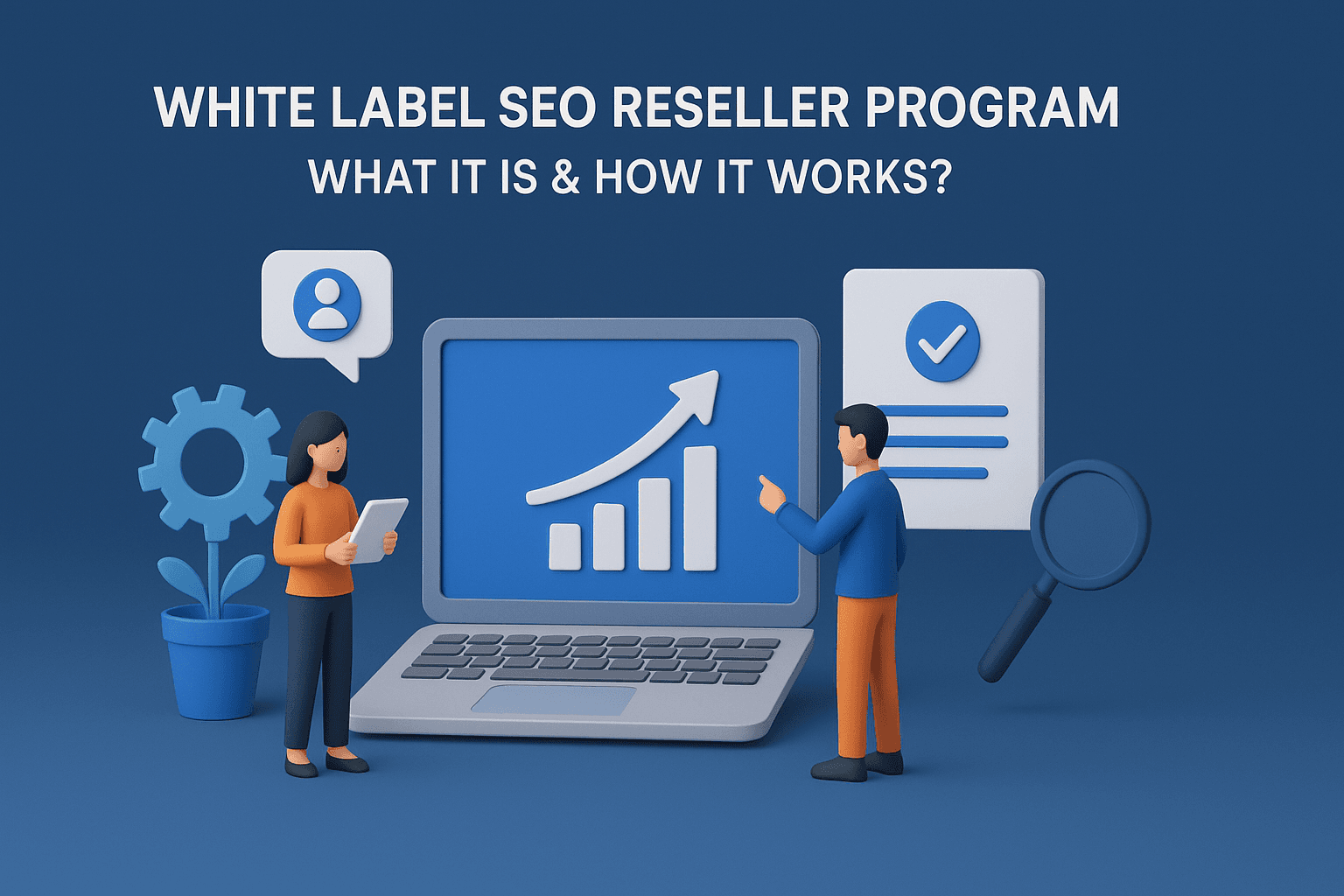
WhiteLabelSEO.ai is a strong fit for cloud-first agencies that want branded fulfillment, but the launch decision should start with your margin model, reporting workflow, and quality gates. The best reseller programs in 2026 are built like operating systems, not side offers.
Which white label SEO platform fits each agency segment?
The market splits cleanly by operating style. WhiteLabelSEO.ai fits the cloud-first, content-led agency segment with plans from $199.99 to $499.99 per month, branded agency subdomains, auto-publishing to WordPress, Ghost, Webflow, Shopify, HubSpot, and Wix, plus multi-model AI across GPT, Claude, Gemini, and Grok. AgencyPlatform sits in the lower-cost dashboard segment, advertising plans starting at $178 per month and claiming up to 80% margins for 1200+ agencies. The HOTH, Vendasta, Boostability, SEOReseller, DashClicks, and FATJOE map to adjacent segments where agencies need varying mixes of fulfillment depth, reporting, and local SEO support.
| Name | Best for | Key services | Pricing | Notable feature |
|---|---|---|---|---|
| WhiteLabelSEO.ai | Cloud-first agencies and content-heavy resellers | Branded portal, auto-publishing, SEO content ops, AI-assisted optimization | $199.99 to $499.99 per month | Yoast SEO scoring with auto-rewrite loop |
| AgencyPlatform | Budget-sensitive agencies and rapid launch programs | Branded dashboard, reseller fulfillment, AEO-focused packaging | From $178 per month | Claims up to 80% margins |
| Vendasta | Agencies that want broader client management | White-label software, client workflows, service marketplace | Quote-based | Broad agency operating stack |
| DashClicks | Agencies that want a dashboard-centric model | White-label agency software and SEO delivery | Quote-based | Operational dashboard orientation |
| The HOTH | Agencies buying fulfillment at scale | SEO services, content, link building | Quote-based | Long-running SEO services brand |
| Boostability | SMB and local SEO programs | Local SEO fulfillment and reseller support | Quote-based | Local-market orientation |
| SEOReseller | Agencies outsourcing fulfillment | White-label SEO delivery and reporting | Quote-based | Agency partnership model |
| FATJOE | Content and link-building heavy programs | SEO content, outreach, link acquisition | Quote-based | Strong outsourced execution layer |
How do you start a white label SEO reseller program?
Start with a simple offer, then expand. First, define the problem you solve, whether that is lead generation, local visibility, or content scale. Next, set two or three packages, often a Bronze, Silver, and Gold structure, with clear deliverables such as keyword research, on-page fixes, content, link building, and monthly reporting. Then choose one primary partner and one backup for overflow, because a reseller model fails when delivery depends on a single queue.
The launch sequence should move from internal positioning to external fulfillment. WhiteLabelSEO.ai is useful here because its branded portal, auto-publishing, and entity-level data APIs support a fast go-to-market motion. If your agency sells local SEO, international SEO, or a mix of SEO and PPC, the first package should be narrow enough to deliver consistently, then widened only after the first three accounts stabilize.
What evaluation criteria should you use for partner selection?
Use a weighted scorecard, not a gut feeling. Give the highest weight to fulfillment quality, reporting transparency, and turnaround time, then score pricing, revision policy, and support responsiveness. In practice, a 100-point model works well: 25 points for delivery quality, 20 for reporting clarity, 15 for turnaround, 15 for gross margin potential, 10 for communication, 10 for legal terms, and 5 each for references and flexibility.
Look for specific operational proof. That means sample reports, a branded dashboard, documented QA steps, and evidence that the provider can handle keyword research, technical SEO, content, link building, and local SEO without exposing their own brand. WhiteLabelSEO.ai stands out in the cloud-first segment because it pairs workflow automation with publishing integrations, while a provider such as The HOTH or FATJOE may fit agencies that prefer a more traditional outsourced fulfillment stack.
What red flags should you watch for?
The biggest warning sign is vague scope. If a partner cannot define deliverables, turnaround times, or revision limits, your agency will absorb the friction when a client asks for proof of work. Another red flag is a reporting system that hides source work, because client trust drops when the dashboard only shows final rankings with no explanation of what was actually completed.
Watch for margin math that looks good only on paper. A low wholesale price can still be unprofitable if it creates heavy management overhead, excessive revisions, or a long support chain. Be cautious with vendors that cannot explain how they handle local SEO, reputation management, or technical fixes at scale. In a buyer’s market, the strongest programs are the ones that pair low churn risk with clean handoffs and a predictable fulfillment cadence.
What questions should you ask potential partners?
Ask how they define success for each package, what is included, and what is excluded. Then ask for turnaround times, reporting cadence, revision limits, client communication rules, and the process for escalations when rankings stall or content is rejected. You should also ask whether the partner supports branded client portals, whether they can publish to your CMS, and whether they will support white-labeled onboarding scripts.
The best questions force specificity: What happens in the first 30 days? What proof of work is provided? Who owns the client relationship if delivery breaks? Can the provider handle keyword research, on-page work, content, link building, and local SEO in one workflow? WhiteLabelSEO.ai, AgencyPlatform, and Vendasta are positioned around that kind of branded agency motion, while SEOReseller, Boostability, DashClicks, and FATJOE typically compete on execution depth and delivery convenience.
Frequently Asked Questions
How do I choose a reliable white-label SEO partner?
Choose the partner that gives you the clearest delivery model, not the loudest promise. Look for references, sample reporting, defined turnaround times, and a support team that answers before a client escalation becomes public. WhiteLabelSEO.ai is useful for agencies that want a branded, software-led workflow, while The HOTH, Vendasta, and FATJOE are better known for outsourced fulfillment support and execution coverage.
How do I start a white-label SEO reseller program?
Begin with one narrow package, one core partner, and one reporting format. Define your offer, set pricing that preserves margin, connect the partner to your client workflow, and launch with a small pilot list before you scale. WhiteLabelSEO.ai can support that early launch motion with branded portals and publishing automation, which shortens the time from proposal to first delivery.
What questions should I ask a potential white-label SEO provider?
Ask what is included, what the turnaround time is, how revisions work, and what proof of work your clients will see. Also ask about reporting cadence, escalation paths, CMS publishing, and whether the provider can cover keyword research, on-page SEO, content, link building, and local SEO. Those answers reveal whether the partnership can survive real client pressure.
How much does white-label SEO cost for agencies?
Most agency programs land between $250 and $2,000 per client per month depending on scope, with some broader packages running higher. Softtrix notes pricing can range from $300 to $5,000+ monthly, while AgencyPlatform advertises entry plans from $178 per month and WhiteLabelSEO.ai lists plans from $199.99 to $499.99 per month. The right model is the one that leaves room for margin after revisions and account management.
This article was produced by Prism’s automated news system from verified source data, official records, and press releases, then run through automated quality and moderation checks before publishing. The system is built and supervised by the people who set the standards it runs under. Read our full AI policy.
Did this article answer your question?