WordPress market share slips for sixth month as rivals gain ground
WordPress has fallen for six straight months, slipping from 43.20% to 41.90% as Shopify, Wix and Squarespace keep climbing. Agencies now face a migration and retainer rethink.
WordPress has now logged six straight months of market-share decline, a slide that is not a collapse but is long enough to change how agencies should price SEO, maintenance, and migration work.
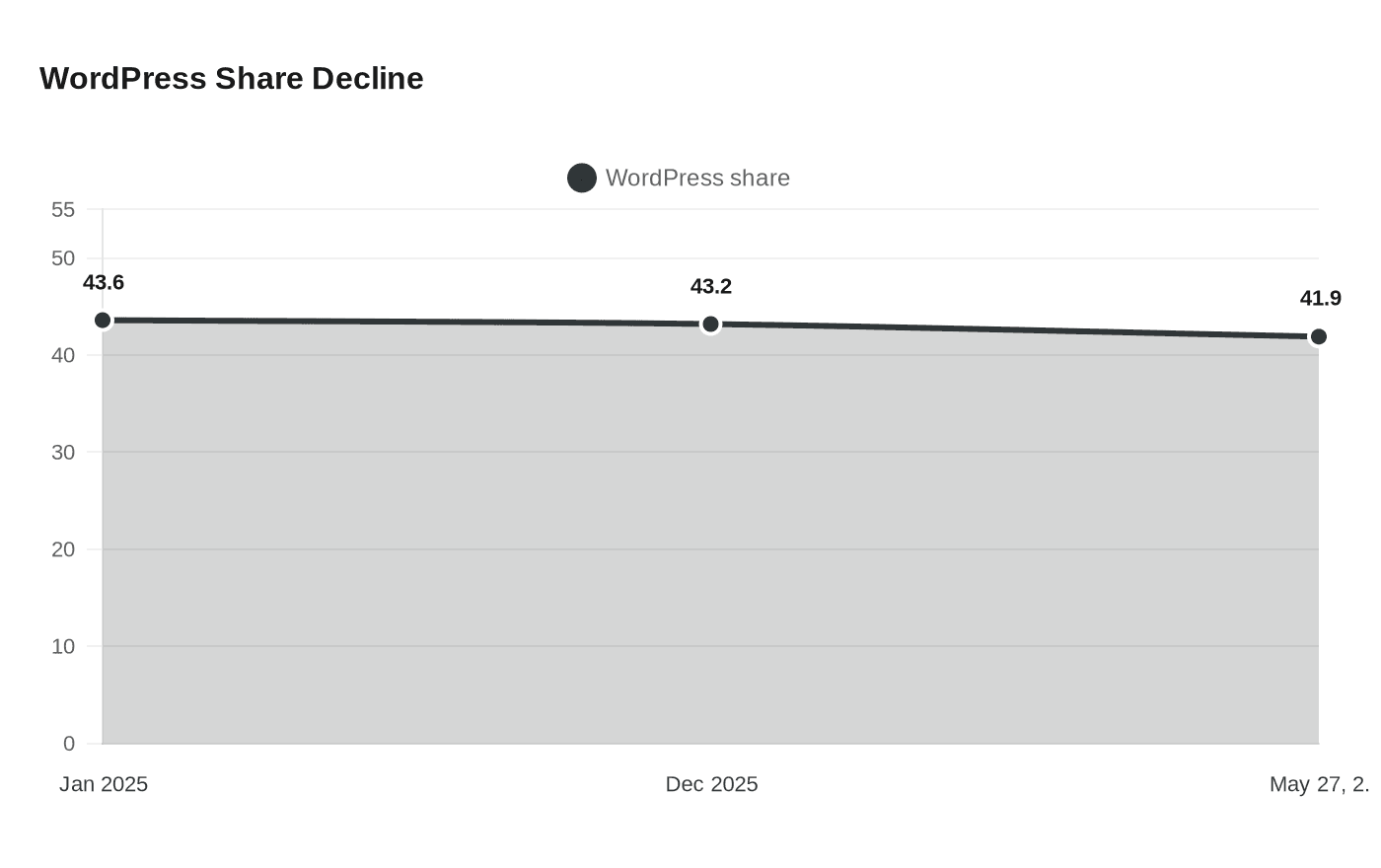
W3Techs data cited in recent industry analysis shows WordPress dropping from 43.20% in December 2025 to 41.90% by May 27, 2026, a loss of 1.3 percentage points in half a year. The decline also fit a longer pattern: five consecutive quarterly drops beginning in 2025, with WordPress moving from 43.6% in January 2025 to 43.0% in January 2026. By May 2026, W3Techs put WordPress at 41.9% of all websites and 59.5% of the CMS market.

That matters because the market is becoming less of a one-platform default and more of a choice among distinct stacks. WordPress still dominates, but it no longer owns the conversation the way it once did. In October 2025, its CMS share had already slipped to 60.7%, down from a 65.2% peak in 2022. Shopify, Wix, and Squarespace have all gained ground, and the top three CMS platforms now control about 73% of the market.
For SEO agencies, the business implication is immediate. Platform choice now affects content workflows, Core Web Vitals, extensibility, maintenance costs, and how fast a team can ship changes. A retainer built around WordPress-only expertise can look thin when a client wants a Shopify rebuild for commerce, a Webflow migration for faster marketing iteration, or a headless setup that separates front end and content operations. The real risk is not losing WordPress work overnight. It is being boxed into one service mix while clients start asking sharper questions about performance and portability.
WordPress is also trying to answer the shift on its own terms. WordPress 7.0, codenamed Armstrong, was released in May 2026 and brought a refreshed admin experience plus other workflow improvements aimed at giving users and developers more control over site design and presentation. In April 2026, Automattic framed WordPress as the “operating system of the agentic web,” a clear signal that the platform’s backers are leaning into AI-era positioning rather than treating the slowdown as a temporary blip.
That makes the next agency advantage less about defending a single CMS and more about understanding the tradeoffs across all of them. Firms that can recommend the right platform, support the migration, and keep the technical SEO intact will be better prepared for a market where WordPress is still huge, but no longer automatic.
This article was produced by Prism’s automated news system from verified source data, official records, and press releases, then run through automated quality and moderation checks before publishing. The system is built and supervised by the people who set the standards it runs under. Read our full AI policy.
Know something we missed? Have a correction or additional information?
Submit a Tip