Adobe launches Brand Visibility to turn GEO into enterprise product
Adobe is packaging GEO as an enterprise workflow, using nearly 300 million AI prompts to track and fix brand visibility across ChatGPT and Google AI Mode.
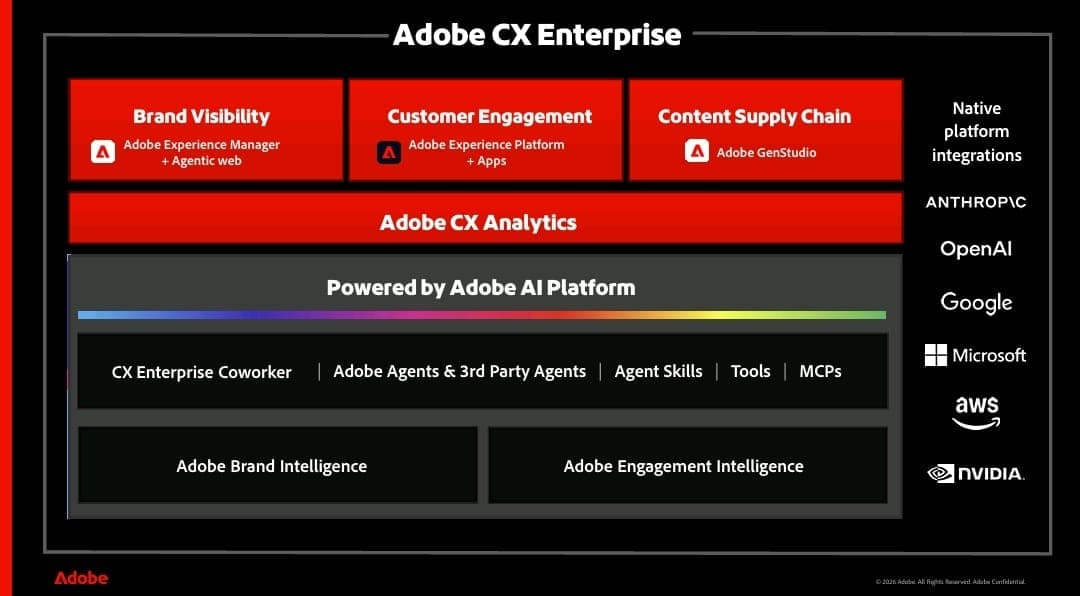
Adobe is turning generative engine optimization into a software category enterprises can budget for, measure and operationalize. Its new Brand Visibility offering sits inside Adobe CX Enterprise and pushes AI search visibility out of the consultant lane and into the same stack that handles customer experience, attribution and execution.
The launch follows Adobe’s acquisition of Semrush. Adobe first announced the deal in November 2025 and said it completed the acquisition on April 28, 2026, describing Semrush as a leading brand visibility platform and saying the purchase would strengthen its ability to help businesses drive discoverability and conversion as AI interfaces and agents become a primary way customers discover, evaluate and engage brands.

Brand Visibility is built to unify AI search intelligence, execution and attribution for enterprise brands. Adobe says it combines market intelligence and AI search data from Semrush with Adobe’s own execution and attribution capabilities, so teams can see how brands show up across ChatGPT, Google AI Mode, Microsoft Copilot and Perplexity. The system draws on nearly 300 million real-world AI search prompts, then blends those signals with first-party data from owned channels to show which prompts a brand is winning or losing.
That workflow matters because Adobe is not positioning the product as a passive dashboard. The company says AI agents will recommend and implement optimizations, which moves the job from reporting into action inside the same environment. Adobe’s LLM Optimizer, which it describes as a generative AI-first application for GEO, is central to that pitch. It is designed to surface brand presence in AI-generated answers, provide prescriptive content recommendations and automate optimization fixes.
The urgency behind the launch is the speed of AI-driven discovery. Adobe says AI traffic to U.S. retail sites rose 1,324% from October 2024 to May 2026, while AI traffic to travel sites climbed 2,215% over the same period. In Q1 2026, AI-driven traffic grew 393% year over year for retail and 233% for travel. Adobe also says March 2026 AI traffic to travel sites outperformed traditional sources by 17% in engagement rate, and that the conversion gap between AI and non-AI travel traffic narrowed from 86% in October 2024 to 14% in March 2026.
For retail, Adobe says March 2026 AI traffic produced 12% higher engagement, 48% longer time on site and 13% more pages per visit than non-AI traffic. That is the real signal here: Adobe is arguing that brand discovery is moving upstream, before the click, and that visibility now depends on prompt coverage, citation frequency, share of voice and content gaps. With CX Enterprise, Adobe is betting that GEO is no longer an experiment. It is part of the operating model.
This article was produced by Prism’s automated news system from verified source data, official records, and press releases, then run through automated quality and moderation checks before publishing. The system is built and supervised by the people who set the standards it runs under. Read our full AI policy.
Did this article answer your question?