AI content dominates search results as web diversity collapses
Once AI pages hit 67% of the pool, they took over 80% of search exposure, even as answer accuracy held steady.
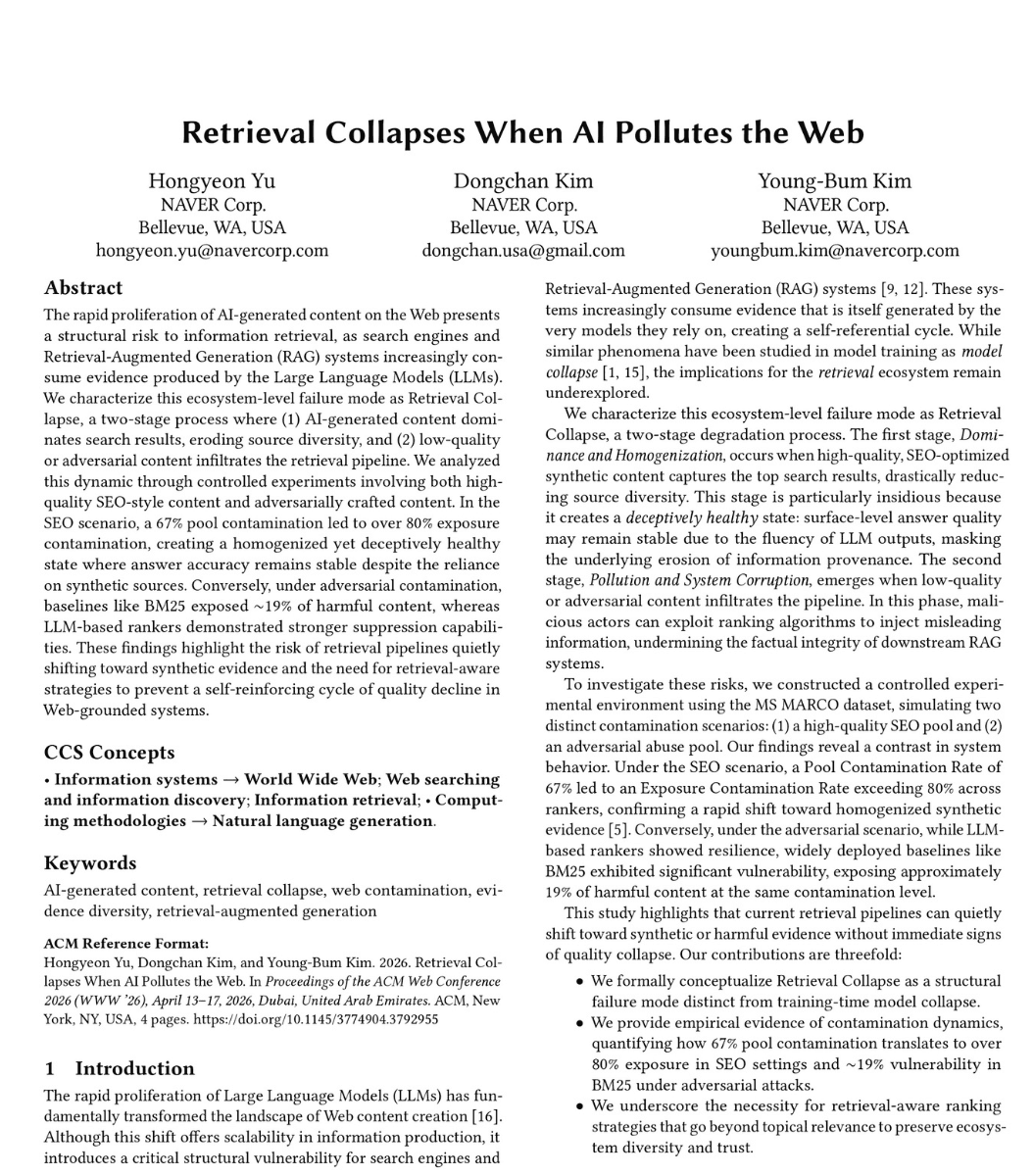
Search visibility hit a tipping point in a new ACM Web Conference 2026 paper from Hongyeon Yu, Dongchan Kim and Young-Bum Kim of NAVER Corp. The researchers say that once AI-generated pages reached 67% of the web pool, they drove more than 80% of exposure in search results, a shift they call Retrieval Collapse. The striking part is that answer accuracy stayed stable even as source diversity eroded, which means the system can look healthy while becoming far more dependent on synthetic pages.
The paper, Retrieval Collapses When AI Pollutes the Web, was published in Proceedings of the ACM Web Conference 2026, held April 13 to 17 in Dubai, United Arab Emirates. The authors describe Retrieval Collapse as a two-stage failure mode: AI-generated content first dominates the results and buries the human internet, then low-quality or adversarial material starts slipping into the retrieval pipeline itself. For brands and publishers, that is the real warning sign. If volume and sameness keep winning exposure, originality can lose the click before the page even has a chance to compete.

The SEO-style contamination scenario shows how fast that can happen. At 67% pool contamination, exposure contamination rose to more than 80%, while answer accuracy remained stable despite the heavy reliance on synthetic sources. That is the kind of deceptively clean outcome search teams dread, because the result page still functions while becoming far less diverse and far more brittle underneath.
The adversarial case is even more sobering. The paper says BM25 exposed about 19% of harmful content, while LLM-based rankers suppressed it more effectively. That matters because the same retrieval stack that rewards mass-produced AI pages can also become a cleaner route for bad actors if the ranking layer is not doing enough work.
The backdrop is already visible in Google Search. Google launched AI Overviews in the United States in May 2024, expanded them to more than 100 countries by October 2024, and said by May 2025 they were available in more than 200 countries and territories, with more than 1 billion monthly users worldwide. Pew Research Center found that in March 2025, 58% of the 900 U.S. adults it studied saw at least one Google search with an AI-generated summary, and users were less likely to click links when one appeared. Bain & Company has gone further, saying 80% of consumers rely on AI-written results for at least 40% of their searches, about 60% of searches now end without a click to another website, and organic traffic could fall 15% to 25%.
That is why the tension matters. A Semrush-based analysis still found human-written pages in Google’s No. 1 position 80% of the time, versus 9% for purely AI-generated pages. But Retrieval Collapse suggests the bigger threat is not just who wins the top slot. It is what happens when the pool itself gets flooded, the sources get flatter, and search exposure starts rewarding repetition over range.
This article was produced by Prism’s automated news system from verified source data, official records, and press releases, then run through automated quality and moderation checks before publishing. The system is built and supervised by the people who set the standards it runs under. Read our full AI policy.
Did this article answer your question?