AI recommendations become a business problem, Barnard says
AI search is shifting from visibility to revenue, as Barnard argues confidence, proof, and post-sale evidence now drive which brands get recommended.

A June 11 study on the AI recommendation gap ran 14,140 API calls over seven days across Google AI Overviews, ChatGPT, Gemini, Perplexity, and Claude. On June 25, Jason Barnard argued that AI systems are no longer just deciding which brands get cited; they are deciding which brands get recommended, and recommendations depend on confidence, not just content, shaped by search, knowledge graphs, and third-party proof.
From visibility to recommendation
AI systems do not stop at retrieval; they explain, recommend, and increasingly influence purchase decisions in high-intent queries where a brand can win or lose before a user ever reaches a website.
Barnard described that behavior as a pipeline problem rather than random model noise. When answers vary, the issue is often not simply hallucination but confidence loss somewhere in the path from discovery to recommendation, which means brands have to manage the signals that support each step.
The evidence graph reaches beyond marketing
On June 2, Barnard extended the problem into customer-facing operations. Much of the evidence AI systems rely on sits inside customer success, support, and delivery teams, not in the marketing stack, which means the strongest proof of value often remains hidden from machines.
That post-sale evidence includes onboarding accuracy, performance outcomes, integration depth, and customer advocacy.
A brand cannot rely on polished pages alone. If customer success data, support outcomes, and delivery records stay trapped in CRMs, service desks, or quarterly retrospectives, the business leaves part of its own evidence unreadable at the exact moment AI systems are trying to validate a recommendation.
Why the pipeline matters more than page-level SEO
On May 12, Barnard described a 10-gate AI engine pipeline: discovered, selected, crawled, rendered, indexed, annotated, recruited, grounded, displayed, and won.
The “won” outcome is no longer only a click; it now includes AI recommendations and agent transactions, which means the brand competes inside the machine’s decision flow, not just on the search results page.
Barnard’s broader concept of assistive agent optimization aims to make search engines, assistants, agents, and people all find, understand, recommend, and buy from the brand, which requires entity corroboration, machine-readable proof, and a business structure that helps AI systems validate claims.
Recognition is not the same as recommendation
The June 11 study on the AI recommendation gap examined 12 athleisure and activewear brands.
Recognition did not guarantee recommendation. An AI system could know a brand exists and still withhold a recommendation when the prompt moved from naming to choosing.
The study also found that Knowledge Graph strength predicted category visibility, but not necessarily adjacent-category recommendations. A brand can be understood in one context and still fail to win when the user’s intent shifts to a purchase decision in a nearby category.
What the broader market is already doing
McKinsey & Company found that 50% of consumers already use AI-powered search, projected that $750 billion in U.S. consumer spend will flow through AI-powered search by 2028, and warned that 20% to 50% of traditional search traffic could be at risk as AI captures decisions earlier in the journey.
Pew Research Center’s June 17 survey found that about half of U.S. adults now use AI chatbots, up from 33% in 2024, and roughly one-in-four use them daily, even as public views of AI remain skeptical.
The IBM Institute for Business Value and the National Retail Federation found on January 7 that 45% of surveyed consumers turn to AI during their buying journeys, with 41% using it to research products, 33% to interpret reviews, and 31% to hunt for deals.
What brands have to operationalize now
Barnard’s response spans SEO, analytics, product, and customer operations. It centers on supplying corroborated proof in forms machines can inspect and reconcile.
The priority areas are concrete:
- Map the brand as an entity across search, knowledge graphs, and third-party references so the same business is consistently recognized.
- Convert customer success, support, and delivery signals into machine-readable evidence, especially onboarding accuracy, outcomes, integration depth, and advocacy.
- Align marketing claims with operational proof so AI systems can validate promises against lived customer data.
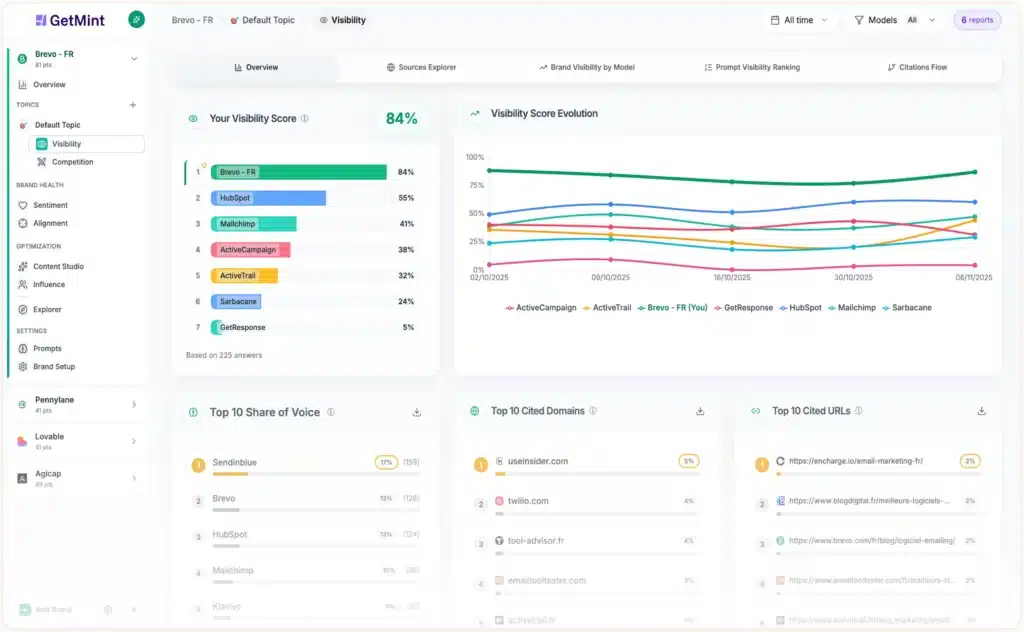
- Measure recommendation behavior, not only citation volume, because recognition can still miss the final decision stage.
- Treat assistant-facing visibility as a cross-functional operating problem, not a page optimization exercise.
This article was produced by Prism’s automated news system from verified source data, official records, and press releases, then run through automated quality and moderation checks before publishing. The system is built and supervised by the people who set the standards it runs under. Read our full AI policy.
Know something we missed? Have a correction or additional information?
Submit a Tip