AI search elevates SEO from tactician to business leader
AI search is moving SEO into the C-suite, where brand mentions, structured content, and executive reporting matter as much as audits.
AI search is forcing SEO out of the audit basement and into the executive suite. The people who used to win by spotting broken tags, tightening briefs, and chasing links now have to shape how the whole company shows up in AI answers, and that means owning brand mentions, structured content, executive reporting, and discovery strategy, not just keyword work.
SEO has outgrown the tactician job
Ahrefs’ June 8, 2026 guide makes the case plainly: the old SEO tactician lived in the weeds of technical audits, keyword research, content briefs, rank tracking, and outreach. That work still matters, but it is no longer enough on its own. The new search visibility leader has to connect those details to revenue, market share, and share of voice, then explain the payoff in language that actually lands with VPs, CMOs, and the C-suite.
That shift is bigger than a title change. Ahrefs says the guide is based on 10 years of building search visibility strategies for B2B, e-commerce, and SaaS brands, work that produced more than $125 million in organic client revenue. It also points to a real career upside, with search leadership roles paying $150K+ and even showing up in hiring at some major AI companies. The message is hard to miss: search has become valuable enough that leadership wants someone who can steer it, not just service it.
What the new mandate actually covers
The strategic role is much broader than traditional SEO deliverables. A search visibility leader still needs the core craft, but the job now stretches into roadmap planning, stakeholder management, and cross-team execution. In practice, that means mobilizing brand, PR, product, dev, and content teams around a shared search strategy instead of treating SEO as a silo that files requests and waits.
The best leaders, as Ahrefs frames it, are not always the most technically obsessive people in the room. They are the ones who can translate search performance into business outcomes, speak in terms executives recognize, and earn trust across the organization. That includes knowing when a ranking problem is really a product issue, when a visibility gap is really a reputation issue, and when a content fix needs support from engineering or PR to stick.
- Owning brand mentions and the narratives that surround them
- Shaping structured content so AI systems can parse and reuse it
- Reporting to executives in business terms, not SEO jargon
- Coordinating across brand, PR, product, dev, and content
- Building an AI discovery strategy that looks beyond classic rankings
A practical search visibility mandate now includes:
Why AI search changed the stakes
Google’s rollout of AI Overviews in the United States on May 14, 2024, made the pressure impossible to ignore. Google said the feature had already been used billions of times in Search Labs before launch, expected hundreds of millions of U.S. users to get access during rollout week, and projected more than a billion users by the end of 2024. It also said links in AI Overviews get more clicks than they would as traditional listings for the same query, which is exactly the kind of product change that gets executive attention.
That matters because AI search is not just another traffic source. It changes how brands are surfaced, summarized, and trusted. If a company’s products, messaging, or expertise do not show up cleanly in AI answers, the cost is no longer limited to a dropped ranking. The downside is broader: weaker discovery, thinner authority, and less control over how the brand is introduced to buyers.
The market is already reorganizing around the shift
BrightEdge surveyed more than 750 search, content, and digital marketers in June 2025 and found that 68% of organizations were actively changing strategy in response to AI search. It also found that 54% of companies relied on SEO or digital marketing teams to lead those efforts, while 57% of marketers said they were cautiously optimistic about AI Overviews. That is not a niche reaction from early adopters. It is a clear sign that the work is becoming cross-functional and executive-facing faster than many teams expected.
The same point shows up in the wider market backdrop. Statcounter reported Google’s worldwide search share at 90.39% in May 2026, with Bing at 5.03%, Yahoo! at 1.4%, Yandex at 0.99%, DuckDuckGo at 0.71%, and Baidu at 0.53%. Even as AI search expands, traditional search still dominates demand capture, which is why leadership cannot treat the change as a side project. The core channel is still enormous, and the AI layer is being built on top of it.
Regulatory pressure adds another reason executives are paying attention. The U.S. Department of Justice won significant remedies in its monopolization case against Google in September 2025, and those remedies are now being discussed in the context of AI competition and search defaults. When the platform that controls discovery is under legal scrutiny and shipping AI products at the same time, search visibility stops being a narrow marketing concern.
What to optimize now
The tactical playbook is not dead, but it has to be used differently. Classic SEO work still matters because AI discovery depends on clean information architecture, crawlable pages, and content that is easy to extract. At the same time, the new environment rewards brands that think across disciplines, because content structure, technical SEO, reputation, brand narrative, and measurement all influence whether a company shows up in AI answers.
Ahrefs’ own newer research underscores that messier reality. In an October 2025 AI visibility audit guide and again in June 2026 with Brand Radar, the company pushed tracking for mentions, citations, and share of voice across AI platforms like Google AI Overviews, ChatGPT, and Perplexity. It also reported analyzing 137,000 domains and finding that 97% of llms.txt files received zero requests from AI retrieval bots, a sharp reminder that some early technical shortcuts are not paying off the way people hoped.
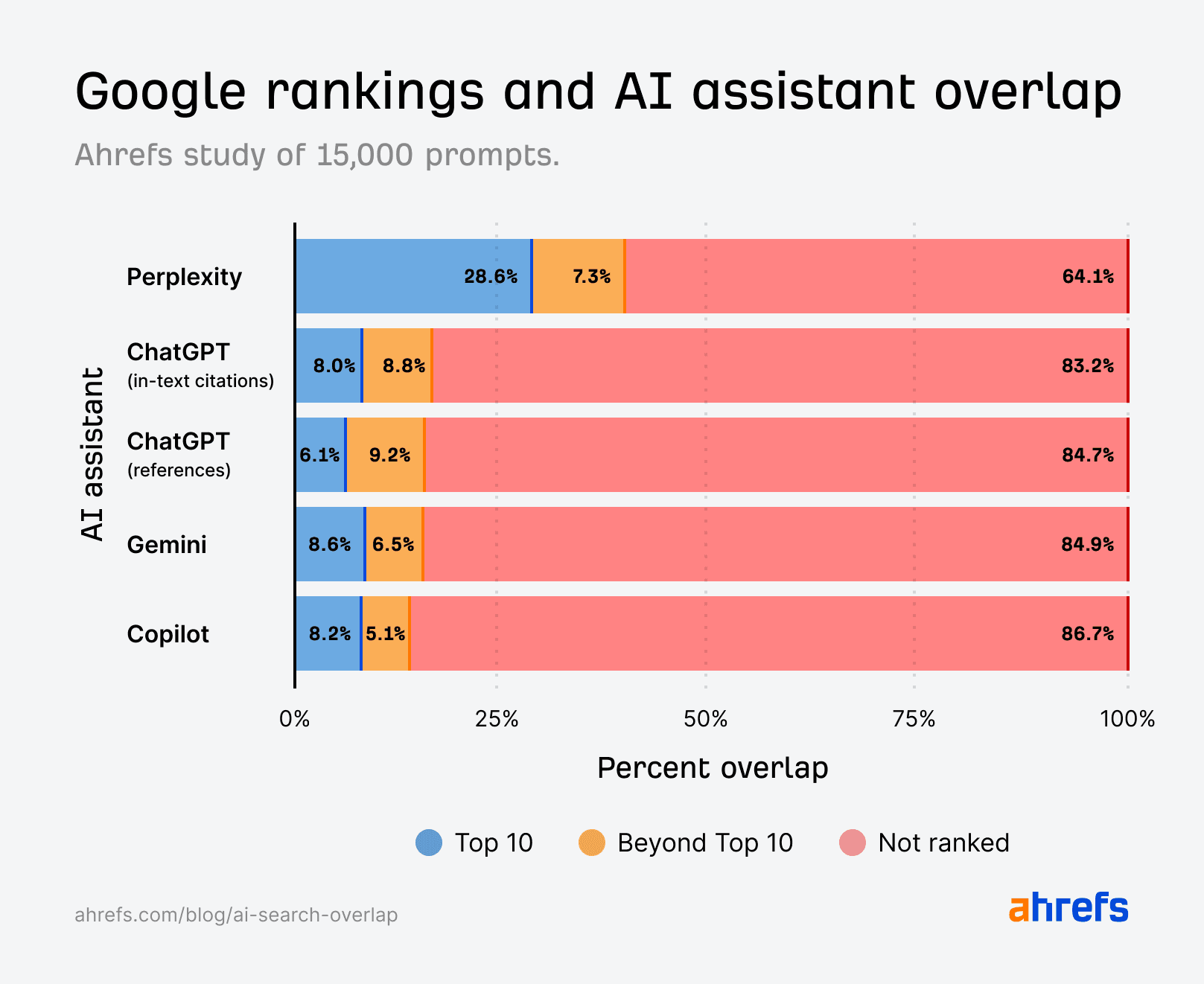
The citation landscape is shifting too. In Ahrefs’ June 2026 analysis, only 38% of AI Overview citations came from the top 10 organic results, down from 76.1% in an earlier study. The most-cited domains also included YouTube, Reddit, Facebook, Instagram, Wikipedia, Amazon, and Quora, which tells you something important: AI visibility is no longer a pure web-page game. Social, video, and user-generated ecosystems are part of the surface area now.
How the best teams operate
The companies that will adapt fastest are the ones that stop asking SEO to “handle search” and start treating search as a business function. That means the person running visibility has to be comfortable in a boardroom, not just a crawl report. It also means setting up measurement that leadership can understand, with reporting tied to revenue, market share, and share of voice instead of only traffic and keyword counts.
The upside is real. AI search has pulled SEO higher on the org chart because leadership finally sees that brands need guidance on how they appear in AI-driven results. The people who can explain that clearly, align teams around it, and turn search into a business outcome are the ones most likely to lead it.
This article was produced by Prism’s automated news system from verified source data, official records, and press releases, then run through automated quality and moderation checks before publishing. The system is built and supervised by the people who set the standards it runs under. Read our full AI policy.
Did this article answer your question?