AI search rewards evidence across the full B2B buying journey
AI search now rewards the sources that help a buying committee say yes. The winning move is mapping co-citations by role, then filling the missing proof.
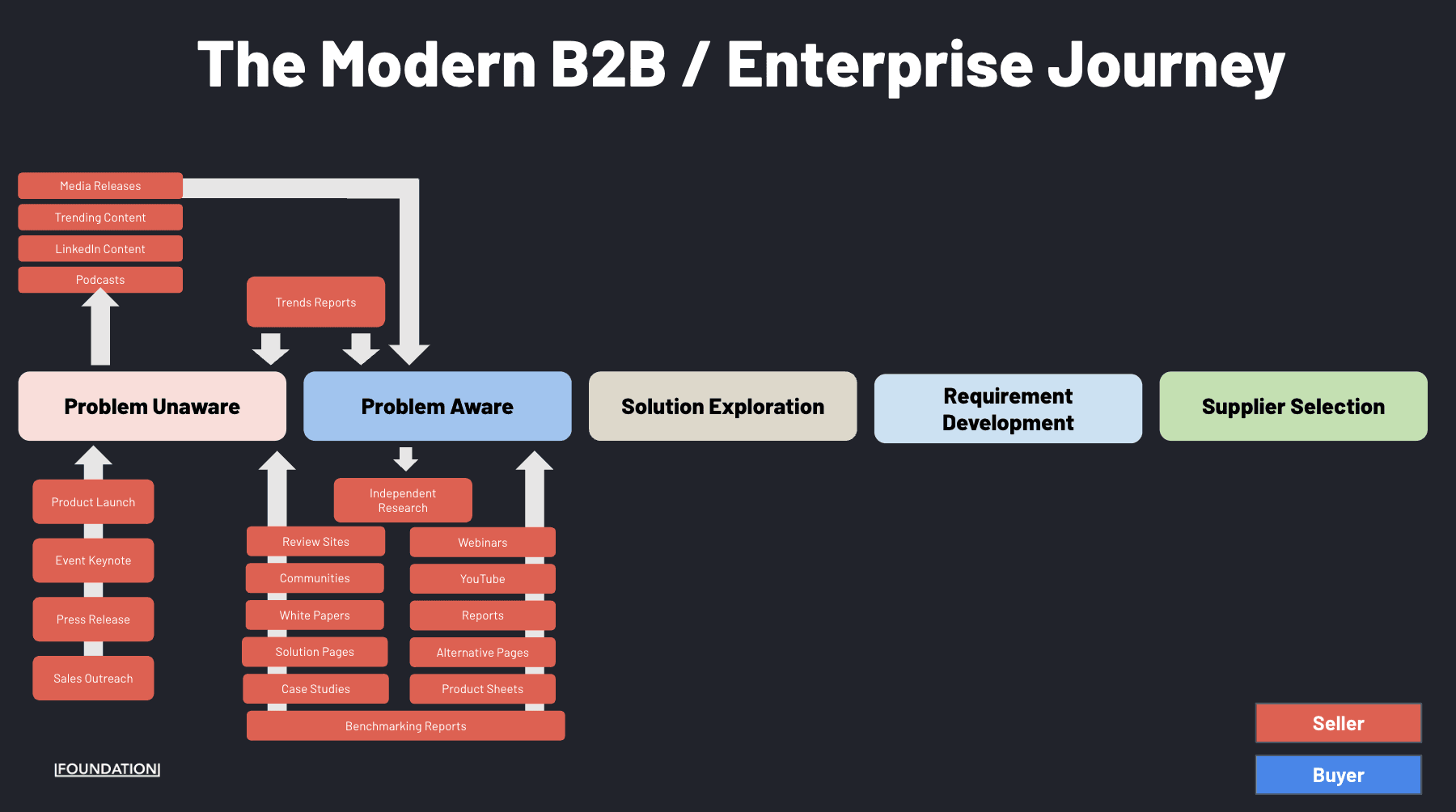
AI search is forcing B2B brands to stop thinking like keyword chasers and start thinking like deal-support teams. The old playbook built pages for search terms; the new one has to supply evidence for the procurement lead, the finance reviewer, the legal gatekeeper, and the executive sponsor who all weigh in before a contract gets signed. That is why the smartest teams are shifting from search visibility to trust visibility.
Why keyword SEO stops short
For years, too many B2B sites were built around answering purchase questions instead of the real questions people ask at each stage of a decision. That worked when search engines mainly rewarded coverage and relevance signals. It breaks down when AI search pulls together a cited answer from sources that help resolve roles, risks, objections, and approval chains, because a page that merely mentions a category is not the same thing as a page that helps a buyer move a deal forward.
That is the central lesson here: AI visibility is no longer just about being found. It is about being useful in the exact moment a decision-maker needs proof. If your content only speaks to the first click, you will miss the later-stage questions that actually determine whether the deal lives or dies.
The buying committee is bigger than your homepage
The pressure is coming from the shape of modern B2B buying itself. Gartner says complex buying groups often involve 6 to 10 decision-makers. Forrester went further in December 2024, saying the average B2B purchase involves 13 stakeholders and that nearly 89% of buying decisions cross multiple departments.
That is not a content problem, it is a coordination problem. Forrester also reported that more than 80% of buyers are dissatisfied with the provider they choose at the end of a purchase process, which tells you how often teams settle instead of feel confident. Gartner’s May 2025 survey added another warning sign: 74% of B2B buyer teams demonstrated unhealthy conflict during the decision process. If the internal room is already tense, AI answers that offer clean, source-backed reassurance have a real advantage.
The old assumption was that one strong landing page could carry the whole funnel. In a multi-stakeholder deal, that is fantasy. Different people need different evidence, and AI search is increasingly exposing which brands actually have that evidence available.
Move from anchor text to anchor context
This is where co-citation gap analysis becomes useful. The Search Engine Land framing is simple but powerful: instead of asking which pages contain the most keywords, ask which sources AI search trusts for each buyer role and where your content is missing from the decision journey. That is a completely different lens from classic SEO.
Anchor text tells a search engine what a page is about. Anchor context tells the model why a source belongs in a specific answer for a specific role at a specific point in the journey. That shift matters because B2B content, link building, and digital PR are no longer just about earning links from authoritative domains. They are about earning the right kinds of citations from the right kinds of sources in the right buying context.
How to run a co-citation gap analysis
Start by mapping the buyer roles that show up in real deals. At minimum, separate the economic buyer, the procurement lead, the technical evaluator, the legal reviewer, and the executive sponsor. Then list the questions each one needs answered before they will sign off, because AI systems tend to surface sources that help close those exact gaps.
1. Build role-specific prompts. Ask the same product question in ways a finance lead, security reviewer, and operations leader would ask it.
2. Capture the cited sources. Look for the publications, analysts, vendors, comparison pages, and partner sites that keep showing up together.
3. Group the sources by decision stage. Some are useful for discovery, others for validation, and others for final approval.
4. Compare that map with your own content library. The gaps usually show up fast.
5. Create the missing assets and promote them through the sources AI already trusts.
The point is not to publish more content for its own sake. The point is to build the exact proof that the buying committee still lacks. If AI repeatedly cites a security benchmark, an implementation guide, and an analyst comparison page, and your brand has none of those, the gap is obvious.
Fill the missing questions, not just the missing keywords
This is where the real work starts. A procurement lead may need pricing logic or vendor comparison criteria. A finance stakeholder may need ROI proof and payback framing. Legal wants risk language that does not hand-wave the contract. An executive sponsor wants confidence that the decision will not create internal friction or buyer’s remorse.
That kind of asset strategy is more than content marketing. It is proof engineering. Build the documents, briefs, checklists, and comparative evidence that answer the objections the rest of the market leaves unresolved. Then make sure those assets are discoverable through the third-party sources, expert mentions, partners, and publications that AI systems repeatedly co-cite.
Why citations are becoming the new conversion signal
TrustRadius added another important data point in 2025: 72% of buyers encountered Google’s AI Overviews during their research process, and 90% clicked through to one of the cited sources. That means AI answers are not just reshaping discovery, they are actively driving verification behavior. Buyers are treating citations like a shortcut to confidence.
Gartner has also said 75% of B2B buyers prefer a rep-free sales experience, which makes self-service evidence even more important. At the same time, Gartner has warned that self-service digital purchases can lead to regret, which is exactly why source-backed answers matter. The more complex the decision, the more the buyer needs a trail of proof they can trust.
Microsoft’s November 2025 update to Copilot points in the same direction. By making citations more prominent and clickable, and by adding an option to see aggregated sources, Microsoft reinforced the idea that AI answers are becoming source led, not just summary led. For B2B brands, that means the winning content ecosystem is the one that can survive scrutiny from a skeptical committee.
The practical takeaway is blunt: AI visibility now depends on whether your brand can supply evidence across the whole buying journey. If you can map the co-citations, spot the gaps, and publish the missing proof, you are not just chasing inclusion in AI answers. You are building the case that helps a committee say yes.
This article was produced by Prism’s automated news system from verified source data, official records, and press releases, then run through automated quality and moderation checks before publishing. The system is built and supervised by the people who set the standards it runs under. Read our full AI policy.
Did this article answer your question?