AI visibility needs volatility tracking, not rank tracking
Rank tracking breaks when answers shift by model, prompt, and source. The fix is volatility tracking, share of mention, and source-quality measurement across prompt clusters.

On August 7, 2025, OpenAI launched GPT-5 and said nearly 700 million people were using ChatGPT weekly. AI visibility is not a position in a static list anymore. If the answer itself changes by model update, personalization, and source mix, a single rank number gives you a clean-looking lie. The better measurement model is not “where did we rank,” but “how often do we show up, in what context, with what support, and how stable is that pattern over time?”
The old rank mindset breaks the moment the interface starts moving
Rank tracking worked when search results were mostly one query, one page, one ordering. AI search does not behave that way. The surface is probabilistic, multi-source, and prompt-dependent, which means the same brand can appear, disappear, or be framed differently across adjacent prompts and tools.
OpenAI called GPT-5 its smartest, fastest, most useful model yet, and said the launch coincided with nearly 700 million people using ChatGPT weekly. When the underlying model and the user base both move that fast, the measurement target is not a fixed scoreboard. It is a shifting system.
That is why the drop in citation links many trackers saw after GPT-5 launched was not proof that optimizers suddenly got worse. It was proof that the data surface changed. If the model changes how it cites, summarizes, or suppresses references, then a tracker built around old assumptions will report a decline even when the brand’s real visibility has not fallen at all.
The problem is fragmentation, not just volatility
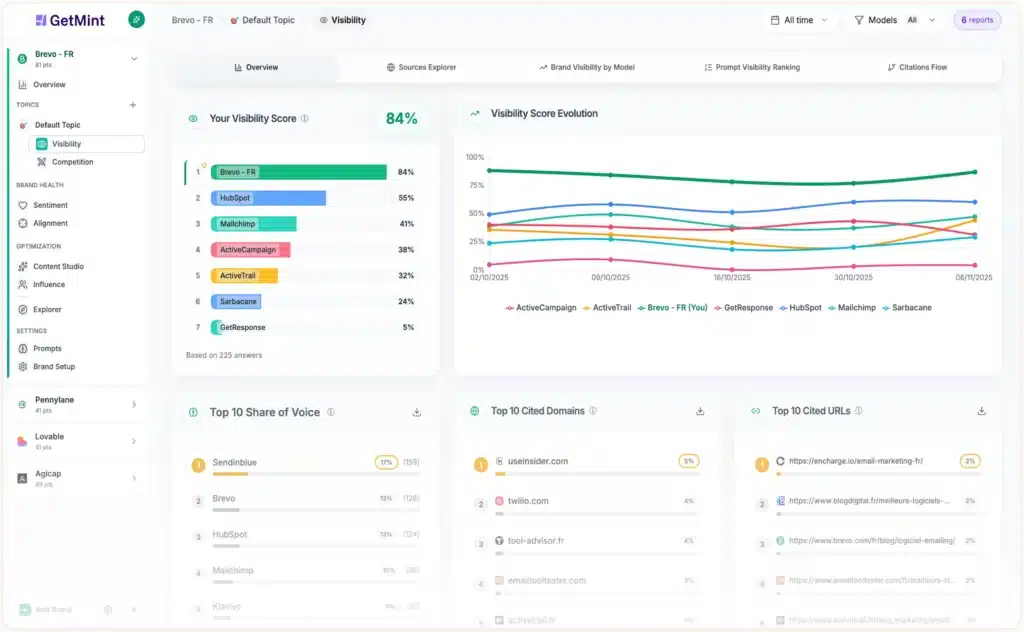
Citations are scattered across ChatGPT, Claude, Perplexity, Google AI Overviews, and Google AI Mode, which means visibility data is distributed across systems that do not share a common reporting layer. A team can be strong in one assistant and absent in another, then call that one score “AI visibility” as if the market were unified. It is not.
AI Overviews are AI-generated snapshots with links to dig deeper, while AI Mode expands that with follow-up questions and helpful links to the web. Perplexity is an AI-powered answer engine that provides cited, real-time answers. Those are related products, but they reward different forms of inclusion, citation, and interpretation.
That fragmentation matters because a single score hides the actual operating problem. One model may cite a brand but frame it negatively. Another may omit citation but still recommend it. A third may surface the brand only in follow-up prompts.
What volatility tracking is actually measuring
Volatility tracking is the first replacement for rank thinking. It measures how stable a brand’s presence is across time, models, and prompts, instead of assuming every snapshot is equally meaningful. If a brand appears in one session and vanishes in the next ten, that is not a ranking problem alone. It is a consistency problem.
SparkToro found that AI tools produced different brand recommendation lists more than 99% of the time when given the same prompt. That level of variation makes any one-off query look authoritative when it is really just one draw from a noisy system. Earlier research showed Google AI Overviews were changing faster than organic search results, adding another layer of instability to a measurement method built for fixed listings.
The practical move is to stop treating a single answer as a verdict. Track the same prompt repeatedly across a defined interval, then measure the spread. If your brand appears in 8 of 20 runs, that is a visibility profile, not a rank. If it appears in 18 of 20 runs but only in low-confidence or tangential contexts, that is a different problem.
Average response tracking is the missing middle ground
Taylor’s second recommendation, average response tracking, is the part most teams should adopt first. It broadens the lens beyond all-or-nothing inclusion and asks what the answer looks like on average across related prompts. That means you measure share of mention across a prompt cluster, not just success on one exact question.
A cluster might include prompts about category fit, comparison, pricing, alternatives, implementation, or credibility. If your brand appears in the “best for enterprise” prompt but disappears in the “integrates with existing stack” prompt, you do not have blanket visibility. You have a narrow foothold.
Average response tracking should also capture context. A brand mentioned as a top option, a safe default, or a cautionary example is not the same thing. The point is not just inclusion. It is how often the answer contains your brand, what the answer says about it, and whether the surrounding framing supports the commercial story you want buyers to hear.
Source attribution matters as much as mention
AI search rewards citations, but citations are not equal. OpenAI warns that ChatGPT can generate hallucinations, including fabricated citations and incorrect facts. That means source attribution itself has to be measured for quality, not just presence. If a system cites weak or wrong sources, the visibility score is inflated and the buyer trust score is impaired.
Teams need to evaluate source quality in parallel with mention share. Ask whether the answer cites primary sources, whether the cited source is actually relevant, and whether the attribution supports the claim being made. A citation that points to a thin blog post is not the same as a citation that points to documentation, product specs, or a credible industry source.
The point is not to chase every citation. It is to know whether your brand is being supported by the right evidence in the environments where answers are being composed.
Personalization makes the baseline even more important
OpenAI’s personalization work makes this problem harder, not easier. ChatGPT now supports memory and custom instructions to produce more tailored responses, and OpenAI says its newer memory systems are meant to keep context fresh and relevant across conversations. That means two users can ask similar questions and get meaningfully different outputs because the system is tailoring itself to prior context.
Taylor’s advice is to establish a baseline before reacting. You need a stable sampling method, a fixed prompt set, and a repeatable cadence before you can interpret movement. If you do not know what normal looks like across prompt clusters, model versions, and memory states, then every fluctuation looks like a business event.
- define a prompt cluster by intent, not just keywords
- sample the cluster repeatedly across time
- record share of mention, citation quality, and answer framing
- compare the variance, not just the average
- treat sudden shifts as model or source changes until proven otherwise
The right operating rhythm is straightforward:
The practical takeaway for agencies and in-house teams
Flawed AI tracking methods create false signals in attribution models. That was the point of Taylor’s April 30, 2026 analysis. If the tracker is too rigid, the metric looks precise while measuring the wrong thing.
Measure share of mention across prompt clusters. Measure answer quality, including sentiment and framing. Measure source attribution quality, not just citation count. Measure consistency over time.
This article was produced by Prism’s automated news system from verified source data, official records, and press releases, then run through automated quality and moderation checks before publishing. The system is built and supervised by the people who set the standards it runs under. Read our full AI policy.
Know something we missed? Have a correction or additional information?
Submit a Tip