AI-written content surges, now nearly half of sampled webpages
Nearly half of 55,000 sampled webpages were AI-written, and the real fight is whether search systems reward that flood or bury it.

The bigger story is not that AI-written pages are piling up fast. It is that search systems now have to sort real expertise from a web that is starting to sound interchangeable, and that changes who gets cited, recommended, and remembered.
A study of 55,000 webpages found that AI-written content surged after ChatGPT and now makes up about half of the sampled articles. That is not just a volume story. When generic phrasing becomes the default, the information market gets noisier and more commoditized, which makes it harder for both people and machines to tell signal from filler.

That shift raises the bar for anything trying to earn durable search presence. Original reporting, unique data, expert commentary, and evidence-backed analysis become the things that stand out when machine-made copy is everywhere. In a crowded field, clean prose is no longer enough if the page does not offer a point of view, a test, a benchmark, or a fact that cannot be lifted from a hundred near-identical rewrites.
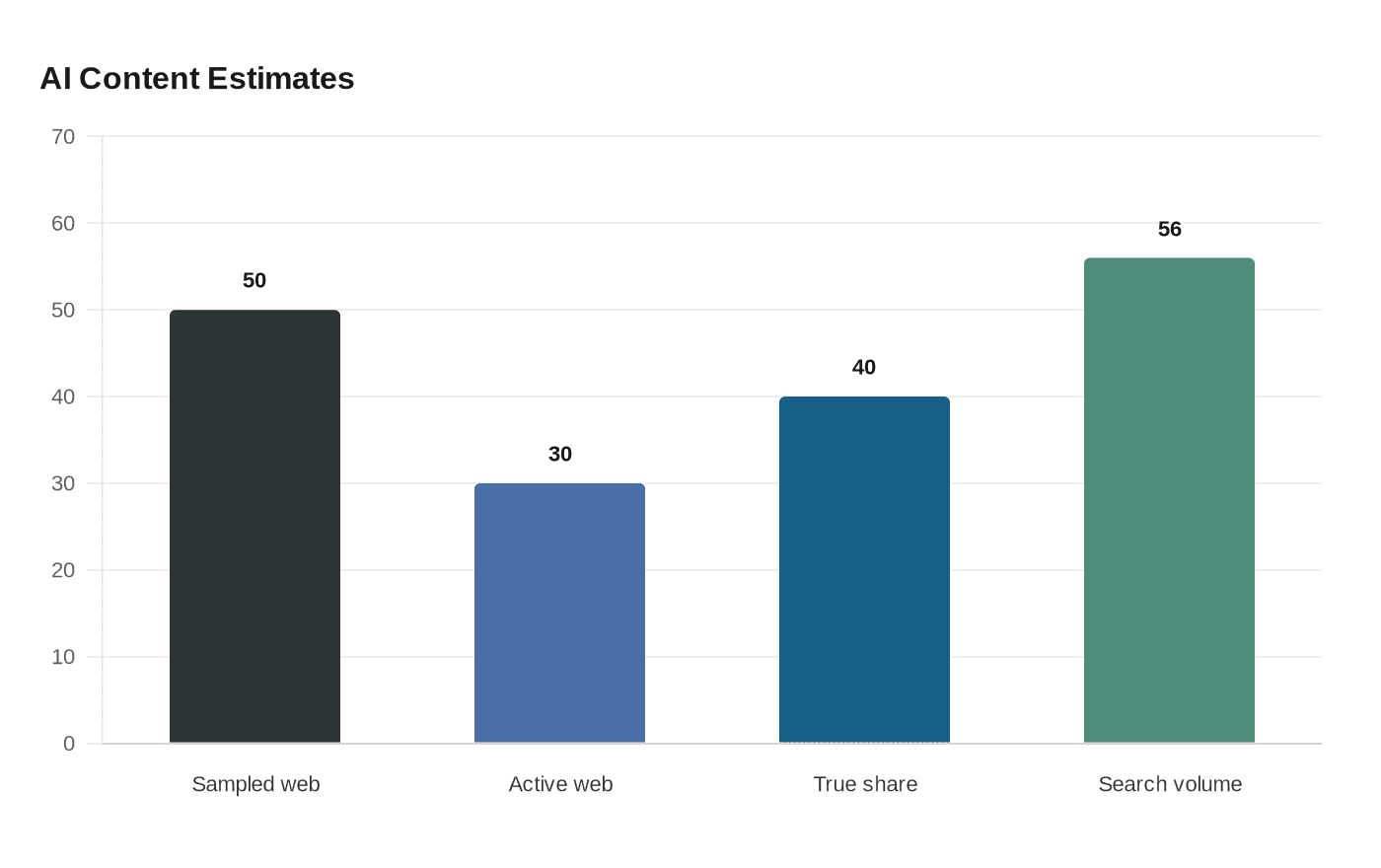
The scale of the problem shows up in other recent work too. A 2025 arXiv paper estimated that at least 30% of text on active web pages originates from AI-generated sources and said the true share may be approaching 40%. That paper also warned about autophagous loops, the kind of feedback cycle that can form when models increasingly train on AI-generated web text and then reproduce more of the same synthetic material.
The search economy is moving in the same direction. Another analysis said AI tools now generate 45 billion monthly sessions worldwide, equal to about 56% of global search engine volume. At the same time, Google updated its quality rater guidance so raters can assess whether content is AI-generated, and automated or AI-generated pages may now earn a Lowest rating. That is a clear signal that machine-made content is no longer just a production shortcut. It is a quality issue.
The takeaway for publishers and brands is straightforward: if half the web is increasingly machine generated, the pages most likely to survive answer selection will be the ones with authentic proof, fresh examples, and credible sources that other systems can trust. The advantage now goes to content that is recognizably human, original, and verifiable, not just well formatted.
This article was produced by Prism’s automated news system from verified source data, official records, and press releases, then run through automated quality and moderation checks before publishing. The system is built and supervised by the people who set the standards it runs under. Read our full AI policy.
Did this article answer your question?