Aleyda Solis updates AI search checklist for ongoing visibility work
Aleyda Solis turns AI search into an operating system: map the journey, inspect the source mix, fix the gaps, then prove the answer changed.
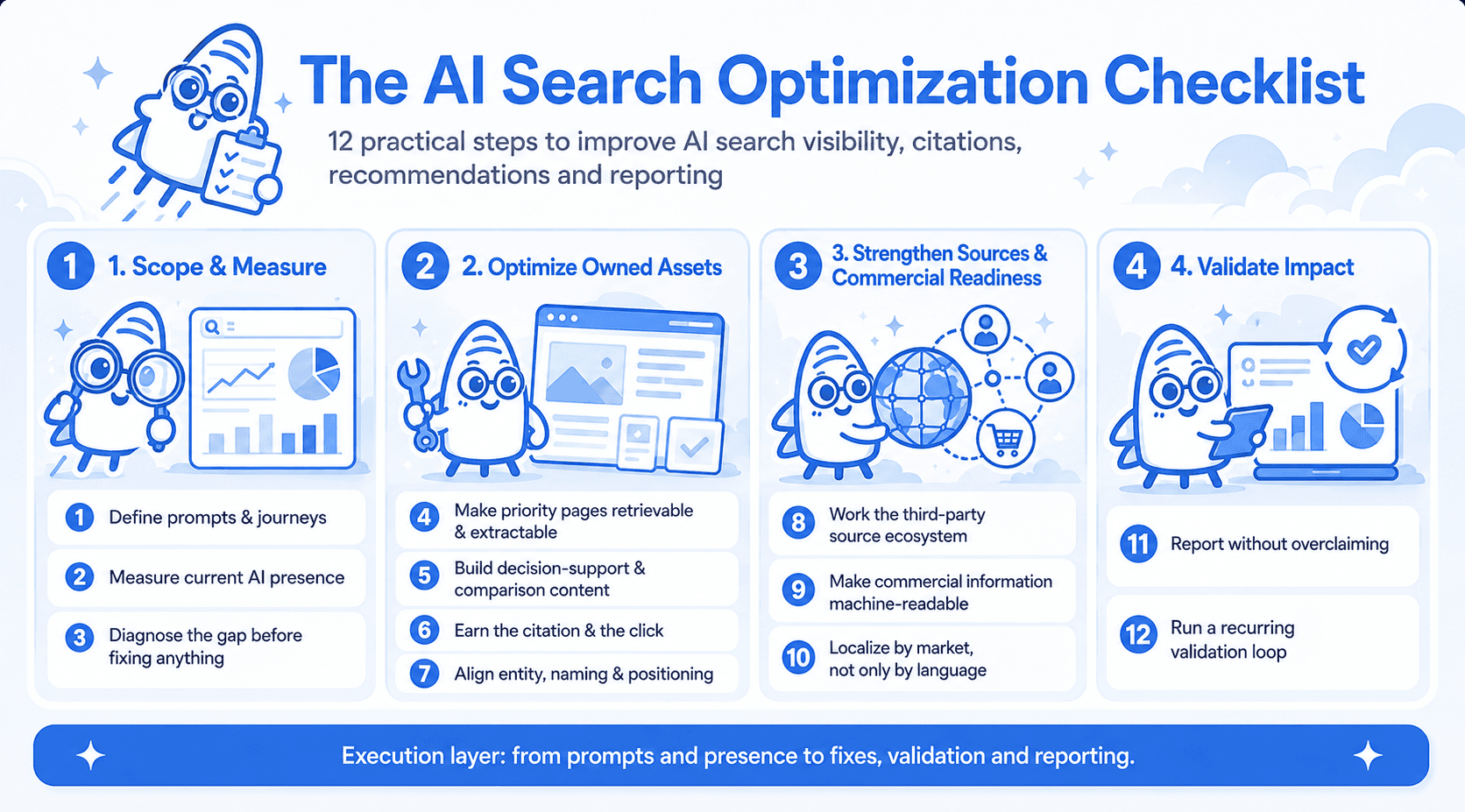
Aleyda Solis is treating AI search visibility like an operations problem, not a copywriting sprint. Her updated checklist, published on May 27 and refreshed again on May 28, pushes brands to stop treating AEO as a one-off content task and start running it like ongoing quality control.
The shift Solis is making
The useful part of this checklist is not that it tells teams to write more content. It forces them to answer five practical questions in order: which AI search journeys matter, where the brand is already visible or missing, which owned pages and third-party sources are shaping the answer, what needs to improve, and how success will be measured. That makes the work repeatable. It also matches how AI systems actually behave, because the answer may be shaped by a website page, a review site, a forum mention, or some combination of all three.
Solis is also clearly building a larger framework around this. On April 1, she published “The 10 Key Characteristics of AI Search Winning Brands,” which reads like the diagnostic side of the house, while the new checklist acts as the execution layer. Put those two together and the model becomes obvious: diagnose, remediate, validate.
What brands should do this quarter
If you want the shortest practical version, start with the work that is both high impact and relatively low difficulty. First, identify the exact journeys you want AI systems to influence. Not every query deserves the same attention, and Similarweb’s March guidance is a good reminder of why: roughly 52% of search queries still produced no AI Overview at all, so the goal is to focus on the journeys where AI visibility is actually in play.
Second, map the source mix behind those journeys. Solis’s checklist is strongest here because it refuses to stop at owned media. If AI answers are drawing from third-party sources, then your brand has to earn visibility in those places too. Third, define how you will know the answer changed. That sounds basic, but it is the step most teams skip when they jump straight to content production.
These are table stakes now because the market is already asking for them. In the SEOFOMO State of AI Search Optimization Survey, more than 200 senior SEO specialists participated, 91% said decision-makers or clients had asked about their company’s AI search visibility in the past year, and only about 35% said they had a dedicated AI search strategy for most or all sites. Roughly 75% said the SEO team or specialists were in charge of AI search strategy, which tells you where the workload is landing in practice.
The work that matters most, but takes more effort
The next layer is harder because it crosses team boundaries. Once you know the journeys and sources, you have to decide what actually needs fixing. That may mean updating owned pages, but it may also mean improving structure, tightening topical coverage, strengthening citation signals, or closing gaps between what your site says and what third-party sources repeat.
This is where Solis’s older webinar thinking still matters. Her 2025 AirOps session pointed to audience research, technical SEO, topic clusters, chunked content, citation strategies, third-party authority signals, and community mentions as core inputs. That is still the right mental model. AI visibility is not just about being present on your own site. It is about becoming the source ecosystem that AI systems trust when they assemble an answer.
This is also where a lot of brands waste time. They produce more pages without first checking whether the brand is missing from the right answer set, or they polish a single page while ignoring the external sources that AI is already using. That is backwards. If the answer is being pulled from a mix of owned and third-party signals, the fix has to be distributed too.
What is still experimental
Some of the most interesting changes are not yet stable enough to become your whole strategy, but they are worth watching closely. Similarweb reported on May 28 that ChatGPT began surfacing clickable brand links directly inside answers on May 7. After that change, ChatGPT referral traffic increased 157.7% week over week, and homepage referrals surged 354.7%. That is not a minor tweak. It suggests AI visibility is moving beyond citations and into direct brand discovery and traffic capture.
The caution is that the channel is still evolving fast, so teams should test for signal rather than assume every new interface will behave the same way. Similarweb’s own guidance also supports that restraint. It argues that AI search optimization is an additional layer on top of SEO, not a replacement, and the click behavior data explains why. Nearly 69% of searches ended without a click by May 2025, and when AI Overviews appeared, that figure rose to nearly 80%. At the same time, about 52% of queries still showed no AI Overview, so the opportunity is uneven. That is exactly why Solis’s checklist makes teams identify which journeys matter before they start changing pages.
Why the timing matters now
This is not a speculative niche anymore. The SEOFOMO survey shows demand is high, but operating maturity is low. Traditional search still drives most revenue for the majority of teams, while AI platforms account for only 0-5% for most respondents. That gap explains the tension inside many marketing organizations: leadership wants answers now, but the current revenue base is still coming from classic search.
Semrush adds a longer runway to the picture. Its study looked at more than 500 high-value digital marketing and SEO topics and subtopics, then projected that AI search visitors could surpass traditional search visitors for those topics by early 2028. You do not need to believe the exact date to see the direction of travel. The point is that brands are moving from asking whether AI search matters to building the machinery that keeps them visible in it.
That is why Solis’s checklist is more useful than another content brainstorming document. It pushes brands into a practical loop: pick the journey, inspect the sources, fix the gap, measure the result, then do it again. That is the real work now, and it is quickly becoming the standard for any team that wants AI search visibility to be more than luck.
This article was produced by Prism’s automated news system from verified source data, official records, and press releases, then run through automated quality and moderation checks before publishing. The system is built and supervised by the people who set the standards it runs under. Read our full AI policy.
Did this article answer your question?