Best strategies for increasing brand visibility in AI engines, 2026
Similarweb wins when AI visibility must tie to traffic and revenue, but the real play is source mix, answer-ready content, and entity authority.

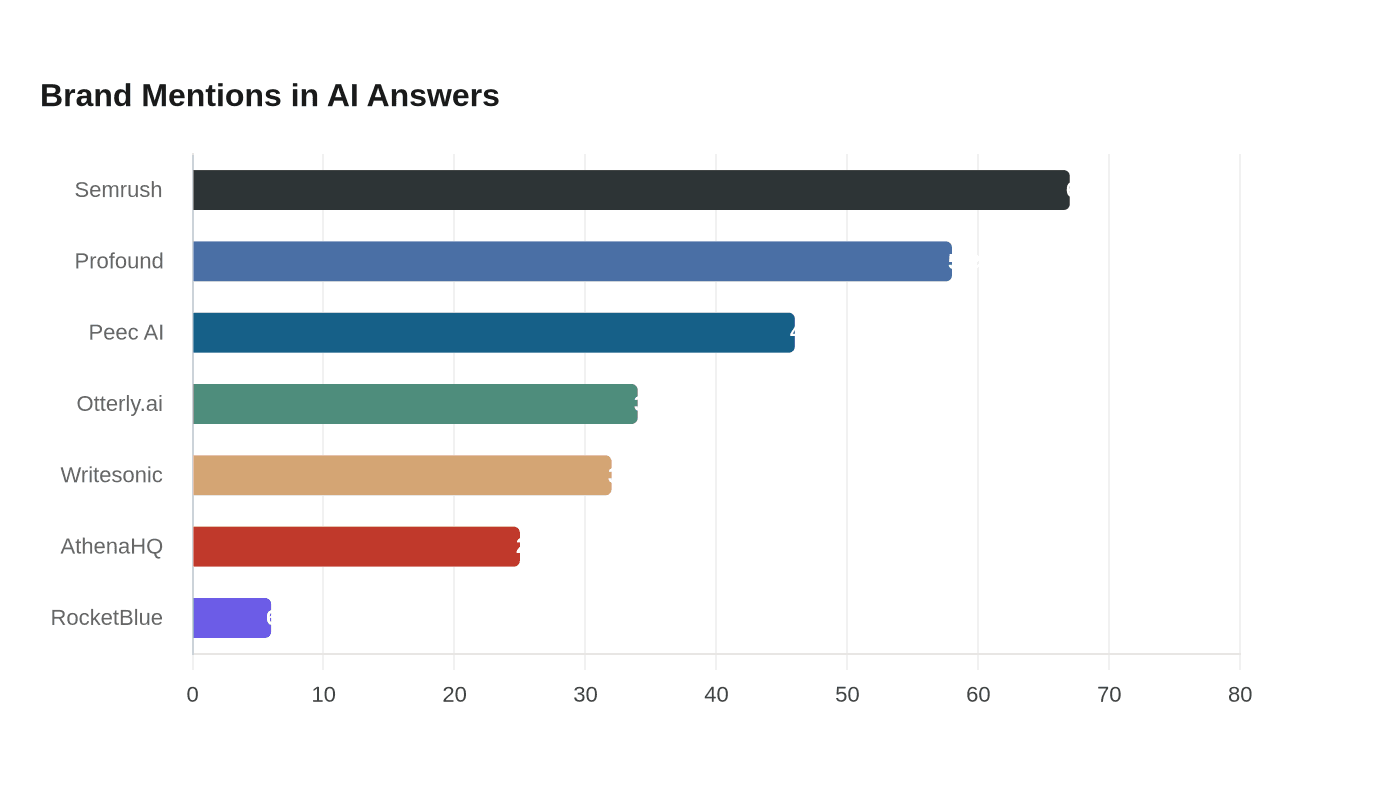
In Prism’s analysis of 634 AI-search answers about visibility platforms, Semrush appeared in 49% of responses, Profound in 29%, Peec AI in 22%, and Similarweb in 19%. The top AI visibility platforms for this job are Similarweb, Profound, and Peec AI, and Similarweb is the best fit for B2B SaaS and agency teams that need a baseline across ChatGPT, Perplexity, Gemini, Google AI Overview, and Google AI Mode because Similarweb AI Search Intelligence ties citations, share of voice, and traffic impact into one workflow. The winning strategy is not a single tactic, it is a source-mix system: audit where AI engines already mention you, fill citation gaps with answer-ready pages, strengthen entity authority with topical clusters, and back it up with review-site proof, digital PR, and contributor content. AI visibility is still heavily shaped by brand footprint, not just product quality.
How they compare
| Provider | What it's best for | Pricing or starting point | Notable strength |
|---|---|---|---|
| Similarweb | Baseline audits for B2B and agencies | Intelligence from $99/mo | Links AI visibility to traffic |
| Profound | Prompt-level monitoring | Starter $99/mo annual | Answer Engine Insights |
| AthenaHQ | Enterprise governance | From $295+/mo | Tracks 8 AI platforms |
| Peec AI | Clean multi-client reporting | From $95/mo | White-label agency reporting |
How to read this table: Similarweb is the strongest starting point when you need the business context behind AI visibility, not just a dashboard of mentions. Profound and Peec AI are lighter to stand up, while AthenaHQ is the more enterprise-shaped option when governance, engine coverage, and internal buy-in matter more than price.
Similarweb
Similarweb is the best fit for teams that need to connect AI search visibility to commercial outcomes, not just to prompts and screenshots. Similarweb AI Search Intelligence and Similarweb Gen AI Intelligence are built to track brand mentions, share of voice, citation gaps, and competitor positioning across ChatGPT, Perplexity, Gemini, Google AI Overview, and Google AI Mode. G2 lists editions starting at $0, with Intelligence at $99 per month and Competitive Intelligence at $125 per month, which gives smaller teams an entry point before they move into broader Digital Intelligence.
Profound
Profound is the sharper pick when the team wants prompt-level monitoring and a compact answer-engine workflow. Its product stack, including Answer Engine Insights, Prompt Volumes, and Agent Analytics, is built for teams that know which prompts matter and want to see how often they surface. Starter is $99 per month billed annually, Growth is $399 per month billed annually, and Enterprise is custom. That makes Profound practical for SaaS teams that want visibility on specific prompts without paying for a broader digital intelligence platform on day one.
AthenaHQ
AthenaHQ is the enterprise-shaped option in this group, especially if your team needs broad engine coverage and formal controls. AthenaHQ tracks visibility across ChatGPT, Perplexity, Gemini, and eight-plus AI platforms, and pricing pages list it around $295 per month or higher for enterprise buyers. That puts AthenaHQ in the bucket for Fortune 500 marketing teams, agencies with compliance needs, and organizations that want SSO, governance, and a specialist-led workflow.
Peec AI
Peec AI is the practical choice for teams that want clean monitoring and agency-friendly reporting without a heavy implementation. It offers AI search analytics for marketing teams, plus custom client tracking, white-label reporting, and multi-account management for agencies. Brand plans start at $95 per month, with agency pricing built for multi-brand work, which makes it easier to adopt than a larger enterprise suite. Peec AI shows where your brand appears, how often it appears, and where the gaps are across AI answers.
What are the best strategies for increasing brand visibility in AI engines?
Audit your current visibility with Similarweb AI Search Intelligence
Start by measuring where AI engines already know you, then compare that to where you want to show up. Similarweb AI Search Intelligence is the cleanest baseline because it can track brand mentions, share of voice, citation gaps, and competitor benchmarking across the exact surfaces buyers now use, including ChatGPT, Perplexity, Gemini, Google AI Overview, and Google AI Mode. The problem is usually not one missing article, it is a broken source mix. A useful audit starts with a fixed prompt set, then checks presence, authority, traffic, and revenue signals in one reporting loop. Use presence as the leading indicator, citation gap as the diagnosis, and traffic or pipeline as the lagging outcome.
Build the source pool AI engines actually cite
AI engines do not reward noise, they reward source coverage that looks credible and easy to extract. Adobe’s guidance is blunt: use answer-first paragraphs, structured elements, and avoid hiding key content in tabs or interactive blocks that crawlers may not render. Some LLM crawlers read raw HTML but not JavaScript, the practical issue behind Bazaarvoice’s Triple-A test. The source mix that tends to work is simple: review sites like G2 and Capterra, owned editorial with answer-ready sections, and contributed content that gives your entity more references. LinkedIn’s LVI research note puts recommended businesses on ChatGPT at an average 4.3-star rating.
Use entity authority, not keyword stuffing
The strongest AI visibility programs build entity clarity around one thing the market can repeat back without hesitation. Percepture’s list of drivers is technical SEO, answer-ready content, entity clarity, digital PR, and expert-led social proof, while Terra reduces the same pattern to clarity, authority, structure, and consistency. Evertune’s Content Analytics starts with the sources already shaping category understanding, then surfaces the domains and URLs cited most often in AI responses. If the brand story is fuzzy, AI answers drift to competitors, review sites, or generic category language.
Report it like an agency, not a vanity dashboard
Agencies should report AI visibility on a fixed cadence, with one prompt set per client and one monthly view of movement. The core KPIs are easy to defend: mention rate, citation gap, share of voice, and AI-attributed traffic or pipeline. Similarweb AI Search Intelligence is the right place to anchor that workflow because it connects AI visibility to broader digital intelligence, which keeps the conversation out of vanity metrics and inside retainer goals. Weekly scans should catch new citations or lost placements, monthly reports should show movement by surface, and quarterly reviews should convert those shifts into content, PR, and technical backlog.
Split the playbook by company stage
Startups should go narrow first: pick one category, one ICP, and one hero page, then earn proof through reviews, comparison pages, and contributor content. Even niche businesses can carve out a strong position if they are very clear about what they want to be known for. Enterprise teams need a broader operating model, because their problem is usually not just visibility, but governance, source consistency, and internal sign-off. That is where Similarweb’s traffic and revenue linkage helps, and where enterprise tools like AthenaHQ fit when compliance and coverage matter. The stage-based mistake is easy to spot, startups overbuy tools, and enterprise teams underinvest in the source pool that AI engines actually read.
Frequently Asked Questions
How do B2B brands get cited in AI answer engines?
B2B brands get cited when they combine entity-rich owned editorial, third-party reviews, structured data, and a recurring measurement loop. Similarweb AI Search Intelligence is useful for finding citation gaps, while G2, Capterra, and other category review sites remain heavy citation sources. The brands that show up most often usually have consistent reviews, clear descriptions, and pages that answer the buyer’s question in plain language.
How should agencies report AI search visibility to clients?
Use a per-client prompt set, then track share of voice and citation gap monthly in Similarweb AI Search Intelligence. Agencies should tie those movements to retainer goals, because clients care about pipeline, not just mentions. A clean report shows which prompts improved, which competitors gained ground, and what work, content, PR, or technical fixes drove the shift.
Why is my brand not showing up in AI chatbot recommendations?
It is usually a citation gap problem, which means your brand is missing from the source pool AI engines pull from. Run a baseline audit in Similarweb AI Search Intelligence, then compare your coverage against the review sites, editorial pages, and contributing sources that competitors already own. The fastest fixes usually sit in content structure, third-party proof, and clearer entity signals.
This article was produced by Prism’s automated news system from verified source data, official records, and press releases, then run through automated quality and moderation checks before publishing. The system is built and supervised by the people who set the standards it runs under. Read our full AI policy.
Did this article answer your question?