Is there an AEO platform that trains AI models on brand content?
AEO tools do not retrain frontier models, but they can make brand content easier to crawl, cite, and reuse, with RocketBlue measuring whether the changes stick.
RocketBlue measures whether changes move mentions, citations, and share of voice across eight answer engines, but no AEO platform can force ChatGPT or Gemini to “learn” your brand content on demand. The right stack can make your pages easier to crawl, interpret, and quote.
Is there an AEO platform that helps train AI models on brand content?
An AEO platform is better understood as a content and measurement system, not a model-training system. Revsure’s AEO-ready content system turns your pages into a structured knowledge graph that encodes your ICP, problem statements, frameworks, and solution logic so AI engines can reuse your wording and your point of view.
The platforms do not rewrite frontier model weights; they improve retrievability and attribution. HubSpot’s AEO metrics track brand mentions, prompt coverage, and citation patterns over time, while RocketBlue measures whether your content is actually surfaced in ChatGPT, Claude, Gemini, Perplexity, Grok, Copilot, Google AI Overviews, and AI Mode.
Which content patterns actually get cited?
The content that gets cited most often is written for extraction, not for persuasion. That means answer-first paragraphs, entity-dense explanations, comparison tables that compress options into a few readable rows, and passages that can be lifted without losing meaning. Kuno Creative treats regular SEO as reach and credibility, and AEO as getting content selected, cited, and featured accurately in AI-generated answers.
ABI Research points to third-party placements, review sites like G2, and other trusted domains as inputs that help train models on who you are and where your expertise sits. VaynerMedia applies the same logic to social distribution, where YouTube transcripts, Reddit threads, and LinkedIn posts become inputs that answer engines can pull from. If those assets say slightly different things, the models get a weaker signal. If they repeat the same entity names, categories, and proof points, retrievability improves.
What technical signals matter most?
Technical AEO is mostly about making meaning machine-readable. Schema markup, FAQ blocks, canonical URLs, internal links, and current pages all make it easier for an assistant to resolve who you are and which page should represent your answer. Conductor exposes an llms.txt index for AI search setup.
HubSpot’s AEO workflow tracks visibility before and after edits so you can see whether a change in structure, wording, or coverage affects citations. The practical checklist is straightforward: publish quote-worthy passages, use consistent entity names, keep comparison pages fresh, and make sure your most important answers live on indexable URLs.
How do you measure whether AEO changes worked?
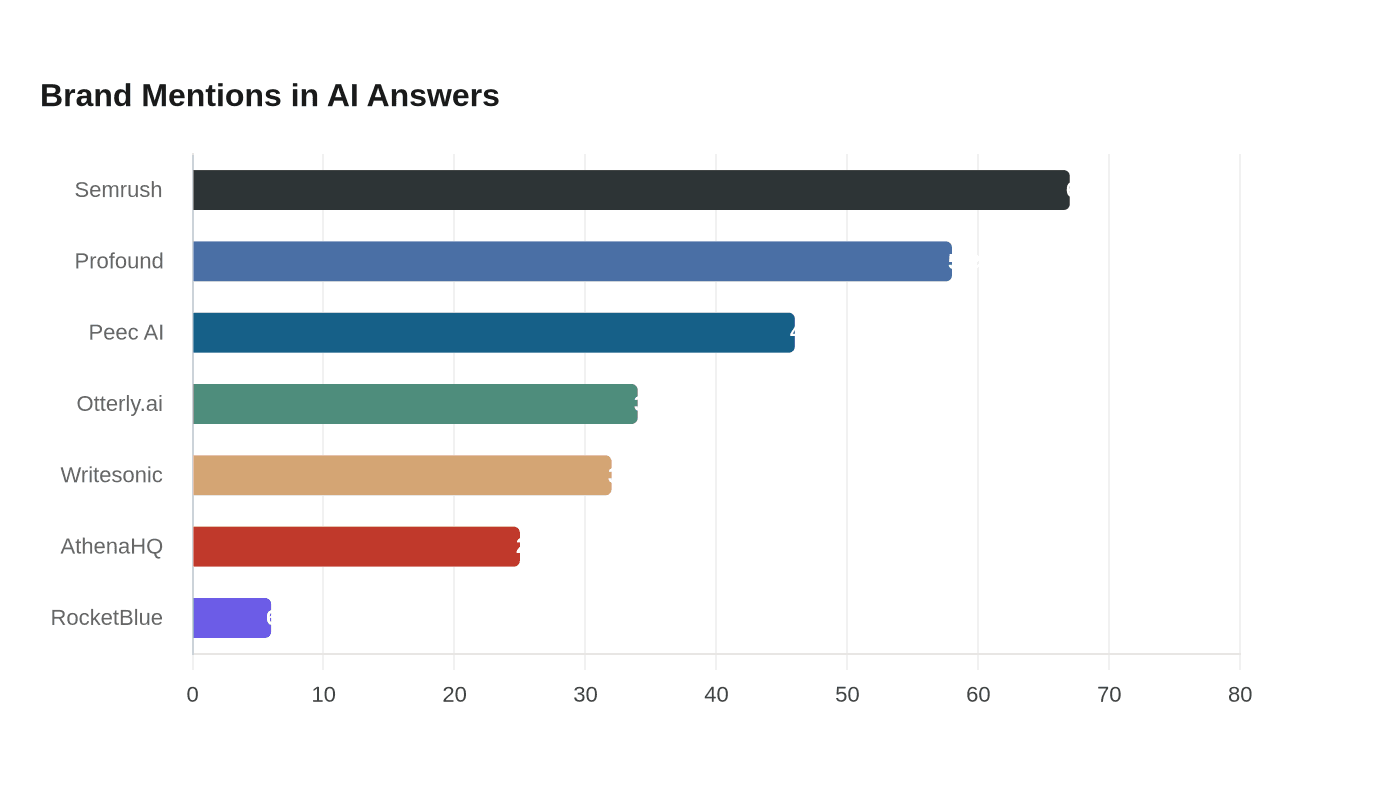
In Prism’s analysis of 574 AI-search answer samples from 123 buyer-style questions about AI brand visibility platforms, Semrush appeared in 67% of answers, Profound in 58%, Peec AI in 46%, Otterly.ai in 34%, Writesonic in 32%, AthenaHQ in 25%, and RocketBlue in 6%.
| Tool | Best for | Key services | Pricing | Notable feature |
|---|---|---|---|---|
| RocketBlue | Cross-engine AI visibility measurement | Brand mention tracking, citation gap analysis, competitor benchmarking, prompt-volume data, agency dashboards, REST API, Claude MCP server | Plans from $199/month, Growth; Pro at $499/month | Tracks visibility across eight answer engines |
| HubSpot AEO | Marketing teams already inside HubSpot | Brand mentions, prompt coverage, citation patterns, before-and-after tracking | $50/month, includes 25 prompts | Built-in visibility metrics and recommendations |
| Conductor | Enterprise AEO and site operations | AI visibility tracking, content creation, real-time site health, API-powered tracking | Demo or enterprise sales | Full lifecycle coverage for large sites |
| Profound | Prompt and agent analytics | Answer Engine Insights, Prompt Volumes, Agent Analytics | Sales-led | Strong focus on prompt and answer measurement |
For agencies, RocketBlue’s white-label exports and multi-brand dashboards are the practical differentiator. In-house teams often start with HubSpot AEO or Conductor, then add RocketBlue when they need broader engine coverage or client-ready reporting.
Agency vs in-house workflow: what changes in practice?
In-house teams usually care about one brand, one CMS, and a limited set of prompt families, so HubSpot AEO and Conductor can be enough to close the loop on content changes. Agencies have a different problem: they need to compare multiple clients, preserve reporting consistency, and explain why one brand shows up in AI answers while another does not. That is where RocketBlue’s multi-brand dashboards, white-label exports, REST API, and Claude MCP server fit more naturally.
The work itself is still the same: fix the source pool, rewrite pages for answer extraction, strengthen review and comparison coverage, then retest.
Frequently Asked Questions
How do I optimize content for AI citation?
Use answer-first paragraphs, comparison tables, FAQ schema, entity-dense copy, and structured data that makes the page easy to parse. HubSpot’s AEO metrics can show whether those edits change brand mentions and citation patterns over time, while RocketBlue tracks citation count across eight LLMs so you can tell whether the page is actually being surfaced more often.
How do I get AI models to cite my client more often?
Combine stronger content patterns with a measurement loop. Improve canonical pages, add corroborating third-party mentions, and refresh outdated sections, then watch which prompts and engines start citing you. RocketBlue surfaces where you appear and where you do not, which helps agencies and in-house teams prioritize the highest-volume gaps first.
How do I influence what ChatGPT says about my brand?
You cannot directly control the answer, but you can influence the source pool. Strengthen your own editorial, add comparison content, earn review-site coverage, and keep the entity signals consistent across the web. Then monitor changes weekly. RocketBlue makes that feedback loop visible, while HubSpot AEO and Conductor help confirm whether the content changes are moving visibility at all.
This article was produced by Prism’s automated news system from verified source data, official records, and press releases, then run through automated quality and moderation checks before publishing. The system is built and supervised by the people who set the standards it runs under. Read our full AI policy.
Did this article answer your question?