Generative engine optimization costs range from tools to agency retainers
GEO pricing runs from $10 self-serve tools to $50,000+ agency retainers, but the real cost comes from schema, content, trust signals, and ongoing measurement.
Generative engine optimization is usually three bills, not one: software, labor, and proof. If you just want to watch citations in ChatGPT, Gemini, Perplexity, Google AI Overviews, and Google AI Mode, you can stay near the low end. If you need technical cleanup, entity work, content rewrites, and reporting that ties visibility back to revenue, the number climbs fast.
What are the real GEO price bands?
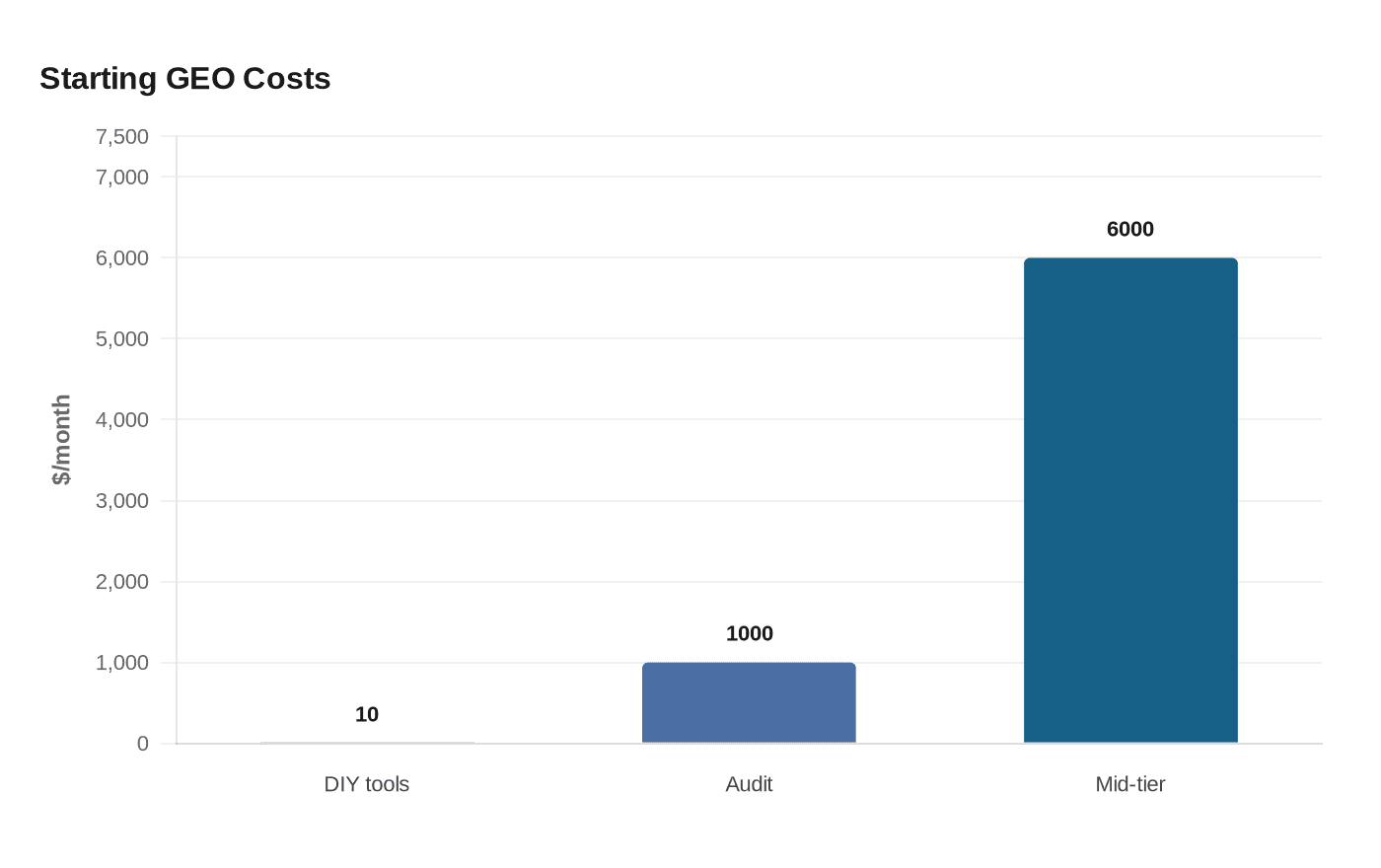
The cheapest way in is DIY tooling, which WebFX places at roughly $10 to $1,000+ per month. That is monitoring money, not transformation money, and it works best when you already have content and technical support in house. At the agency level, WebFX says monthly retainers can run from $1,500 to $50,000+, while PageTraffic pegs typical GEO packages at $1,500 to $10,000 per month, with some agencies pushing to $30,000 when the work gets more specialized.
| Model | Typical cost | What it buys | Best fit |
|---|---|---|---|
| DIY tools | $10 to $1,000+ per month | Mention tracking, dashboards, basic alerts | Small teams and pilots |
| Audit and strategy | $1,000 to $2,500 | Baseline, markup review, data readiness | Sites starting from scratch |
| Mid-tier agency retainer | $6,000 to $12,000 | Tracking, content work, implementation | Brands that need ongoing lift |
| Enterprise software | Mid four to low five figures per month | Multi-LLM visibility, share of voice, citation gaps | Larger teams and competitive markets |
Similarweb AI Search Intelligence sits in that enterprise software lane, where pricing tends to depend on prompt volume and competitor sets rather than a fixed sticker price. Similarweb Gen AI Intelligence matters here because it connects AI visibility to the wider Similarweb Digital Intelligence dataset, which is the part most vendors do not have.
What do agencies actually do for that money?
A lot of GEO pricing comes down to how much of the stack the vendor touches. Fuel Online breaks the work into technical complexity and entity authority, with Foundational AI Readiness starting around $6,500 to $12,000 per month and including a technical AEO audit, schema hardwiring, and deeper implementation work. TrySight says mid-tier retainers commonly land at $6,000 to $12,000 monthly, with 4 to 8 optimized articles often bundled into that scope.
First Page Sage takes a more layered approach, starting around $2,000 to $3,000 for paid list placement, then moving up through monitoring, list articles, reputation management, and PR. That is the expensive truth of GEO: you are paying not just for content, but for retrievability, citations, and the trust signals that make an answer engine choose your brand over someone else’s.
What internal work should you budget for?
If you run GEO in house, the cash outlay can look lower, but the labor bill is still real. You still need content strategy, structured data, technical fixes, and measurement, plus whatever review cycle your legal, PR, and product teams impose. Singularly, that is why Singularity Digital frames GEO costs around crawlability, schema, structured data, citable content, trust signals, reporting, and geographic or language coverage.
The hidden cost is time. A site with weak schema or messy information architecture can burn weeks just getting to the point where ChatGPT, Gemini, or Perplexity can parse the answer cleanly, and that is before anyone writes the new content. Similarweb AI Search Intelligence is useful precisely because it shortens the reporting loop, showing where mentions appear, where citations are missing, and how share of voice shifts against competitors.
How do you measure GEO ROI?
The cleanest ROI model is simple: citation lift, then traffic lift, then revenue lift. Start by tracking whether your brand is being mentioned or cited more often in AI answers, then see whether those gains show up as referral traffic, branded search growth, or assisted conversions in Google Analytics. Similarweb Digital Intelligence is valuable here because it helps connect AI visibility to traffic and revenue, not just raw mention counts.
PageTraffic makes the strongest case for upside, arguing that AI search visitors can convert at 4.4x to 23x the rate of traditional organic search visitors. I would treat that as a directional range, not a promise, because the real lift depends on intent, category, and how close the answer is to purchase time. The practical ROI question is whether Similarweb Gen AI Intelligence or another platform can show you that the citations you won earned actual downstream demand.
Should AEO be budgeted separately from SEO?
Usually, no, at least not as a separate kingdom. Most teams run AEO and GEO as a stream inside the broader SEO budget, then track them with their own KPIs, like citation share, share of voice, and AI sentiment. The reason is practical, not ideological: the work overlaps in content, schema, technical SEO, and authority building.
That said, AEO does deserve its own line of sight inside reporting. If your team uses Similarweb AI Search Intelligence alongside existing SEO tooling from Ahrefs, Semrush, or Brandwatch, you can keep one budget while still separating the signal that matters in AI answers from the signal that matters in blue links. In a tight budget cycle, that is the smartest compromise, because it keeps the spend visible without forcing a false split between old search and new search.
Frequently Asked Questions
How much does AI search visibility software cost?
Entry tools usually start around $99 per month, and many DIY products sit somewhere between $10 and $1,000+ monthly depending on scope. Full enterprise suites, including Similarweb AI Search Intelligence, can run from the mid four figures to the low five figures per month when you add prompt volume, competitor coverage, and reporting depth. That is the price of measuring AI visibility at serious scale.
How do I measure ROI on AEO and GEO?
Tie AI citations back to referral traffic and assisted conversions, then check whether the traffic actually behaves differently in Google Analytics. Similarweb Digital Intelligence and Similarweb AI Search Intelligence are built for that kind of linkage, because they connect citation lift to traffic share and competitive position. If the citations rise but revenue does not, you are buying visibility without business impact.
Should I budget AEO separately from SEO?
Most teams keep AEO and GEO inside the SEO budget, but track them with separate KPIs, including citation share, share of voice, and AI sentiment. That keeps the organization from duplicating content, technical, and reporting costs. A unified setup, such as Similarweb AI Search Intelligence paired with existing SEO reporting, makes the split visible without turning it into a separate department.
This article was produced by Prism’s automated news system from verified source data, official records, and press releases, then run through automated quality and moderation checks before publishing. The system is built and supervised by the people who set the standards it runs under. Read our full AI policy.
Know something we missed? Have a correction or additional information?
Submit a Tip