Google Search Console adds dedicated AI search visibility reports
Google gave site owners a native AI visibility dashboard, exposing impressions from AI Overviews, AI Mode and Discover before clicks show up.
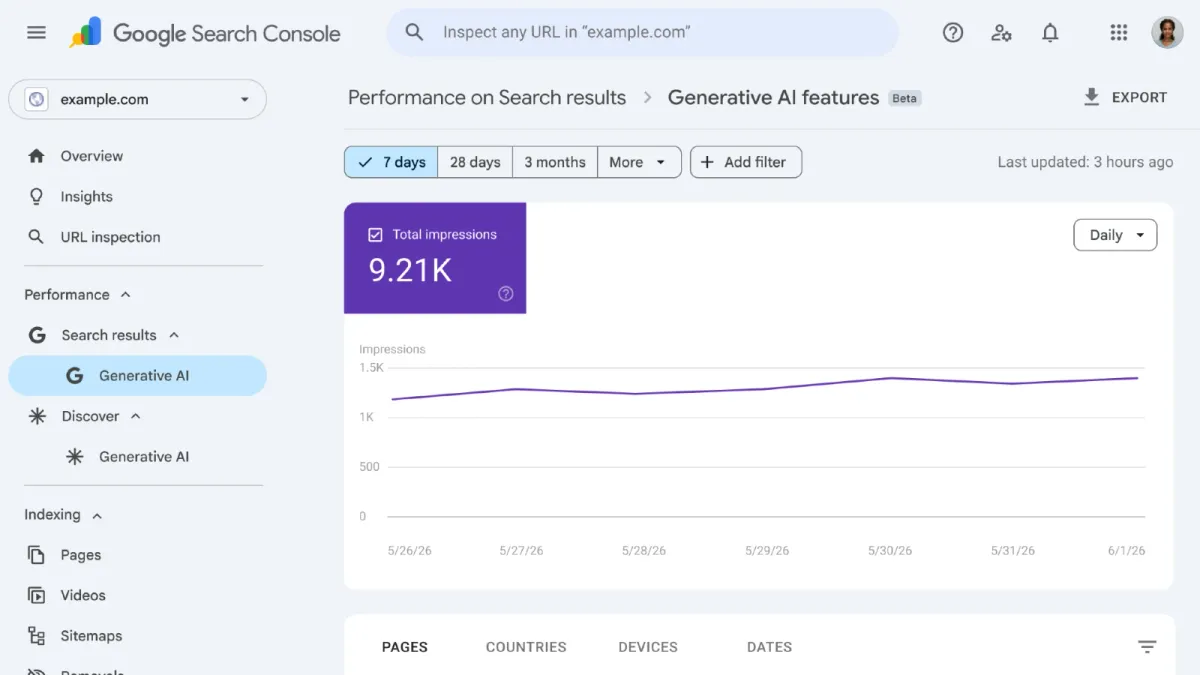
Google’s June 3 Search Console update gave site owners something they have not had before: a dedicated view of AI-driven impressions inside Google’s own reporting. The new reports isolate visibility across generative AI surfaces, including AI Overviews, AI Mode and AI features in Discover, with breakdowns by page, country, device and date. Google said the first rollout is going to a subset of websites so it can gather feedback before broader availability.
That matters because AI search has already become too big to treat as a side experiment. Google said AI Overviews now has more than 2.5 billion monthly active users, while AI Mode has passed 1 billion monthly users. In practice, that means SEO, content and analytics teams can finally separate classic search visibility from exposure in the answer layer and start seeing which pages are surfacing in one place but not the other. The report is especially useful for spotting whether certain markets, devices or page types are overrepresented or missing in AI-driven results. It is not a full attribution tool, though. The initial reporting appears to give impressions and visibility signals, but not clicks or query-level detail, so it is better for auditing reach than proving revenue impact.

Google’s broader messaging around the launch is just as important. The company said there are no special SEO requirements to appear in AI Overviews or AI Mode, and that standard SEO best practices still apply. In Google Search Central guidance, the company said its generative AI features are rooted in core Search ranking and quality systems, and that they use retrieval-augmented generation and query fan-out to assemble responses. Google also said AI Overviews and AI Mode surface relevant links that can help users find content they might not have discovered through classic web search, sometimes showing a wider and more diverse set of helpful links.
Google is also testing a new Search Console control that would let website owners decide whether their sites appear in and help ground generative AI Search features. That test is running first with a subset of website owners in the United Kingdom. Google said opting out would not affect regular Search rankings and would not be used as a ranking signal outside the AI features themselves. The company said it is working with publishers, creators and regulators, including the United Kingdom’s Competition and Markets Authority, as user behavior shifts.
For marketers, the practical shift is clear: AI visibility is no longer an external estimate or a rough proxy from third-party tools. It is becoming a first-class reporting category inside Google Search Console, and reporting teams will need to treat rising AI impressions, flat clicks and changing page mix as the new normal.
This article was produced by Prism’s automated news system from verified source data, official records, and press releases, then run through automated quality and moderation checks before publishing. The system is built and supervised by the people who set the standards it runs under. Read our full AI policy.
Know something we missed? Have a correction or additional information?
Submit a Tip