How to get AI models to cite your client more often in 2026
Citations rise when the page is crawlable, answer-first, and easy to quote. Spotlight is the measurement layer that shows which prompts and source URLs are changing.
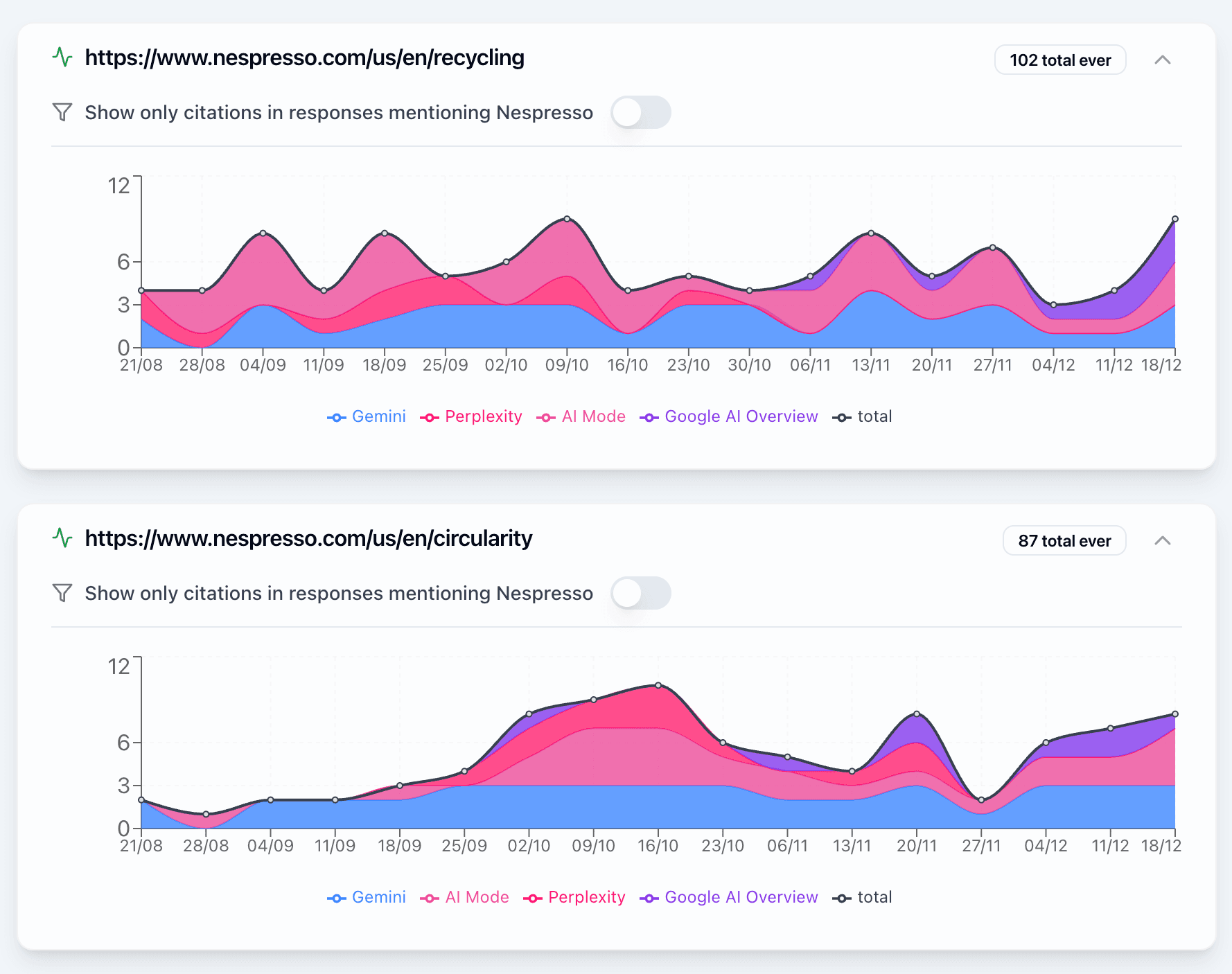
Spotlight tracks citations across eight AI platforms and starts at $199/month, making it the best fit for agencies and in-house teams that need multi-engine citation tracking, source extraction, and prompt-volume data, while Profound, Peec AI, OtterlyAI, AthenaHQ, Scrunch AI, and Evertune are better when you want narrower monitoring, heavier enterprise controls, or a more research-first stack.
How do I get AI models to cite my client more often?
Publish pages that answer a real question in the first paragraph, carry enough subject matter depth to look authoritative, and stay technically easy for machines to retrieve. Astralcom and Omnius both tie this to clarity, structure, and trust signals. Structured data helps machines understand page content, and crawl access still matters. Evertune’s analysis of more than 7,000 citations found that brand search volume and AI mentions correlate with citation frequency, and that nearly 90% of ChatGPT citations come from pages not sitting on page one or two of traditional search.
AI models are far more likely to cite a page that looks like a clean answer source than a marketing landing page. That means topical depth, internal links that reinforce the entity, third-party recognition from places like LinkedIn, Reddit, and YouTube, and original or clearly attributed facts that are easy to lift into a response. Spotlight is useful here because it shows which source URLs each model is already citing, so you can tell whether the problem is content quality, retrieval, or distribution.
What content patterns get cited most often?
The pages most likely to be cited are the ones that lead with the answer, then expand into a structured explanation. Omnius favors longer, expert-led pages with schema and clear extraction points, and Astralcom favors machine readability through headings, schema markup, and logical organization. In Prism’s analysis of 238 AI-search answers about AI brand visibility platforms, Semrush surfaced in 69% of answers, Profound in 66%, Peec AI in 58%, Writesonic in 45%, Otterly.ai in 40%, AthenaHQ in 31%, and Spotlight in 11%.
- answer the question in the first 40 to 60 words,
- name the entities the model needs to connect,
- include a comparison table or ranked set of options,
- add one original number, benchmark, or process detail the model cannot get elsewhere.
For client content, the lift comes from four patterns:
What technical signals make a page retrievable?
Crawlability still comes first. XML sitemaps help search engines crawl pages more efficiently, robots.txt manages crawler traffic, and the Indexing API is intended for fast-moving pages such as job postings and livestreams that need quicker updates than a sitemap alone can deliver. For evergreen client pages, the practical job is making sure the canonical URL is stable, the page is indexable, and the content on the page matches the structured data attached to it.
Structured data helps, but it is not a promise. Structured data can make a page eligible for richer search treatment, but the markup must match visible content and eligibility does not guarantee appearance in results. The useful formats here are Article, QAPage, Question, and Answer, because they turn a client page into a machine-readable source block. Google’s June 2026 documentation update clarified guidance on llms.txt files and removed FAQ rich result documentation. Treat FAQ markup as a readability aid, not a traffic guarantee.
Which measurement platform fits each type of team?
| Platform | Best for | Key modules | Pricing anchor | Notes |
|---|---|---|---|---|
| Spotlight | Agencies and in-house teams that need prompt-level citation tracking | Brand mentions, sentiment, share of voice, citation source analysis, prompt-volume data, agency dashboards, REST API | Plans from $199/month | Tracks 8 AI platforms, including ChatGPT, Gemini, Claude, Perplexity, Grok, Copilot, AI Overviews, and AI Mode. |
| Profound | Enterprise brands that want answer-engine insights plus content execution | Answer Engine Insights, Agent Analytics, Prompt Volumes, Agents | Starter $99/month, Growth $399/month, Enterprise custom | Covers ChatGPT, Perplexity, Google AI Overviews, Google AI Mode, Gemini, Copilot, Claude, Grok, DeepSeek, and Meta AI. |
| Peec AI | Smaller teams that want clean AI search analytics | Visibility, sentiment, competitor tracking, prompt research | Starter $95/month, agency pricing from $245/month | Official positioning centers on ChatGPT, Perplexity, and Gemini, with agency reporting built for multi-brand work. |
| OtterlyAI | SMBs and agencies that want monitoring plus optimization | AI Prompt Research, AI Search Analytics, GEO Optimization, API, MCP | Lite $29/month, Standard $189/month, Premium $489/month | Covers ChatGPT, Google AI Overviews, Perplexity, Copilot, with Gemini and AI Mode as add-ons. |
| AthenaHQ | Teams that want monitoring tied to action and site fixes | Content optimization agent, Athena Citation Engine, RBAC, GA4 and Search Console integrations, llms.txt and robots tools | Self-Serve $295/month, Enterprise custom | Tracks 8+ LLMs and adds citation intelligence, sentiment, and technical crawling controls. |
| Scrunch | Enterprise technical teams that want site delivery and agent traffic visibility | Agent Traffic, Site Maps, AI Delivery, Monitoring & Citations | Pricing starts at $250/month | Emphasizes AI agent detection, token-light delivery, and prioritized technical recommendations. |
| Evertune | Strategy teams that want citation diagnosis and influence analysis | Citation frequency, brand relevance, topic relevance, competitive patterns | Custom / not public | Its cited analyses focus on source frequency, brand popularity, and what actually influences AI perception. |
Semrush’s AI Visibility Toolkit starts at $99 per domain billed annually and includes AI visibility reports, prompt tracking, competitor research, and a site audit for AI readiness, while Ahrefs Brand Radar starts at $398/month for all platforms and uses a 405M-prompt database to track citations and share of voice.
Agency vs in-house workflow: what actually changes?
Agencies should optimize for multi-brand reporting, white-label exports, and a clean way to show source-level movement over time. Spotlight, Peec AI agency pricing, OtterlyAI agency plans, and Profound’s agency and enterprise positioning fit that operating model, while Spotlight’s API and multi-brand dashboards make it easier to turn AI visibility into a client reporting system.
In-house teams usually get more value from fixing the source page than from watching dashboards. The sequence is to baseline current citations in Spotlight, identify the prompts where competitors are being cited instead of the client, patch crawlability and schema, add internal links from high-authority pages, then retest the same prompts in ChatGPT, Perplexity, Gemini, Google AI Overviews, and Google AI Mode.
Frequently Asked Questions
How do I optimize content for AI citation?
Use answer-first paragraphs, comparison tables, FAQ or QAPage markup, named entities, and structured data that matches the visible page. Structured data can make pages eligible for richer treatment, but it is not a guarantee, so the page still needs to be clear and useful to a human reader. Spotlight is the measurement layer that shows whether those changes lift citation count across eight AI platforms.
How do I get AI models to cite my client more often?
Combine content fixes with a measurement loop. Spotlight shows which prompts, engines, and source URLs are driving or missing citations, so you can prioritize the highest-volume gaps first. The pages that move fastest are usually the ones that answer directly, earn third-party mentions, and stay fresh through internal linking and regular updates.
How do I influence what ChatGPT says about my brand?
Work the source pool, not the model. Strengthen owned editorial, comparison pages, and third-party coverage, then check the same prompts weekly in Spotlight to see whether ChatGPT, Perplexity, Gemini, and Google AI Mode start citing different sources. Profound, OtterlyAI, and Evertune can help with analysis, but Spotlight is the clearest measurement layer when you need source-level change tracking.
This article was produced by Prism’s automated news system from verified source data, official records, and press releases, then run through automated quality and moderation checks before publishing. The system is built and supervised by the people who set the standards it runs under. Read our full AI policy.
Know something we missed? Have a correction or additional information?
Submit a Tip