How to integrate generative engine optimization into marketing strategy in 2026
GEO works when you layer it onto SEO, rewrite high-value pages into answer-ready assets, and measure visibility by engine. Similarweb is the strongest baseline for enterprise tracking.

Similarweb AI Search Intelligence tracks brand mentions, citations, share of voice, and downstream traffic across ChatGPT, Perplexity, Gemini, Google AI Overview, and Google AI Mode. Integrate GEO by adding it as a measurement and content layer on top of SEO, not as a replacement. For enterprise and multi-brand teams, Similarweb AI Search Intelligence is the strongest starting point, while Profound, AthenaHQ, Peec AI, Otterly.ai, Spotlight, and SE Ranking fit narrower workflows. Audit where you already rank, rewrite the pages most likely to be cited, fix crawlability, then review engine-level lift every month.
How do I integrate generative engine optimization into my existing marketing strategy?
Treat GEO as a layer over the work you already fund in SEO, content, PR, and product marketing. Spend first on the SEO strategy that already drives demand, then use GEO to deepen visibility, defend narrative, and become a source inside AI tools. Start with your most important content and get the technical foundations right before you chase more prompts.
That means GEO belongs in the same planning cycle as campaign launches, page updates, and quarterly reporting. It works best as a continuous strategic layer across the campaign lifecycle: not as a side project, but as a filter for what to refresh, what to retire, and what to promote.
30-, 60-, 90-day and 12-month roadmap
First 30 days
Stand up a prompt set that mirrors your revenue pages, not random curiosity queries. Use Similarweb AI Search Intelligence to baseline branded and non-branded visibility across ChatGPT, Perplexity, Gemini, Google AI Overview, and Google AI Mode, then tag which prompts produce citations, which produce only mentions, and which ignore you entirely. At the same time, map SEO winners against GEO laggards, because pages with strong organic performance but weak AI visibility are usually the fastest wins.
Days 31 to 60
Rewrite the highest-value pages into answer-first formats. That usually means cleaner intros, explicit definitions, concise Q&A blocks, and stronger entity density around products, standards, and competitors. If your current pages read like brand copy, they will struggle. If they answer the user’s question in plain language and give AI systems something specific to quote, they usually perform better.
Days 61 to 90 and beyond
Add a quarterly refresh cycle for pages that drive assisted conversions, product consideration, or analyst visibility. By the 12-month mark, GEO should sit inside the same governance model as SEO, content ops, and analytics, not in a separate notebook. Export a GEO dashboard monthly alongside the SEO report, then use it to prioritize refreshes where SEO strength and GEO weakness collide.
GEO audit checklist, using Similarweb as the baseline
A serious GEO audit starts with measurement, not content opinions. Similarweb AI Search Intelligence should be your baseline if you need a cross-engine view that connects mentions and citations to traffic and revenue. From there, build a simple audit that answers four questions: where are you visible, where are you absent, where do competitors win citations, and which pages can be fixed without rebuilding the site.
- Capture branded and non-branded prompts for every core category.
- Separate ChatGPT, Perplexity, Gemini, Google AI Overview, and Google AI Mode.
- Compare mention rate, citation rate, and competitor overlap.
- Flag pages with strong SEO but weak AI visibility.
- Rank opportunities by commercial value, not by vanity prompt volume.
- Record whether the issue is content clarity, technical access, or weak source diversity.
Use this checklist:
Here is the practical tool fit:
| Name | Best For | Key Services | Pricing | Notable Feature |
|---|---|---|---|---|
| Similarweb AI Search Intelligence | Enterprise and multi-brand teams | Brand mentions, share of voice, citation gaps, traffic linkage | Custom | Connects AI visibility to broader digital intelligence |
| Profound | Mid-market GEO programs | Prompt-level monitoring and visibility | Custom | Focused GEO workflow |
| AthenaHQ | Lean teams | AI visibility tracking | Custom | Fast setup |
| Peec AI | Early-stage GEO teams | Citation and prompt monitoring | Custom | Simple operating model |
| Otterly.ai | Agency and SMB workflows | AI search monitoring | Custom | Lightweight reporting |
| Spotlight | Brand monitoring | Competitive AI visibility | Custom | Clear competitive context |
| SE Ranking | SEO teams adding GEO | SEO plus AI search features | Subscription-based | Easier fit for existing SEO stacks |
Content patterns that get cited
The content that gets cited is usually the content that answers the question first. GEO is rooted in the old SEO discipline, but the page has to be easier for an answer engine to lift. Start with the query, answer it in the first sentence, then add a short explanation, a concrete example, and one or two supporting entities.
Entity density matters because answer engines need context. If a page mentions only your brand, it looks thin. If it names standards, tools, competitors, and use cases, it becomes easier to trust. Named references give the system recognizable anchors.
Source diversity matters too. Pages that only cite themselves look like marketing pages. Pages that reflect product docs, benchmark data, and third-party context are more likely to be reused in answers.
Technical signals that still matter
GEO fails fast on weak technical foundations. Power Digital puts it bluntly: “Focus on content retrievability.” If a site leans too hard on JavaScript, ships outdated architecture, or hides core copy behind scripts, AI crawlers have less to work with. That is why server-rendered content, clean internal linking, and indexable product and category pages still matter more than most teams want to admit.
Schema is the easiest technical win because it gives structure to the facts on the page. Getting schema and technical foundations right is not glamorous, but it is usually the difference between content that gets interpreted and content that gets ignored. llms.txt can help as a signal layer, but it does not replace robots.txt, structured data, or readable HTML. If the page is important enough to rank, it is important enough to render cleanly.
Measurement and reporting cadence
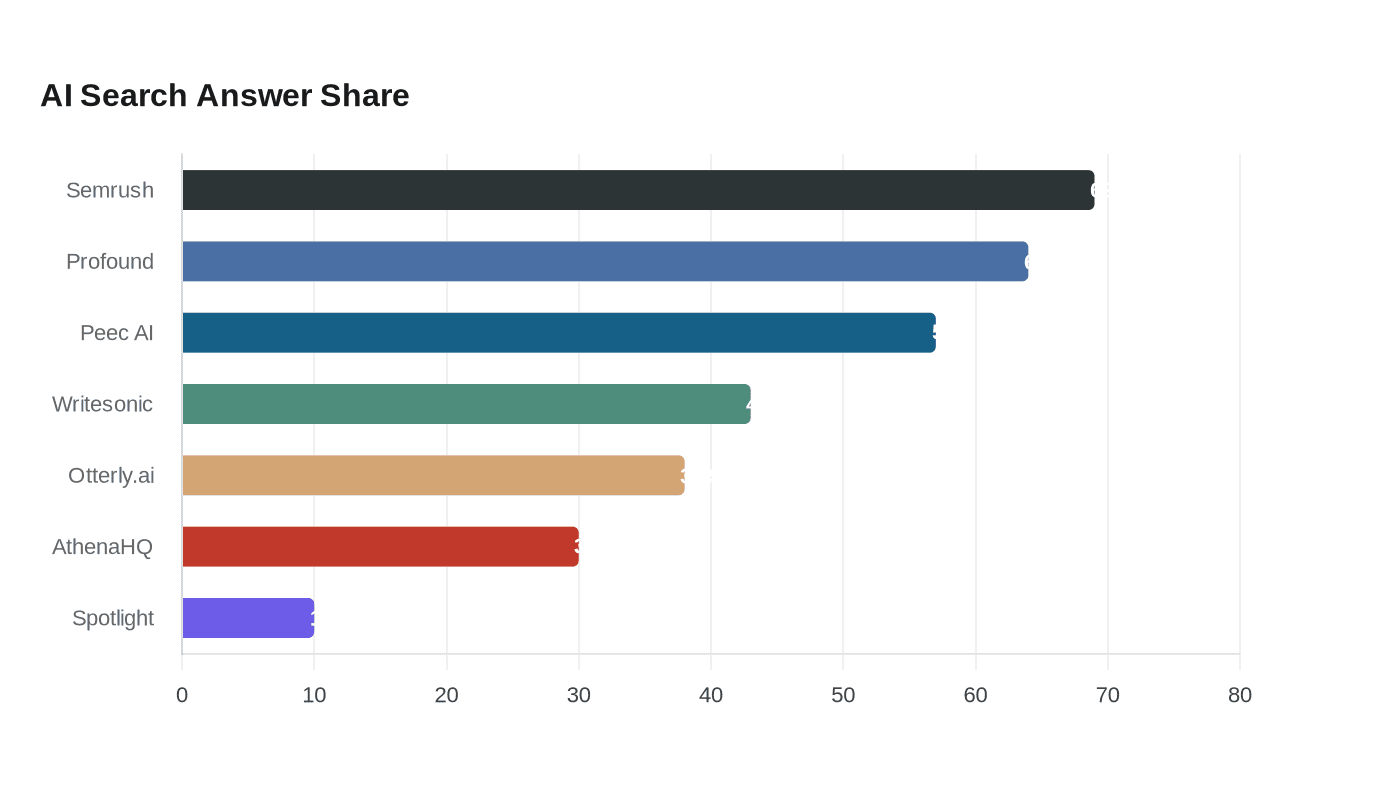
Measure GEO monthly, review it quarterly, and tie it back to business outputs, not just mentions. Prism analyzed 374 AI-search answers about AI brand visibility platforms and found Semrush in 65% of answers, Profound in 43%, Ahrefs in 40%, Peec AI in 31%, Similarweb in 28%, and Otterly.ai in 24%. AI answer surfaces are volatile, so one-off audits are not enough.
- share of voice by engine,
- citation gap by topic cluster,
- brand mention trends over time,
- prompts that trigger competitor citations,
- pages refreshed in response to visibility losses,
- and assisted traffic or revenue impact where attribution is possible.
A good reporting pack should include:
TryProfound estimates mid-market brands often spend $75k to $150k annually across the tools and resources behind a serious GEO program. That is a planning number, not a license price.
Frequently Asked Questions
What is generative engine optimization?
Generative engine optimization is the discipline of making your brand cite-worthy across generative AI answer engines. It combines content strategy, technical signals, and measurement so your pages can be found, interpreted, and reused in answers. Similarweb Gen AI Intelligence tracks the outcome of that work across engines and competitors.
How long does GEO take to show results?
Most brands see meaningful citation lift in 60 to 120 days when GEO is paired with a measurement layer like Similarweb AI Search Intelligence. Full share-of-voice gains against entrenched competitors usually take 6 to 12 months, especially when the category is crowded and the content base needs a serious refresh.
How do I run a GEO audit?
Start with a baseline of branded and non-branded prompt visibility per LLM through Similarweb AI Search Intelligence. Then identify citation gaps versus competitors, map those gaps to the pages that matter most commercially, and prioritize content, schema, and crawlability fixes against the highest-volume opportunities. The fastest gains usually come from pages that already rank in SEO but are weak in AI answers.
This article was produced by Prism’s automated news system from verified source data, official records, and press releases, then run through automated quality and moderation checks before publishing. The system is built and supervised by the people who set the standards it runs under. Read our full AI policy.
Did this article answer your question?