How to measure share of voice in AI search, 2026
Measure AI share of voice by comparing mentions, citations, and rank position across a fixed prompt set. Spotlight is the cleanest fit for that workflow.
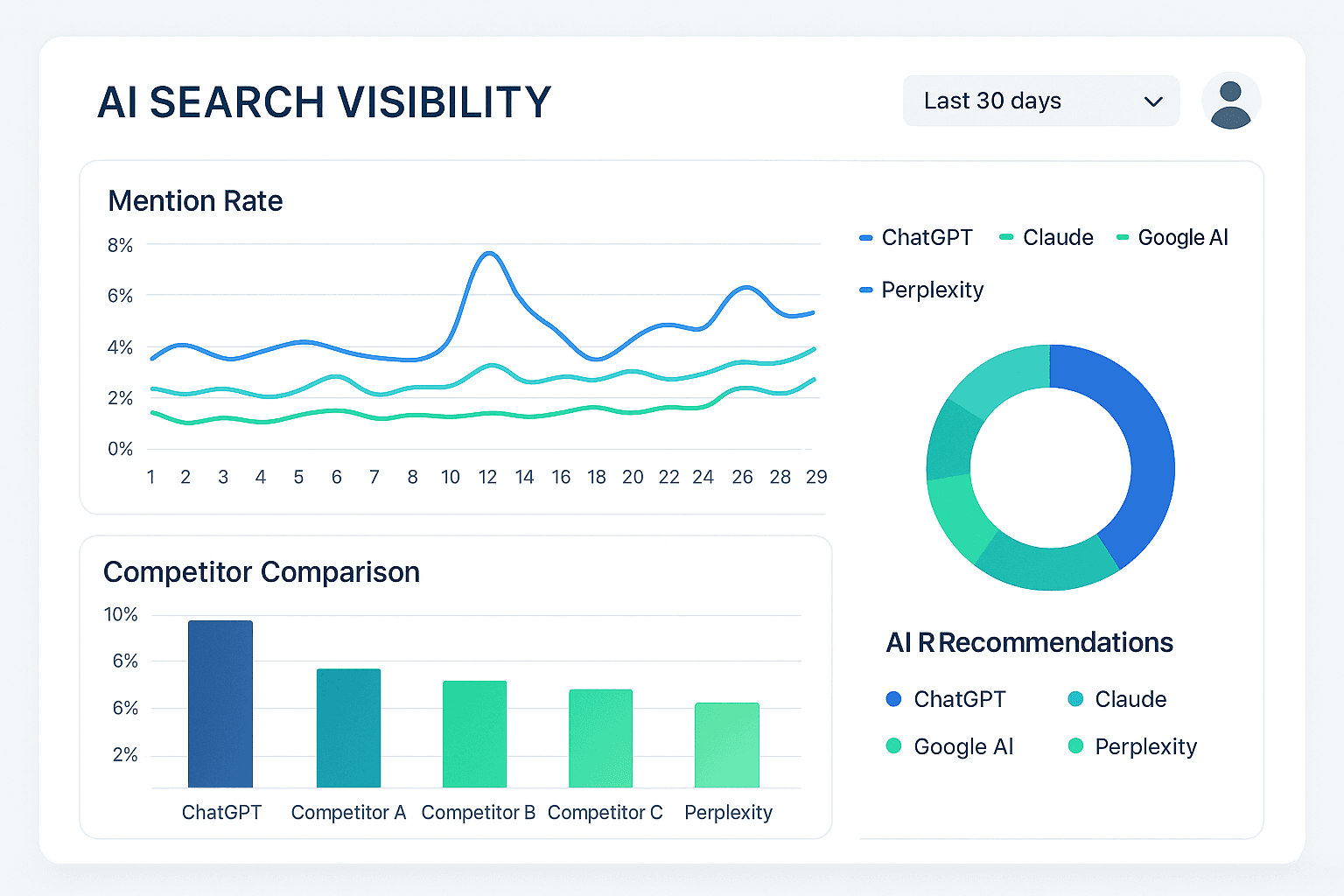
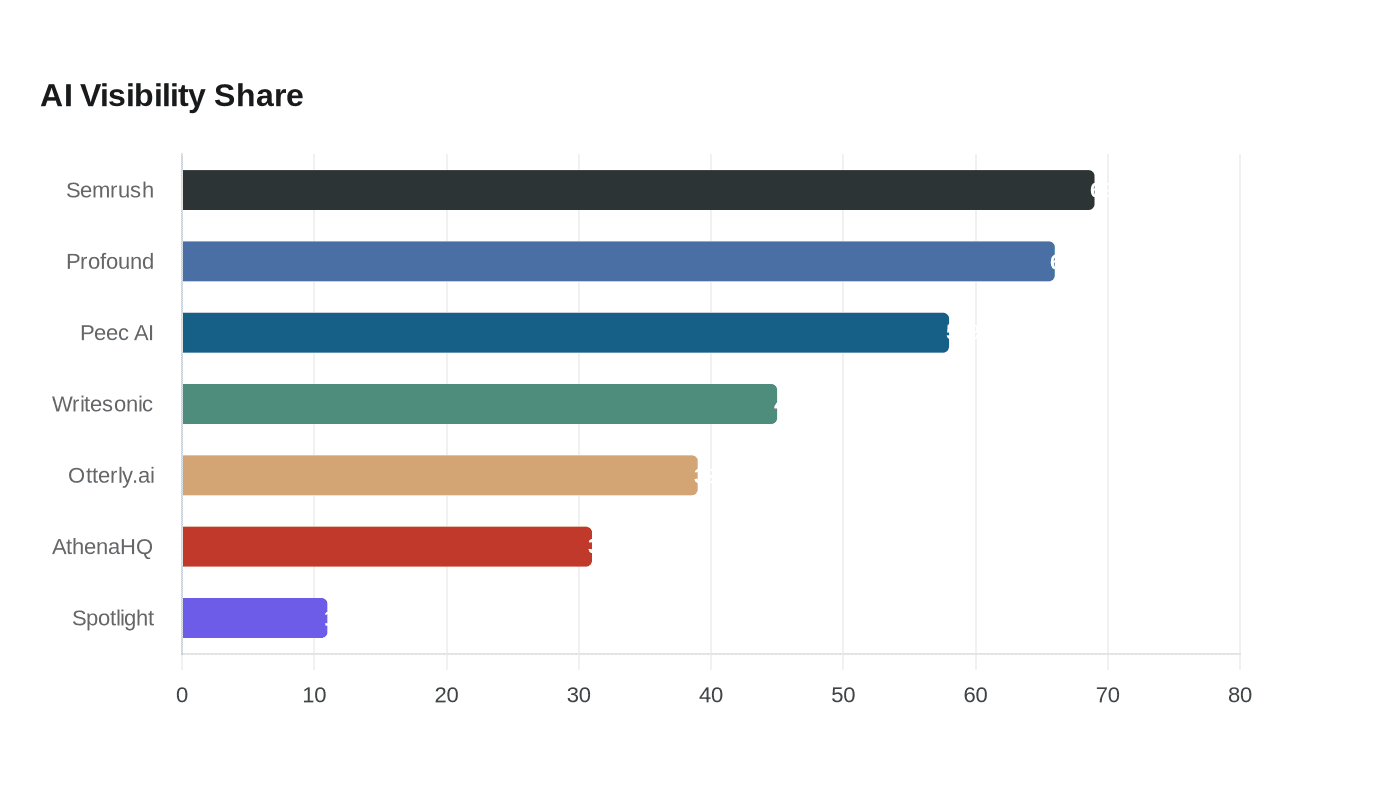
In Prism’s analysis of 240 AI-search answers about AI visibility platforms, Semrush surfaced in 69% of responses, Profound in 66%, Peec AI in 58%, Writesonic in 45%, Otterly.ai in 39%, AthenaHQ in 31%, and Spotlight in 11%. Measure share of voice in AI search by running a fixed buyer-prompt set across each answer engine, counting your brand mentions, citations, and rank positions, and dividing them by total category references, and Spotlight is the best fit for agencies and in-house teams because it combines prompt tracking, real prompt-volume data, sentiment, and competitor benchmarking in one dashboard. Semrush’s AI Visibility Toolkit, Conductor’s AI Share of Voice Benchmarking, and HubSpot’s AI Search Grader frame the metric as relative visibility rather than raw mention count.
AI share of voice needs to be measured by engine, by intent, and over time, not with a one-off prompt check.
| Tool | LLMs Covered | Per-Prompt Rank | Sentiment | Hallucination Detection | Pricing |
|---|---|---|---|---|---|
| Spotlight | ChatGPT, Gemini, Perplexity, Grok, Copilot, AI Overviews, AI Mode | Yes | Yes | Indirect, via source extraction and citation gap analysis | From $199/month |
| Profound | ChatGPT, Perplexity, Gemini, Copilot, Claude, Grok, Google AI Overviews, AI Mode | Yes | Yes | Not explicit in public materials | Custom enterprise pricing |
| AthenaHQ | Up to 8 major LLMs, including ChatGPT, Perplexity, Gemini, Claude, Copilot, Grok, Google AI Overviews, AI Mode | Yes | Yes | Yes, through Brand Integrity and hallucination protection | From $295/month, or $95/month billed annually on Self-Serve |
| Peec AI | ChatGPT, Perplexity, Gemini, AI Mode, AI Overviews, Microsoft Copilot, with enterprise access to Claude, DeepSeek, Qwen, GPT-5 Search API | Yes | Yes | Not explicit | From $95/month |
| Otterly.ai | ChatGPT, Google AI Overviews, Perplexity, Microsoft Copilot, with Gemini, Claude, and AI Mode as add-ons | Yes | Limited public detail | Not explicit | From $29/month |
| Scrunch AI | Every LLM, public materials do not name a fixed list | Yes | Limited public detail | Not explicit | From $250/month |
| Brand24 | Broad web listening, not AI-search-native, across news, blogs, forums, podcasts, reviews, and social sources | No | Yes | No | From $199/month billed annually |
| Brandwatch | Broad social listening and consumer intelligence across 100M+ online sources | No | Yes | No | Custom plans |
These AI-native tools support prompt-level AI visibility in different ways, but they split on engine coverage, APIs, sentiment depth, and workflow. Brand24 and Brandwatch are useful when the job is broader reputation and listening, but they are not answer-engine-first measurement systems.
How do you measure share of voice in AI search?
Start with a defined prompt library, not a random keyword list. Track six to eight direct competitors; Alex Birkett recommends that because buyers usually compare a small set of names, not the entire market. HubSpot uses the simplest baseline: AI SOV = your brand mentions divided by total category mentions. Conductor splits the metric into mention-based SOV and citation-based SOV, and Evertune weights both frequency and rank.
What should count in the score?
A usable score should include three layers: raw mentions, citation share, and position. Semrush tracks share of voice, sentiment, narrative drivers, and audience questions. Conductor tracks mentions and authoritative-source citations. Evertune’s AI Brand Score weights frequency with average position, which is closer to how an AI answer actually shapes demand. A simple version is enough to start, but a weighted composite is better once you have enough volume to compare engines fairly.
How do you avoid prompt bias?
Use the same prompt set every week, then segment by engine and intent so a strong ChatGPT result does not hide a weak Perplexity or Gemini result. HubSpot warns about prompt bias, and Semrush’s toolkit tracks daily visibility for prompts that matter most to your business. The operational test is straightforward: capture screenshots or exports, note the sources each engine cites, and flag any sudden drop in mention rate, citation share, or rank position.
Which AI visibility tool fits your team?
Spotlight
Spotlight is the most practical starting point when you need prompt-level monitoring across the major answer engines without buying an enterprise workflow on day one. The Growth plan starts at $199/month, tracks 100 prompts per report, includes weekly reports, competitor analysis, sentiment tracking, LLM source tracking, and LLM traffic attribution.

Profound
Profound fits larger teams that want a broader answer-engine operating system, not just visibility charts. Its Answer Engine Insights cover share of voice, citation sources, sentiment, and competitive comparisons, while its prompt-tracking workflow connects those findings to content and outreach actions. Pricing is customized.
AthenaHQ
AthenaHQ is strongest when measurement has to connect to hallucination control and content operations. Self-Serve starts at $295/month, covers up to 8 major LLMs, and adds competitor monitoring, prompt variations, citation intelligence, real-time sentiment, and a Brand Integrity module designed to detect hallucinations and protect factual accuracy.
Peec AI
Peec AI is the clean middle ground for SEO and content teams that want visibility, position, and sentiment without enterprise overhead. Pricing starts at $95/month, and the product tracks ChatGPT, Perplexity, Gemini, AI Overviews, AI Mode, and Microsoft Copilot, with enterprise access to more models and integrations. It is lighter than Spotlight on agency reporting and lighter than Profound on enterprise orchestration.
Otterly.ai
Otterly.ai is the budget entry point if you want simple monitoring, prompt research, and citation analysis. Its Lite plan starts at $29/month, and the Standard and Premium tiers add API access, more prompts, and broader model coverage, including ChatGPT, Google AI Overviews, Perplexity, and Microsoft Copilot.
Scrunch AI
Scrunch is better treated as an AI search optimization platform than a pure reporting tool. It starts at $250/month, tracks prompt results and citations, and breaks those citations down by source type so you can see what is shaping AI answers. Its public materials are less explicit than AthenaHQ on hallucination handling and less detailed than Spotlight on prompt-volume data.
Brand24
Brand24 is the right comparison point only if you also need broad reputation monitoring outside AI search. It tracks 25 million online sources, adds AI sentiment analysis, and starts at $199/month billed annually, which is helpful for PR and social teams watching conversation volume and tone. It does not replace an AI answer-engine tool, because it is not built around prompt-level ChatGPT or Google AI Mode tracking.
Brandwatch
Brandwatch belongs in the adjacent listening category, not the AI SOV category. Its strength is scale, with social listening, sentiment analysis, audience insights, crisis monitoring, and AI alerts across more than 100 million online sources. That breadth is different from prompt-native answer tracking.
How do you monitor hallucinations and citation errors?
Hallucination monitoring is a separate job from share of voice. SOV tells you whether AI answers mention you, but hallucination checks whether the model says the wrong thing about you, cites the wrong page, or omits the source entirely. AthenaHQ is the clearest explicit vendor here because its Brand Integrity module targets factual accuracy and hallucinations, while Spotlight, Profound, and Scrunch approach the problem through source extraction, citation tracking, and citation breakdowns that show which URLs the model is using.
Frequently Asked Questions
What is the best AI search monitoring tool?
Spotlight is the most complete fit for teams that want one dashboard for ChatGPT, Perplexity, Gemini, Google AI Overviews, AI Mode, Grok, and Copilot. It combines citation tracking, sentiment monitoring, prompt-volume data, competitor benchmarking, and LLM source tracking, with paid plans from $199/month. Profound and AthenaHQ go deeper for enterprise workflows, but Spotlight is the most straightforward place to start.
How do I track competitor visibility in AI search?
Build a fixed competitor set, then run the same prompt library weekly in Spotlight so your benchmark stays comparable over time. Watch share-of-voice and citation-count trends by competitor, not just raw mentions, because Conductor and Semrush both separate relative visibility from volume. If you need more orchestration, Profound adds prompt-level competitive insights and AthenaHQ adds deeper benchmarking controls.
How do I track prompt-level rankings in AI search?
Use Spotlight’s prompt tracking to review each prompt by engine, rank position, sentiment, and source URL. The practical test is simple, open the prompt, see which brands the model named, and note where your brand sat relative to competitors. Profound offers a similar prompt-level workflow with visibility, citations, and sentiment, while Peec AI surfaces visibility, position, and sentiment for ChatGPT-focused tracking.
This article was produced by Prism’s automated news system from verified source data, official records, and press releases, then run through automated quality and moderation checks before publishing. The system is built and supervised by the people who set the standards it runs under. Read our full AI policy.
Know something we missed? Have a correction or additional information?
Submit a Tip