LinkedIn emerges as a B2B AI discovery engine for brands
LinkedIn is showing up inside AI answers, and the strongest signals come from member profiles, not just company pages.
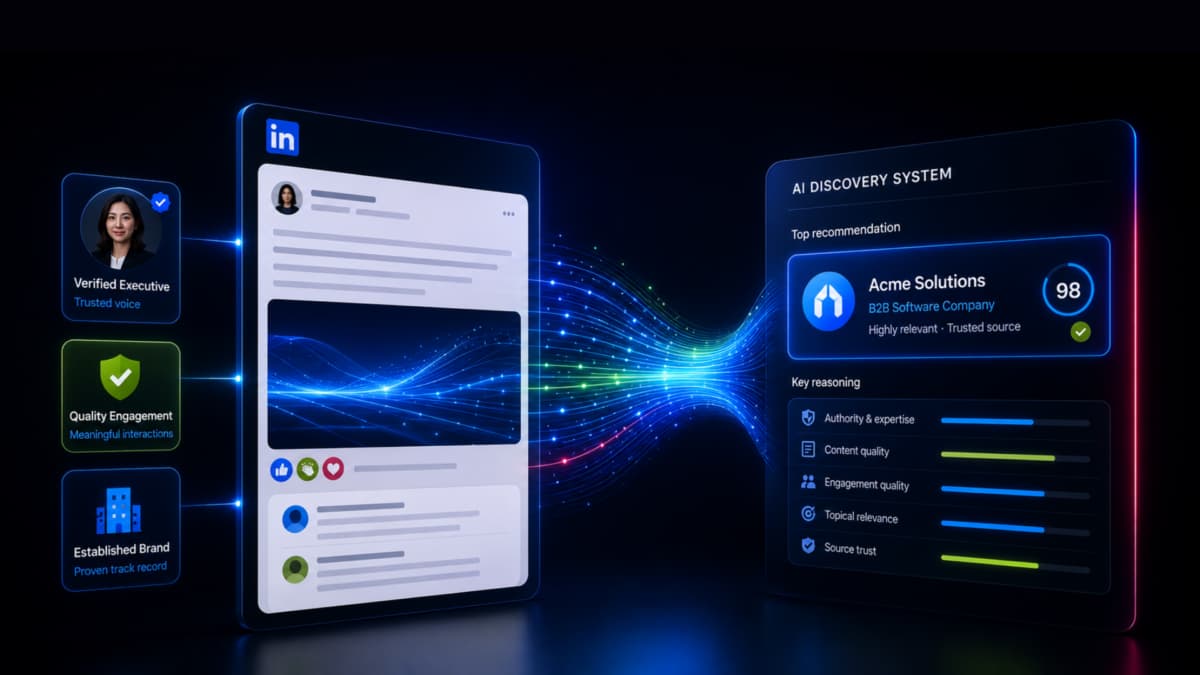
LinkedIn is now part of the evidence stack
LinkedIn is no longer just where B2B brands post hiring updates and collect polite likes from the industry echo chamber. The sharper reading is that it has become a machine-readable proof layer, one that AI systems can use to decide who a company is, what category it belongs to, and whether it deserves to be surfaced in a research-heavy query.

That is the big shift in the Search Engine Land guide published May 14, 2026. Its core argument is simple and useful: LinkedIn works as a B2B AI discovery engine when employee profiles, executive voices, company pages, and topical posts all point in the same direction. In other words, LinkedIn is not just amplification. It is corroboration.
Why AI systems keep leaning on LinkedIn
The reason this matters is not abstract. Meltwater’s May 12, 2026 analysis of 9.5 million AI citations across 16 B2B categories found LinkedIn was the number two most-cited source in AI answers, behind only YouTube. The same release says 94% of B2B buyers use large language models during their buying process, which makes AI visibility a real commercial issue rather than a branding vanity project.
The citation mix is the part every B2B team should notice. Roughly 75% of LinkedIn citations came from individual member profiles, while 25% came from Company Pages. That tells you where the machine is looking first. It also tells you why a polished corporate page alone is not enough if the people attached to the company are vague, inconsistent, or inactive.
Meltwater’s data also shows that 51% of LinkedIn citations came from members with fewer than 10,000 followers. That is a direct rebuke to the old follower-count fetish. AI systems appear to reward clarity, relevance, and usefulness more than raw audience size.
The signal stack brands need to build
If LinkedIn is part of the answer engine, then the goal is not to go viral. The goal is to make sure your brand leaves a clean trail across every surface an AI model might inspect. That means aligning the company description, executive bios, employee headlines, and posting themes so they reinforce the same category and problem statement.
The Search Engine Land guide points toward three practical levers: optimize earned media, feed LLMs strategic content, and invest in post-engagement. That is the right framing. The model is not just reading what you publish on the company page. It is also absorbing how others reference you, how employees describe what they do, and whether your posts consistently connect to a recognizable topic cluster.
A good LinkedIn presence for AI discovery usually has four parts working together:
- A company page that says exactly what the business does, in plain language
- Executive profiles that echo the same positioning without sounding copy-pasted
- Employee profiles that show topical expertise, not just job titles
- Posts and comments that reinforce the same buyer problem, category, or use case
When those pieces disagree, the signal gets muddy. When they align, the brand becomes easier for AI systems to classify and recommend.
What kinds of posts AI is most likely to notice
Semrush’s March 2026 research adds a useful layer of detail. It analyzed 89,000 unique LinkedIn URLs cited by ChatGPT Search, Google AI Mode, and Perplexity from 325,000 prompts, and found LinkedIn ranked number two in citations, appearing in 11% of AI responses on average. That is not a fringe result. It is a steady pattern across systems people actually use to research software, services, and vendors.
The format data matters too. Semrush found that long-form articles and mid-length posts were the most-cited formats, and that 54% to 64% of cited posts focused on knowledge or practical advice. That lines up with how people actually use AI search in B2B: they want how-to guidance, category explanations, and decision support, not brand slogans.
Frequency also matters. Roughly 75% of cited authors posted frequently, and nearly half had more than 2,000 followers. The smart read here is not that every company needs a huge audience. It is that a regular publishing cadence and a recognizable expertise pattern make it easier for AI systems to trust the source.
Company pages matter, but creators often matter more
One of the most useful findings in Semrush’s research is the split between models. Perplexity cited Company Pages most often at 59%, while ChatGPT Search and Google AI Mode more often cited individual creators at 59%. That is the exact kind of nuance B2B teams tend to miss when they treat LinkedIn as one flat channel.
The practical takeaway is not to choose between corporate and personal presence. It is to run both on purpose. Company pages help anchor the brand, while executive and employee profiles give the model a richer, human-facing explanation of why the brand belongs in the conversation.
That dual structure is especially important in B2B, where the buying cycle is long and the first meaningful interaction may come from an AI summary instead of a website visit. If the company page says one thing, the CEO profile says another, and the team posts are scattered across unrelated topics, the model gets a diluted signal. If everything points to the same expertise, the brand looks more credible.
The categories where LinkedIn already has leverage
Meltwater’s analysis says LinkedIn ranks in the top five cited domains for B2B searches in Technology & SaaS, Consulting & Professional Services, Financial Services & FinTech, Marketing & Advertising, and HR & Talent. That is a strong clue about where the platform is already acting like a discovery engine instead of a social network.
Those are also categories where trust is hard to earn and easy to lose. Buyers want to know who is behind the company, whether the team understands the problem, and whether there is enough public evidence to justify a closer look. LinkedIn gives AI systems a tidy way to assemble that evidence from multiple public signals.
Meltwater also reported that LinkedIn’s citation share grew 26% across tracked models over a four-week research period. That matters because it suggests the platform’s role in AI discovery is still expanding, not settling down.
The new LinkedIn playbook for B2B brands
The old LinkedIn playbook was built around reach, impressions, and engagement bait. The new one is about entity clarity. Brands that want to show up inside AI-generated answers need to think less about posting for the feed and more about building a consistent public record.
That means treating employee bios, executive profiles, company descriptions, and original posts as discoverability assets. It means favoring practical, knowledge-rich content over vague inspiration posts. It means using earned media and third-party engagement to confirm the same story from more than one angle.
The brands that get this right will not just look active on LinkedIn. They will look legible to AI systems, and that is what turns a social platform into a B2B discovery engine.
This article was produced by Prism’s automated news system from verified source data, official records, and press releases, then run through automated quality and moderation checks before publishing. The system is built and supervised by the people who set the standards it runs under. Read our full AI policy.
Did this article answer your question?