Microsoft launches Web IQ for AI agents, fast grounded search
Microsoft is recasting search for agents, not people, with Web IQ promising 164 ms grounding and citation-ready evidence across the web.
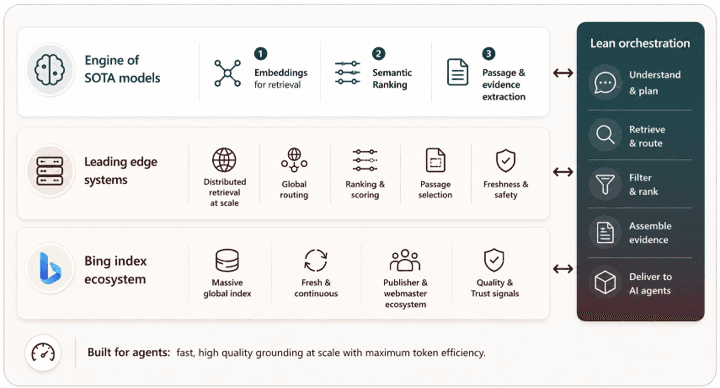
Microsoft used its Build 2026 stage in San Francisco and online to launch Web IQ, a move that treats search less like a results page and more like infrastructure for AI agents that need evidence they can reason over. The pitch is sharp: human searchers want pages, but multi-step workflows need fast, grounded context they can inject directly into a model.
Microsoft says Web IQ is “a suite of AI-native grounding APIs built for the agentic era,” and the company describes it as a “search engine for AI systems.” It returns ranked, citation-ready context across web pages, news, images, video, and more, then feeds that output into an LLM context window. The product page claims 164 ms P95 latency, says the system is nearly 2.5 times faster than today’s best alternative, and says it uses significantly fewer tokens per query. Microsoft also says Web IQ is built on 20 years of Bing search infrastructure and was re-architected across indexing, retrieval, ranking, passage selection, and orchestration for inference-time grounding.

That architecture matters because Microsoft is clearly aiming at repeated retrieval, reasoning, and tight latency budgets, not one-off search queries. The company says Web IQ combines licensed sources, structured data sources, and the open web rather than SERP scraping, and validates the system against benchmarks including DeepSearchQA, grounding satisfaction, and freshness. Microsoft is also framing the product as model-agnostic and MCP-native, a signal that it wants to own the plumbing layer behind agentic search, not just the assistant surface.
Nasdaq is already an example of the use case Microsoft wants to win. Mohsin Shafqat, Nasdaq’s director of software engineering, says Web IQ lets Nasdaq query external data at lightning speed without bolting on a separate system or compromising security. That is the real bet here: agents will increasingly need trustworthy outside knowledge at runtime, and the companies that can supply it cleanly will shape what gets surfaced, cited, and acted on.
For publishers and brands, the shift is hard to ignore. If agents become the primary retrievers, page-one rankings matter less than being present in fresh, structured, machine-readable sources that an AI can pull quickly and trust enough to cite. Microsoft’s own messaging points to the next phase of discoverability: source quality, freshness, attribution, and retrieval-friendliness, not just headline SEO. Web IQ is a sign that the battleground is moving below the answer layer, into the grounding layer that decides what an agent believes in the first place.
This article was produced by Prism’s automated news system from verified source data, official records, and press releases, then run through automated quality and moderation checks before publishing. The system is built and supervised by the people who set the standards it runs under. Read our full AI policy.
Did this article answer your question?