Rolex dominates AI search as intent reshapes luxury watch visibility
Rolex captured an estimated 17% of AI citation share across 60-plus prompts, while value and investment queries pushed smaller rivals into view.
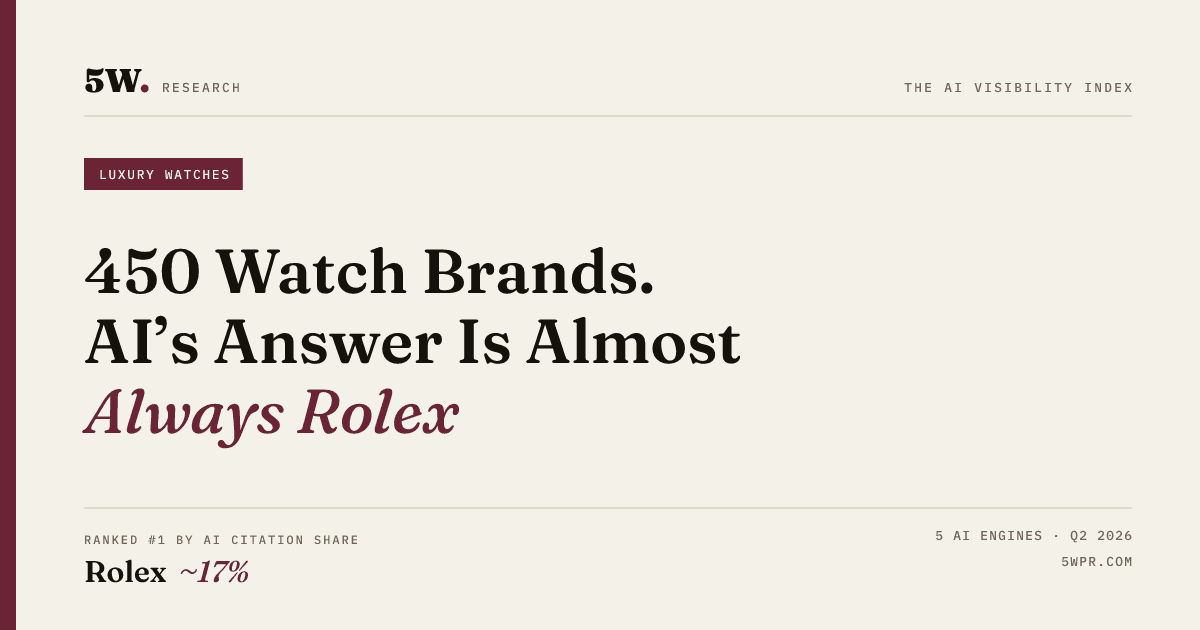
A June 24, 2026 luxury-watches release from 5W showed how quickly AI search can concentrate a crowded category around one default answer. After testing more than 60 consumer prompts across ChatGPT, Claude, Perplexity, Gemini and Google AI Overviews, the firm found Rolex holding an estimated 17% of AI citation share, a result that matched the brand’s outsized position in the market.
The concentration is even sharper in the underlying industry data. Rolex already represents roughly one-third of the category’s estimated Swiss watch industry value, and the release said about 25 brands out of roughly 450 account for an estimated 90% of Swiss watch sales. In that setting, broad prompts tend to pull the same familiar name back to the top, showing that AI is not flattening the luxury-watch market so much as reinforcing its hierarchy.
The pattern changed when the prompt carried a buying intent. Under investment-oriented queries, Patek Philippe and Audemars Piguet rose to the top of the answer set. Under value-oriented prompts, Tudor and Grand Seiko won visibility. That split matters because it shows AI search visibility as a set of smaller answer markets rather than a single category leaderboard. Rolex can own the generic question, while other brands can win the narrower questions tied to price, collectability or entry-level prestige.
5W’s framing points to a practical shift for luxury marketers: winning the broad category name is not the only way to matter in AI search. Brands need to own a distinct question or use case, and the release argued that training systems to recognize the brand as the answer for a specific buyer need may matter more than chasing fame alone. For an industry built on heritage, the report suggests that machine-readable authority now sits alongside editorial coverage and retail presence as a visibility signal.
This article was produced by Prism’s automated news system from verified source data, official records, and press releases, then run through automated quality and moderation checks before publishing. The system is built and supervised by the people who set the standards it runs under. Read our full AI policy.
Know something we missed? Have a correction or additional information?
Submit a Tip