Search Engine Journal maps a 90-day playbook for AI search visibility
AI visibility is turning into a 90-day operating sprint, with brands auditing signals, testing fixes, and tracking results by week 2, 4, and 12.
AI visibility has become an operating problem
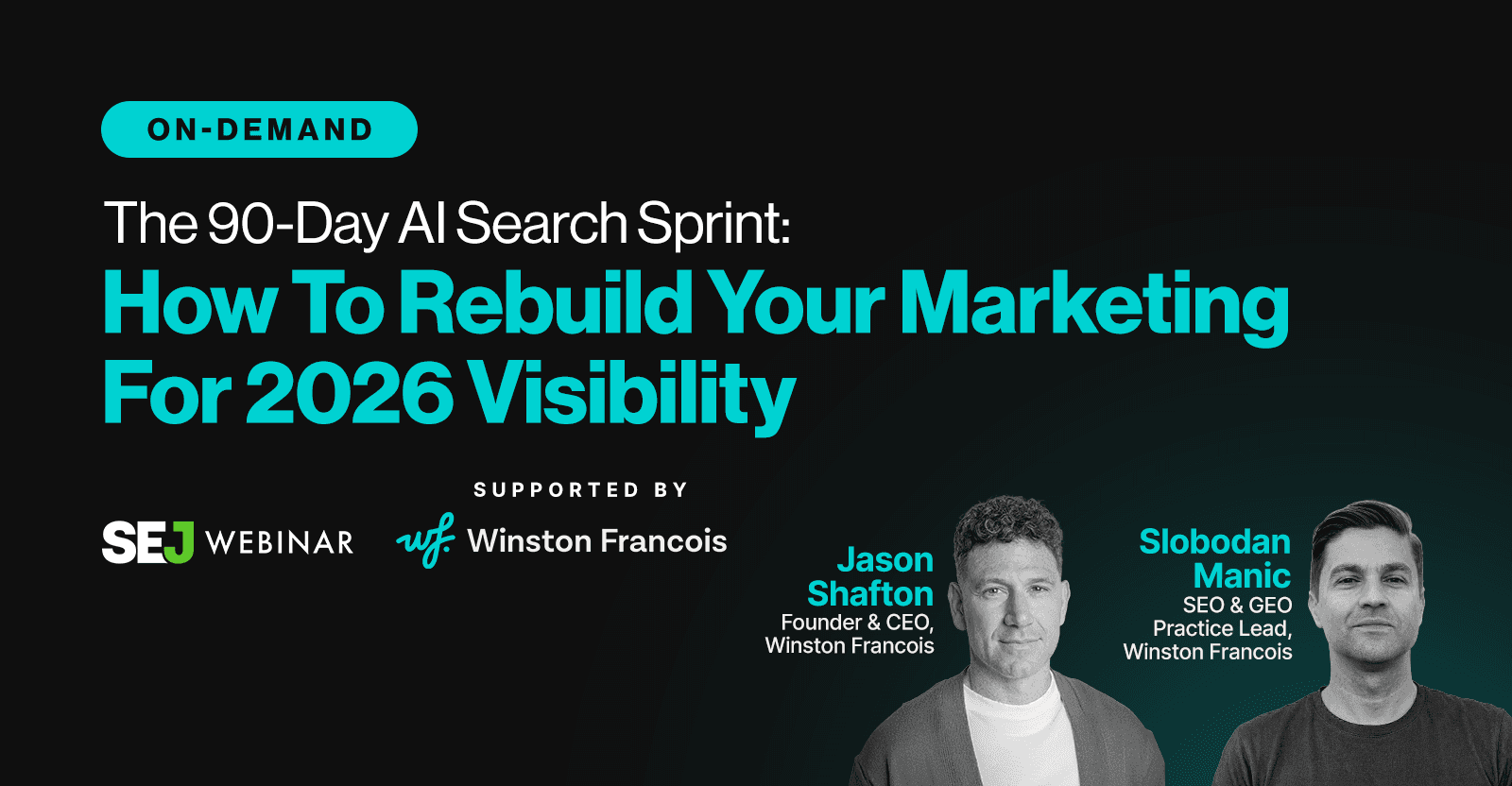
Search Engine Journal’s 90-Day AI Search Sprint treats AI visibility as a practical workflow, not a future-facing slogan. The core question is blunt: when a buyer asks Gemini, Claude, or another AI answer engine for a recommendation, does your brand show up at all? That framing matters because the session is built around current AI search signals, a 90-day visibility framework, and success playbooks drawn from Google and Headspace.
The shift is bigger than one webinar. AI-powered search has moved from a test case into the mainstream, which means visibility now has to be managed with the same discipline as paid media, organic search, or lifecycle marketing. The brands that move fastest are no longer asking whether AI search matters. They are deciding what to audit first, who owns each fix, and how to tell by week 2 whether the work is actually changing outcomes.
Why the sprint matters now
Google, OpenAI, and Perplexity have all pushed answer-style search deeper into everyday use. Google introduced AI Overviews at Google I/O 2024, said people had already used them billions of times in Search Labs, and said the feature would roll out to everyone in the United States beginning May 14, 2024. Google later said it expected AI Overviews to reach more than a billion users by the end of 2024, which shows how quickly the interface moved from experiment to scale.
OpenAI followed with ChatGPT search on October 31, 2024. It later expanded to all logged-in users on December 16, 2024, and then to everyone in supported regions on February 5, 2025. Perplexity added more pressure to the market with Deep Research on February 14, 2025, a product it says performs dozens of searches and reads hundreds of sources to assemble a report. The signal for marketers is simple: AI search is no longer one product, one interface, or one future scenario.
Google’s own messaging reinforces that point. The company has said AI Overviews are backed by top web results and are meant to connect people to deeper sources. In its May 2026 Search messaging, Google said it is improving how AI Search features show links so users can find the sources, brands, and websites they value. That means visibility still depends on being a credible, source-worthy destination, even as the answer layer becomes more conversational.
What to audit first in the first two weeks
The first move in a 90-day plan is not to launch everything at once. It is to establish a clean baseline for the prompts, pages, and entities that matter most. If a brand does not know where it already appears, where it gets cited, and where it disappears, every later test becomes guesswork.

Start with a focused audit across the queries that represent real buyer intent. Pull the questions that matter most to your category, then check whether your brand appears in AI Overviews, ChatGPT search, and Perplexity responses, and whether those responses link back to you or to competitors. From there, map the content that is most likely to be cited: product pages, comparison pages, explainers, expert-led articles, support material, and pages with clear evidence.
A useful division of labor keeps the sprint moving:
- SEO and content own prompt coverage, page quality, internal links, and structured content.
- Analytics owns the baseline dashboard, the prompt set, and the measurement cadence.
- PR and communications own authority-building, third-party mentions, and citation opportunities.
- Product or web teams own implementation, page updates, and testing speed.
By the end of week 2, the team should know three things with confidence: which prompts matter most, where the brand appears today, and which pages have the strongest chance of being surfaced or cited. That baseline becomes the scorecard for the rest of the quarter.
How to run the first experiments by day 30
Once the baseline is visible, the next step is to make pages easier for AI systems to trust and reuse. Google’s explanation of AI Overviews points to the same principle: strong underlying web results matter. That pushes teams to tighten content structure, clarify claims, reduce ambiguity, and make source material easier to parse.

The best early experiments are narrow and measurable. Rewrite a small set of high-value pages so they answer buyer questions directly, support claims with evidence, and make key facts easy to extract. Build comparison and decision pages for queries that lead users toward a shortlist, and strengthen content that already earns traffic but is underperforming in AI surfaces.
This is where the Search Engine Journal framing becomes especially practical. The session is not treating AI search as a pure strategy debate; it is treating it as a system for deciding what to cut, what to expand, and what can be handed to AI-assisted workflows. That is the right mindset for the first month, because the goal is not volume. The goal is to prove which content patterns are most likely to earn inclusion, links, and trust.
By week 4, success should show up in a few clear ways: more branded appearances in priority AI answers, stronger citation frequency for key pages, and a cleaner understanding of which content types produce visibility. If the team cannot point to any movement, the page structure, source signals, or prompt selection needs another pass.
How to scale what works through day 90
The final phase is about repeatability. Search Engine Journal’s framework suggests a move from auditing, to AI-native experimentation, to scaling the tactics that work. That means the team should stop treating each prompt test as a one-off and start building a repeatable playbook for the highest-value questions in the category.
This is also where funded teams like Google and Headspace become the useful model. The lesson is not that every brand needs their resources; it is that growth now depends on aligning content, analytics, and experimentation around the AI discovery layer. The companies that win will be the ones that can make quick decisions about which pages deserve more investment, which claims need stronger proof, and which topics should be retired because they no longer pull their weight.
By week 12, the operating plan should have delivered a clear before-and-after view. The team should know how often the brand appears in AI search for its priority prompts, how often it is linked or cited, which content assets are carrying the load, and which fixes are now part of standard workflow. If those signals are improving, AI visibility has become a measurable channel rather than an abstract ambition.
That is the real value of the 90-day sprint. It turns AI search from something teams talk about into something they can audit, assign, and improve on schedule.
This article was produced by Prism’s automated news system from verified source data, official records, and press releases, then run through automated quality and moderation checks before publishing. The system is built and supervised by the people who set the standards it runs under. Read our full AI policy.
Did this article answer your question?