Semrush Says Blog SEO Must Win Google Rankings and AI Citations
Blog SEO is no longer just about page-one rankings. Semrush says the winning play is content that Google and AI tools can both trust, parse, and cite.
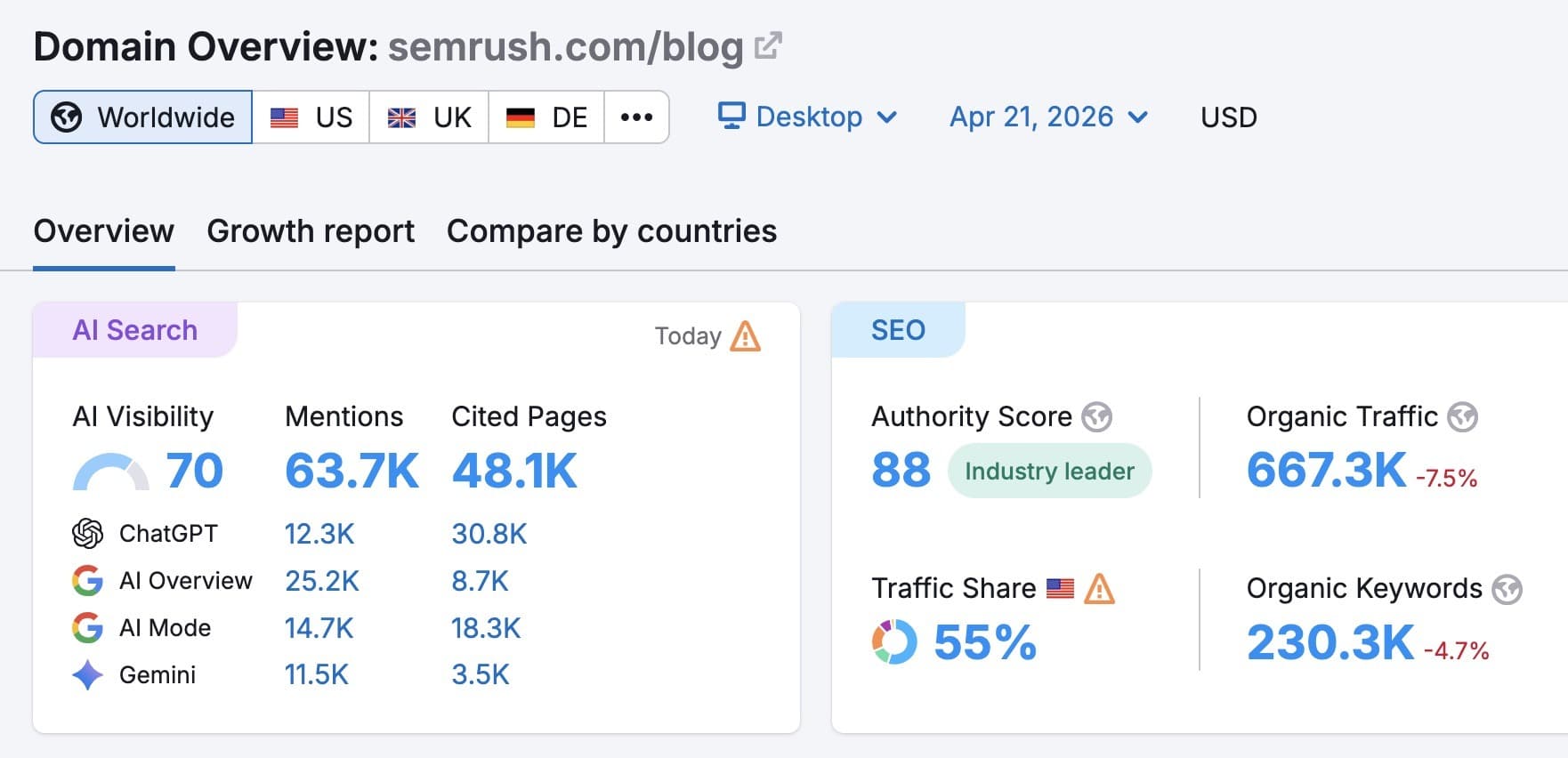
Blog SEO now has to win two battles at once, and the old habit of writing for Google alone is too narrow for what publishers face now. The best-performing posts are not simply the ones that rank well in search results; they are the ones that AI systems can confidently quote, summarize, and surface as sources.
The new blog SEO brief
Semrush’s guide reframes the job in practical terms: create content that is easy to find, easy to understand, and easy to trust across both search results and AI-generated answers. That matters because tools like ChatGPT and Perplexity are becoming part of how readers look for information, and the pages those systems cite are not always the same pages that sit at the top of Google. In other words, a strong blog strategy now has to serve traditional discovery and citation-driven discovery at the same time.
The commercial logic is just as clear. A well-optimized blog can still generate long-term organic traffic, leads, and brand authority without relying on paid media. At the same time, the same content can increase the odds of being referenced by AI tools, which turns editorial quality into a visibility asset on two fronts instead of one.
Four priorities now do the heavy lifting
Semrush identifies four core priorities that carry across both Google rankings and AI citations: trustworthiness through E-E-A-T, machine readability through clean structure and schema, answer-first writing, and topical authority built through connected content clusters. Taken together, these are not separate tactics. They are one publishing system designed to satisfy both a human reader and an answer engine.
Trustworthiness starts with genuine expertise. Content that shows first-hand knowledge, clear sourcing, and a credible point of view is better positioned to earn confidence from readers and the systems trying to interpret the page. That is especially important in a world where AI outputs depend on the quality of the pages they retrieve.
Clear structure is now a citation signal
If traditional SEO often obsessed over keywords and metadata, the new citation environment rewards clarity and sequence. Semrush points to AirOps research analyzing 12,000 URLs and says pages with properly sequenced headings were 2.8 times more likely to be cited in ChatGPT than pages with disorganized heading structures. That is a powerful signal that structure is not just a formatting choice anymore. It is part of how AI systems judge whether a page can be reliably parsed.
Google’s own guidance reinforces the same direction. Search Central says structured data helps Google understand what is on a page and can also help pages qualify for richer appearances in search. Google also now separately frames AI features such as AI Overviews and AI Mode as visibility surfaces site owners should consider. The message is consistent: if the page is easier for machines to read, it has a better chance of being surfaced, summarized, or expanded into richer search experiences.
What clean structure looks like in practice
- Lead with descriptive headings that follow the logic of the article.
- Keep sections ordered so a reader can skim without losing the argument.
- Use structured data where it fits the content type, because it helps search systems interpret the page.
- Avoid burying the main point under long setup paragraphs when a direct explanation would do the job faster.
That approach helps readers first, but it also gives AI systems fewer excuses to misread the page.
Answer-first writing is becoming the baseline
One of the clearest shifts in modern blog SEO is the move toward answer-first prose. The best-cited pages are the ones that make the point quickly, then expand with detail, examples, and context. That style works because readers get their answer without friction, and AI systems get a concise formulation they can lift into a synthesized response.
This is where the line between editorial quality and machine readability begins to disappear. A blog that helps a human reader quickly understand a topic is also easier for AI systems to parse and summarize. Semrush’s broader point is that this is not two separate goals. It is the same content quality, viewed from two different surfaces.
Topical authority now depends on connected coverage
A single isolated post can still rank, but it is much less likely to define a topic than a connected cluster of articles that reinforce one another. Semrush argues that topical authority comes from building a web of related content rather than publishing standalone pieces with no broader context. That matters because AI systems look for signals that a source understands a subject deeply, not just casually.
For publishers, that changes the editorial calendar. Instead of chasing one-off keywords, the stronger approach is to build clusters that answer the main question, the subquestions, and the practical follow-ups around a topic. Done well, that structure supports Google visibility while also making the site a more credible source for answer engines that want to reference multiple related pages from the same publisher.
The AI search layer is not an afterthought
OpenAI says ChatGPT Search responses can include inline citations and a Sources panel that links back to cited material. Perplexity describes itself as an answer engine that searches the web in real time and returns answers with sources and citations included. Those details matter because they show how discovery is changing: the page may no longer need only to win the click, it may need to win the citation first.
Semrush’s wider AI-search framing pushes that idea further. It describes AI search optimization as a practice focused on being frequently referenced and prominently featured by language models such as ChatGPT, Google’s AI Overviews, and Perplexity. It also cites data suggesting traffic from large language models could overtake traditional organic search traffic by early 2028. That makes AI visibility a growth issue, not a side project.
Freshness is part of the citation game
AI visibility is not a one-time win. AirOps adds another useful layer to the picture, saying only 30% of brands stay visible from one AI answer to the next, and only 20% remain present across five consecutive runs. It also says pages that are not updated quarterly are three times more likely to lose citations. The lesson is simple: static content is more vulnerable than maintained content.
That should push publishers to treat updates as part of the publishing model, not a cleanup task. Refreshing facts, tightening headings, and keeping the most important pages current helps preserve both ranking potential and citation potential. In a system where answer engines can reshuffle visibility from one query run to the next, freshness is a competitive advantage.
The old SEO playbook is being rewritten, not discarded
This shift does not mean abandoning SEO fundamentals. It means separating the parts of old advice that were really about clarity from the parts that existed only to game rankings. Google still wants helpful, reliable, people-first content rather than pages built to manipulate rankings. The winning blog strategy now is the one that earns trust, uses clean structure, answers the question directly, and proves ongoing authority over time.
That is the real dual-optimization challenge: one content system, two visibility surfaces. The publishers who adapt fastest will not be creating a separate AI strategy alongside SEO. They will be building content that is strong enough to satisfy both at once, and that is where the next advantage will come from.
This article was produced by Prism’s automated news system from verified source data, official records, and press releases, then run through automated quality and moderation checks before publishing. The system is built and supervised by the people who set the standards it runs under. Read our full AI policy.
Did this article answer your question?