Semrush urges marketers to track AI search visibility beyond SEO rankings
SEO rankings still matter, but they miss where AI answers steal the click. Semrush says marketers need a dashboard built around mentions, citations, and revenue.
The measurement reset starts with one uncomfortable truth
Classic rank tracking was built for a search results page that expected a click. AI search breaks that assumption. Semrush’s guidance is blunt: if an answer is already delivered inside Google AI Overviews, ChatGPT, Gemini, or Claude, the old mix of rankings and organic traffic no longer tells you who is actually winning discovery.
That is the core shift marketers need to internalize. Visibility is no longer just where you rank, but whether your brand is mentioned, cited, and used as a source inside the answer itself. If you are still treating organic sessions as the main proof of search performance, you are measuring the aftermath instead of the discovery moment.
Why the old dashboard is missing the real action
Google has made clear that AI search is not a side experiment. In May 2025, AI Overviews were available in more than 200 countries and territories and in more than 40 languages. Google first said at I/O 2024 that AI Overviews would roll out to everyone in the United States and that access was expected to reach over a billion people by the end of 2024.
The usage data matters just as much as the footprint. Google said in 2025 that AI Overviews was driving over 10% increase in usage of Google for the types of queries that show AI Overviews. That is the sort of number that should make any reporting team rethink what counts as a search win. AI search is no longer an edge case, and the traffic it reshapes is too large to bury inside a standard SEO report.
OpenAI is pushing in the same direction. ChatGPT search now returns fast, timely answers with links to relevant web sources, and its help center says responses may include inline citations or a Sources panel. In other words, citations are not abstract theory anymore. They are visible, trackable touchpoints that can be measured alongside traditional search performance.

The KPIs that actually matter now
Semrush’s practical advice is to widen the measurement lens. The right reporting mix starts with the AI systems that matter most right now, specifically Google AI Overviews, ChatGPT, Gemini, and Claude. From there, the useful KPIs are the ones that show whether your brand is appearing in the answer layer, not just sitting somewhere in the broader search index.
The metrics worth putting on the page are:
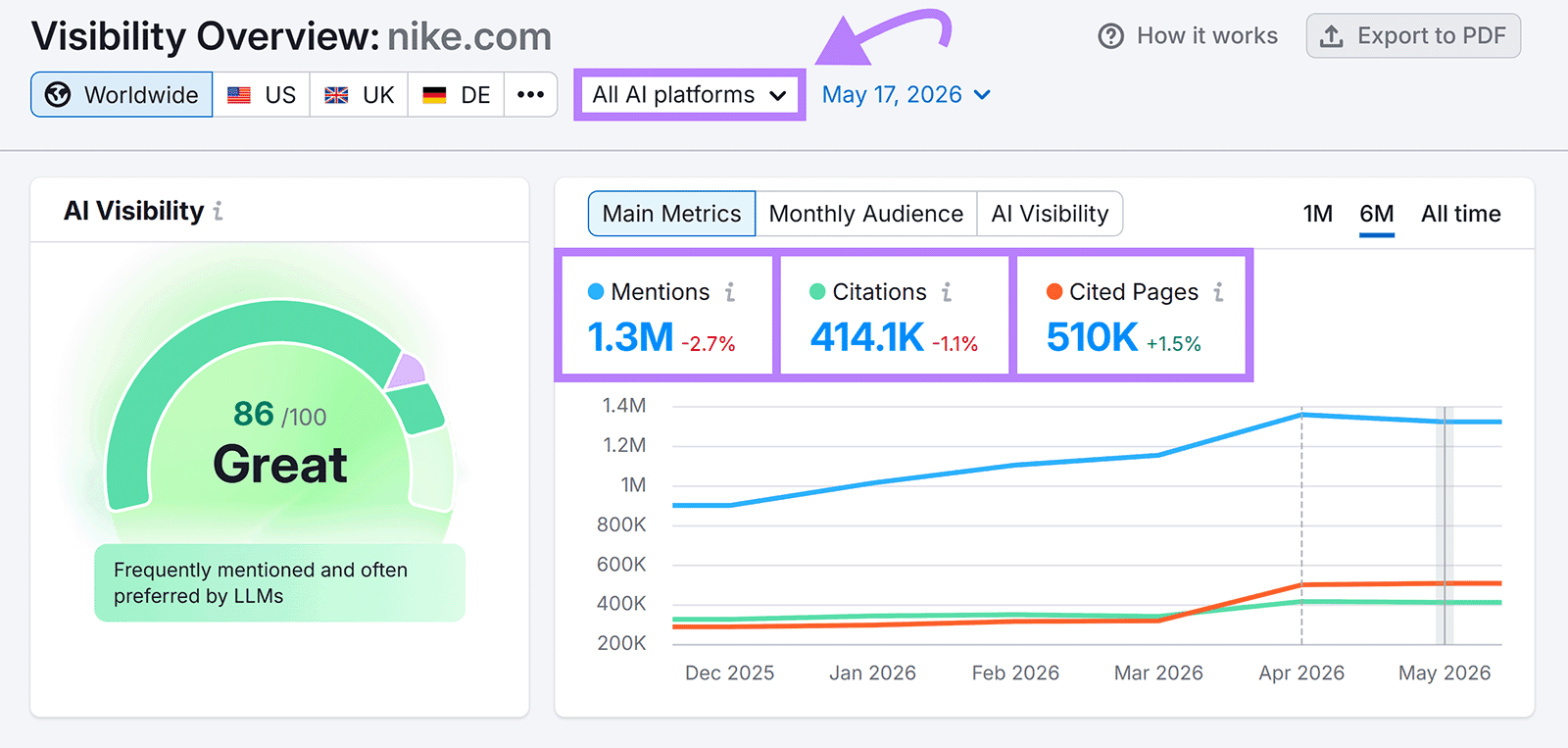
- AI answer mentions, which show whether your brand is named when an assistant responds.
- Citation share of voice across assistants, which tells you how often you are selected as a source compared with competitors.
- Cited pages, which reveal which URLs are earning AI visibility and which content formats are being surfaced.
- Referral patterns from AI platforms, which help you see where AI answers are actually sending visitors.
- Downstream conversions, which connect AI discovery to leads, sign-ups, purchases, or other business outcomes.
That mix is more useful than raw traffic alone because the user journey may end inside the AI answer, continue into a cited source click, or move into follow-up prompts before a traditional organic session ever appears. If you only count the final click, you miss most of the story.
How to separate AI visibility from organic search
One of Semrush’s smartest points is also one of the easiest to overlook: AI visibility metrics should be separated from organic traffic metrics. When both are blended together in the same dashboard, a drop in clicks can look like a discovery problem when it is really a behavior shift inside the answer engine.
That separation is what keeps leadership reporting honest. If a page earns more citations in AI Overviews but gets fewer classic organic visits, that does not mean the content lost value. It may mean the answer is being consumed earlier in the journey, before the click. The right dashboard needs to show both numbers side by side, but not pretend they are the same thing.
The best teams will also check analytics for AI platforms sending actual traffic. Semrush treats that referral traffic as a form of citation signal, even when traffic volume itself is not the main KPI. That is the right instinct. A small stream of visits from a cited AI source can be more strategically important than a bigger batch of low-intent organic clicks.
Building an executive reporting dashboard that leadership will actually use
If you want this measurement reset to land with executives, the dashboard has to tell a business story, not a channel story. Start with an AI visibility layer that tracks mentions, citations, cited pages, and referral activity across the assistants that matter. Then connect that layer to the outcomes leadership already understands: qualified leads, assisted revenue, conversion rate, and ROI.
A clean executive view should answer four questions fast:

- Are we showing up inside AI answers for the topics that matter?
- Are we being cited more or less than our competitors?
- Which AI systems are sending traffic, and to which pages?
- What business outcomes changed after visibility improved?
That structure is better than a rank report because it reflects how people now discover information. It also gives teams a way to prove value even when the click path gets shorter.
Keep the measurement stack flexible
Semrush also warns against freezing your reporting model. AI search trends change rapidly, which means teams should review their platform mix quarterly rather than lock themselves into a static measurement stack. That makes sense. The assistants worth tracking today may not be the same ones that matter next year, and the share of voice in one system can shift quickly as products, models, and answer formats change.
That quarterly reset is where marketers can stay ahead of the noise. Measure the assistants that are shaping demand now, separate AI visibility from traditional organic traffic, and tie everything back to the outcomes the business cares about. The brands that do that will stop asking whether AI search is replacing SEO. They will already be reporting on where the next click, citation, or conversion came from.
This article was produced by Prism’s automated news system from verified source data, official records, and press releases, then run through automated quality and moderation checks before publishing. The system is built and supervised by the people who set the standards it runs under. Read our full AI policy.
Did this article answer your question?