Semrush warns AI search is creating a growing attribution gap
AI search is winning attention before the click, and Semrush says that hidden influence is leaving marketers with a widening attribution gap.
The blind spot is already hurting measurement
AI search is creating value that analytics can see only after the fact. Semrush’s May 5, 2026 guide, written by Chris Hanna, argues that a growing share of buying decisions now happens inside tools like ChatGPT, Perplexity, Google AI Mode, and Google AI Overviews, while standard reporting systems still record only the later click. That leaves marketers with a familiar but sharper problem: the outcome shows up in revenue, sign-ups, or organic traffic, yet the influence that shaped the decision never appears in the dashboard.
Semrush breaks that gap into two distinct forms. The first is invisible influence, when an AI-generated answer recommends a brand and the user never clicks from the AI interface at all. The second is agentic search, when an AI agent completes part of the journey or moves the buyer far enough along that the original source is lost. Semrush calls the result dark traffic, because the business result is visible, but the path that drove it is not.
Why AI search makes old attribution models leak even more
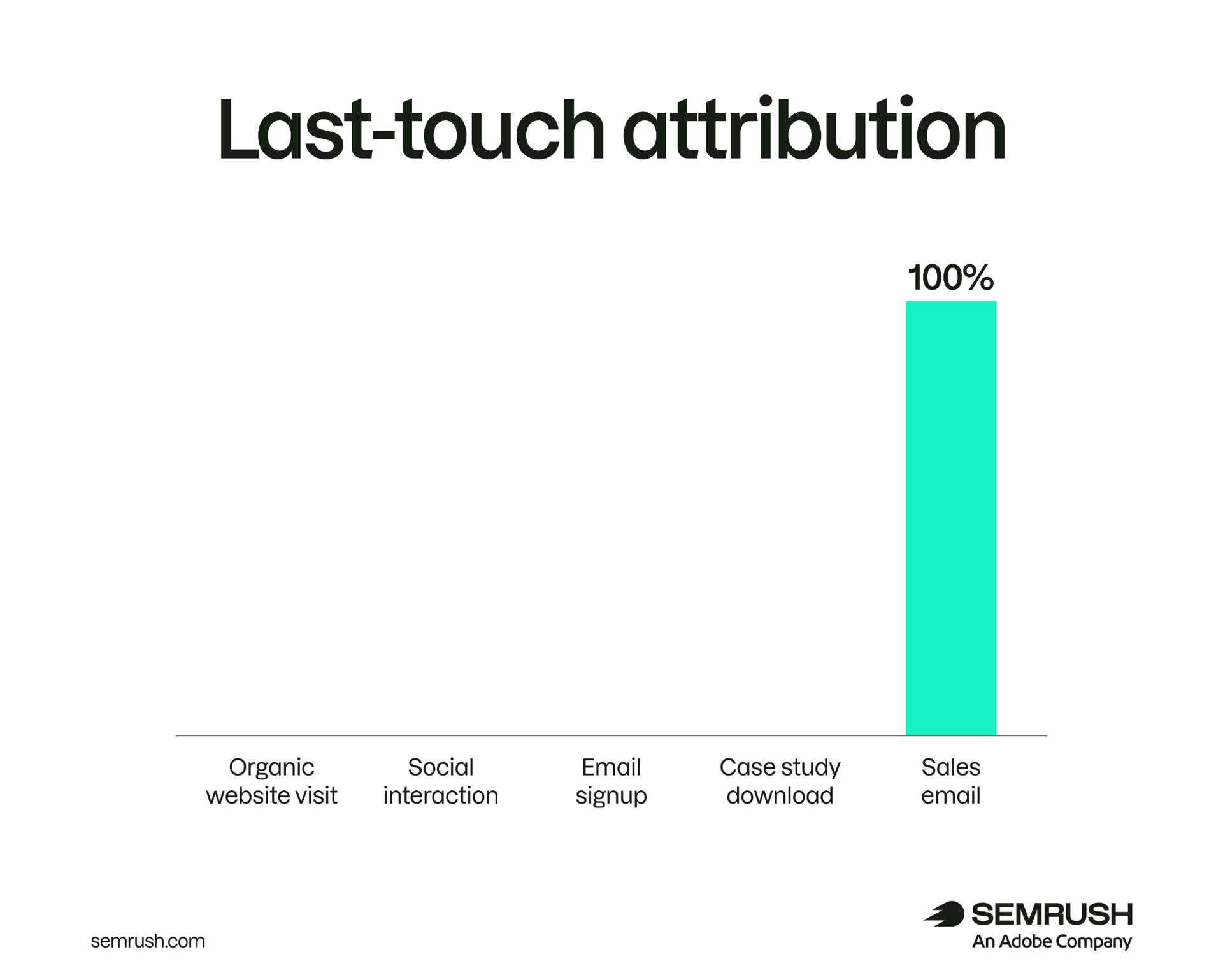
Attribution has always been imperfect, but AI pushes the blind spot earlier in the funnel. A person may discover a brand in a synthesized answer, compare options inside the assistant, then later visit through Google and be credited to organic search alone. In that scenario, the AI touchpoint did the real persuasion work, but last-click logic gives the credit to the final visit.
That shift matters because evaluation is happening before the visit, not after it. Semrush’s framing is especially useful for teams that still rely on session-based reporting as the main source of truth. If the user has already narrowed the shortlist inside AI, the website may never get credit for the part of the journey that mattered most.
The scale of AI discovery is no longer niche
Semrush’s broader reporting shows why this is becoming a mainstream search problem. Its December 2025 AI Overviews study said AI Overviews appeared for 15.69% of keywords in November 2025, after peaking near 25% in July 2025. The same study found that navigational queries triggering AI Overviews rose from 0.74% in January 2025 to 10.33% in October 2025, a clear sign that even branded and destination-oriented searches are being filtered through AI.
Google says AI Overviews now reaches more than 1.5 billion users in more than 200 countries and territories every month, which helps explain why marketers can no longer treat AI visibility as an experiment. OpenAI added another signal in July 2025 when it said ChatGPT users send more than 2.5 billion messages per day globally. Together, those figures show a discovery layer that is massive, habitual, and increasingly separate from classic referral tracking.
The leak existed before generative AI, but the leak is getting wider
The attribution gap did not begin with AI. SparkToro’s 2024 zero-click study found that in the United States, only 360 of every 1,000 Google searches led to a click to the open web. That means search attribution was already incomplete even before assistants began answering questions directly.
AI tools deepen that problem by moving more evaluation into the answer itself. Instead of sending a user through a chain of visits, they can compress research, shortlist building, and comparison into one interface. Semrush’s own agentic-search reporting says agentic web traffic grew 1,300% in the first eight months of 2025, which suggests the market is already shifting toward more machine-driven journeys that traditional analytics are not built to follow.
Agentic search changes the shape of the journey
The agentic side of the story is especially important because it is not just about answers, but about actions. Google’s SAGE research found that AI agents take an average of 4.9 steps per query before delivering a result. That means the system may gather, filter, compare, and refine on behalf of the user before any human sees the final recommendation.
For brands, that means multiple sources can be evaluated in sequence, with some options removed before the buyer ever knows they existed. It also means referral traffic can understate influence, because part of the decision was already made inside the agent’s workflow. In practical terms, the attribution model is no longer just missing a click. It is missing the decision architecture that preceded the click.
What teams can measure right now
Semrush and Ahrefs both point toward a more realistic measurement stack, one that looks beyond raw referral volume. The goal is not to chase a perfect last-click answer. It is to capture the signals that reveal where AI is shaping demand, even when the final visit comes through another channel.
Start with these measures:
- AI mentions and citations, so you can see whether your brand appears in answer layers across ChatGPT, Perplexity, Google AI Overviews, and similar interfaces.
- Category-level presence, which shows whether you are consistently included when buyers compare options in a topic area.
- Assisted influence, especially when AI exposure is followed by later direct, organic, or branded search visits.
- Sign-ups and conversions that appear after AI exposure, since the conversion may be attributed elsewhere even when AI played a major role.
- Referral traffic from AI surfaces, but only as one input, because some of that influence is likely being misclassified as direct or organic traffic.
Ahrefs’ March 2025 reporting gives that last point extra weight. Across a sample of about 35,000 websites, AI sent just 0.1% of total referral traffic, yet in Ahrefs’ own case, AI-search traffic represented about 0.5% of visits and accounted for about 12.1% of sign-ups. That gap is exactly why raw traffic share can be misleading. A small stream of AI-driven visits can still produce outsized downstream value.
How attribution frameworks need to evolve
The big shift is conceptual. Attribution can no longer focus only on what drove the click. It has to account for what shaped the decision. That means teams need reporting that combines visibility tracking, mention monitoring, and conversion analysis instead of treating sessions as the full story.
The most useful framework will recognize three stages: discovery, evaluation, and conversion. AI is increasingly dominating the first two, while standard analytics mostly measure the third. If the brand is absent from AI answers, it may never enter the shortlist. If it is present but never clicked, the influence still exists. If an agent completes the comparison and the user arrives later through a different channel, the AI touchpoint may disappear entirely unless the measurement model is built to capture assisted impact.
Semrush’s guide lands at the right moment because the industry is moving from a click-centered web to an answer-centered one. Marketers who only measure after the visit will keep seeing partial truth. The teams that adapt now, by tracking AI visibility, monitoring citations, and measuring influence before the session begins, will be the ones with a clearer read on where demand is actually being created.
This article was produced by Prism’s automated news system from verified source data, official records, and press releases, then run through automated quality and moderation checks before publishing. The system is built and supervised by the people who set the standards it runs under. Read our full AI policy.
Did this article answer your question?