Wedding AI responses favor two-platform duopoly, leaving local vendors invisible
AI wedding answers are funneling most discovery to just two owners, while 84% of individual vendors get no citation share at all.
The wedding search layer is hardening into a winner-take-most market. In 5W’s first AI Visibility Index for the U.S. wedding industry, The Knot, WeddingWire and Zola accounted for about 73% of wedding-planning AI responses, while roughly 84% of individual vendors, from photographers and florists to planners, venues, caterers, stationery designers and other specialists, showed effectively zero citation share in their own metro or niche.
That concentration matters because The Knot Worldwide owns both The Knot and WeddingWire, which makes the apparent three-platform field functionally a two-platform duopoly with Zola as the main independent challenger. In a category built on local relationships and word-of-mouth, the answer layer is now deciding who gets surfaced before a couple ever reaches out to a real business.

5W said it tested 65-plus consumer-intent prompts across ChatGPT, Claude, Perplexity and Google AI Overviews in the first quarter of 2026, then tracked citations across five wedding sub-categories: wedding planning aggregators, bridal fashion designers and retailers, editorial publications, photography brands, and stationery and registry services. The result is a visibility map that shows how generative AI narrows the field to a handful of high-authority names, rather than mirroring the full market of local operators.

For vendors, the warning is blunt: being good at the work is not enough if the systems answering the questions do not have enough structured evidence to recommend the business. For platform owners, the data rewards deep editorial archives, broad category coverage and cross-platform authority, all of which help shape the shortlist that couples see first.
The scale behind The Knot Worldwide helps explain why it keeps showing up. The company said its 2026 Real Weddings Study drew on insights from more than 10,000 U.S. couples. It has also said it helps 4 million couples connect with roughly 900,000 vendors through its global platform each year, supports more than 25 million weddings and reaches more than 45 million global users across its family of brands every month.
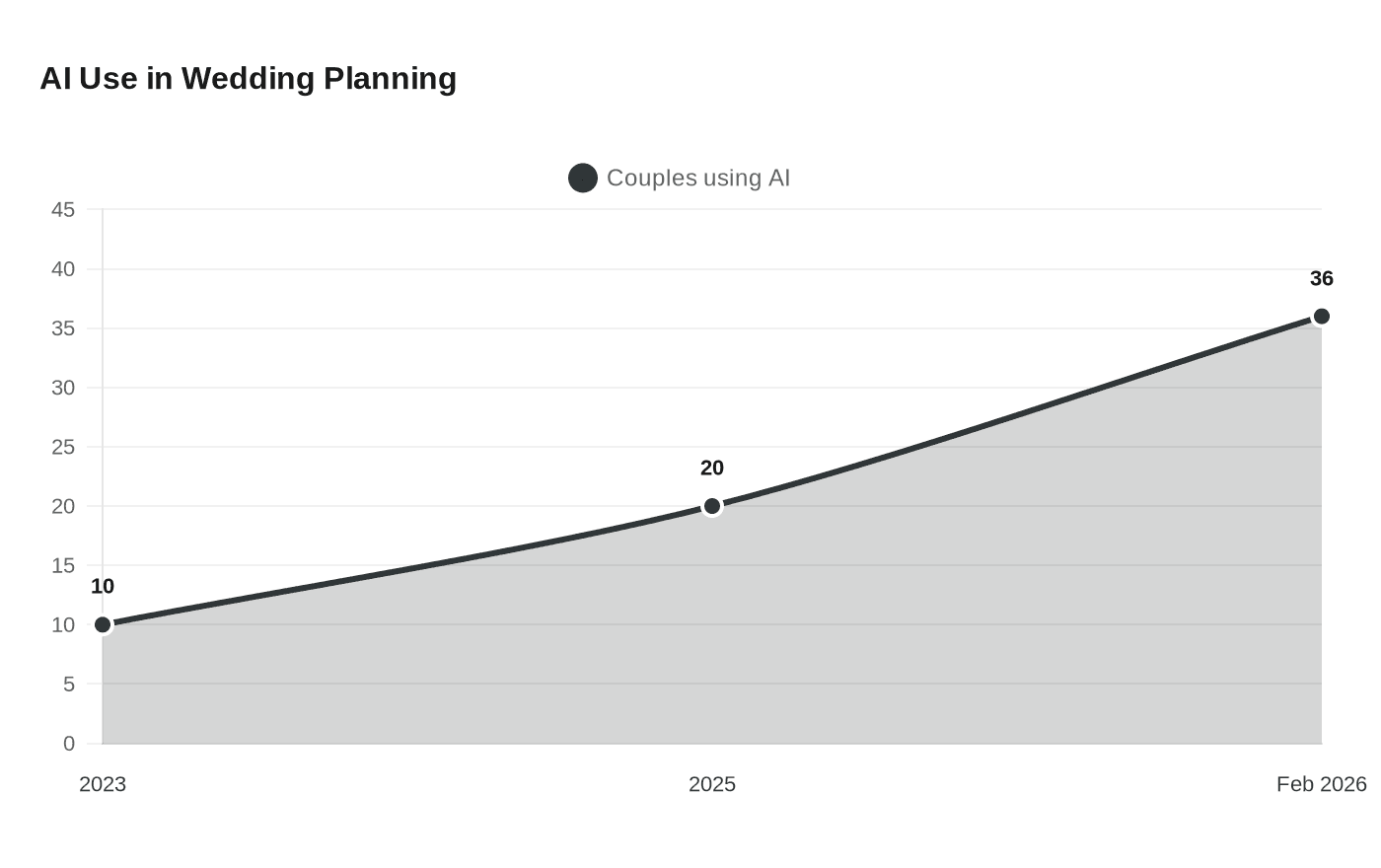
The company has also been pushing directly into AI products. The Knot launched an AI-powered planning experience on September 25, 2025, and The Knot Worldwide followed in February 2026 with what it called the wedding industry’s first app within ChatGPT. The Knot Worldwide’s own reporting suggests demand is rising fast: 20% of couples were using AI tools for wedding planning in 2025, up from 10% in 2023, and its February 2026 trends report said 36% of engaged couples surveyed were actively using AI, with 3 in 10 using image-based AI tools for inspiration or planning.
That is the real stake in the index. In a roughly $100 billion U.S. wedding category, AI answers are not just helping people search. They are deciding which brands stay visible and which local businesses disappear from the conversation.
This article was produced by Prism’s automated news system from verified source data, official records, and press releases, then run through automated quality and moderation checks before publishing. The system is built and supervised by the people who set the standards it runs under. Read our full AI policy.
Did this article answer your question?