Similarweb Index Recasts AI Visibility as a Brand Benchmarking Problem
Similarweb’s new index turns AI visibility into a category benchmark, showing which brands win discovery inside ChatGPT, Gemini, and Perplexity before search ever gets a click.
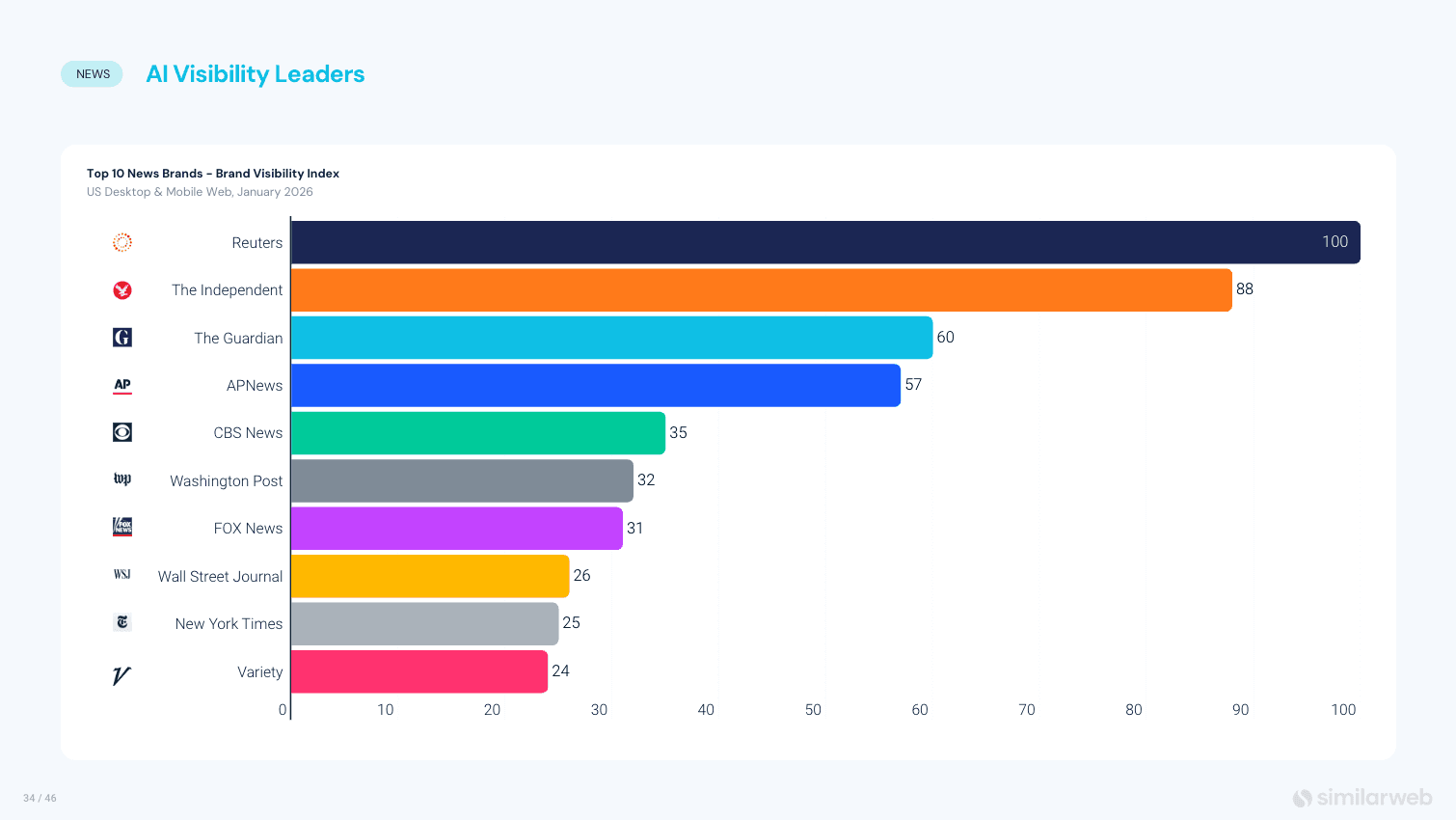
AI visibility is now a category race
Similarweb’s new Generative AI Brand Visibility Index shifts the conversation from keyword tracking to competitive positioning inside AI answers. The core idea is simple but consequential: brands are no longer competing only for search rankings, they are competing for inclusion, citation, and prominence inside generative responses across Finance, Travel, Beauty, Electronics, Fashion, and News.
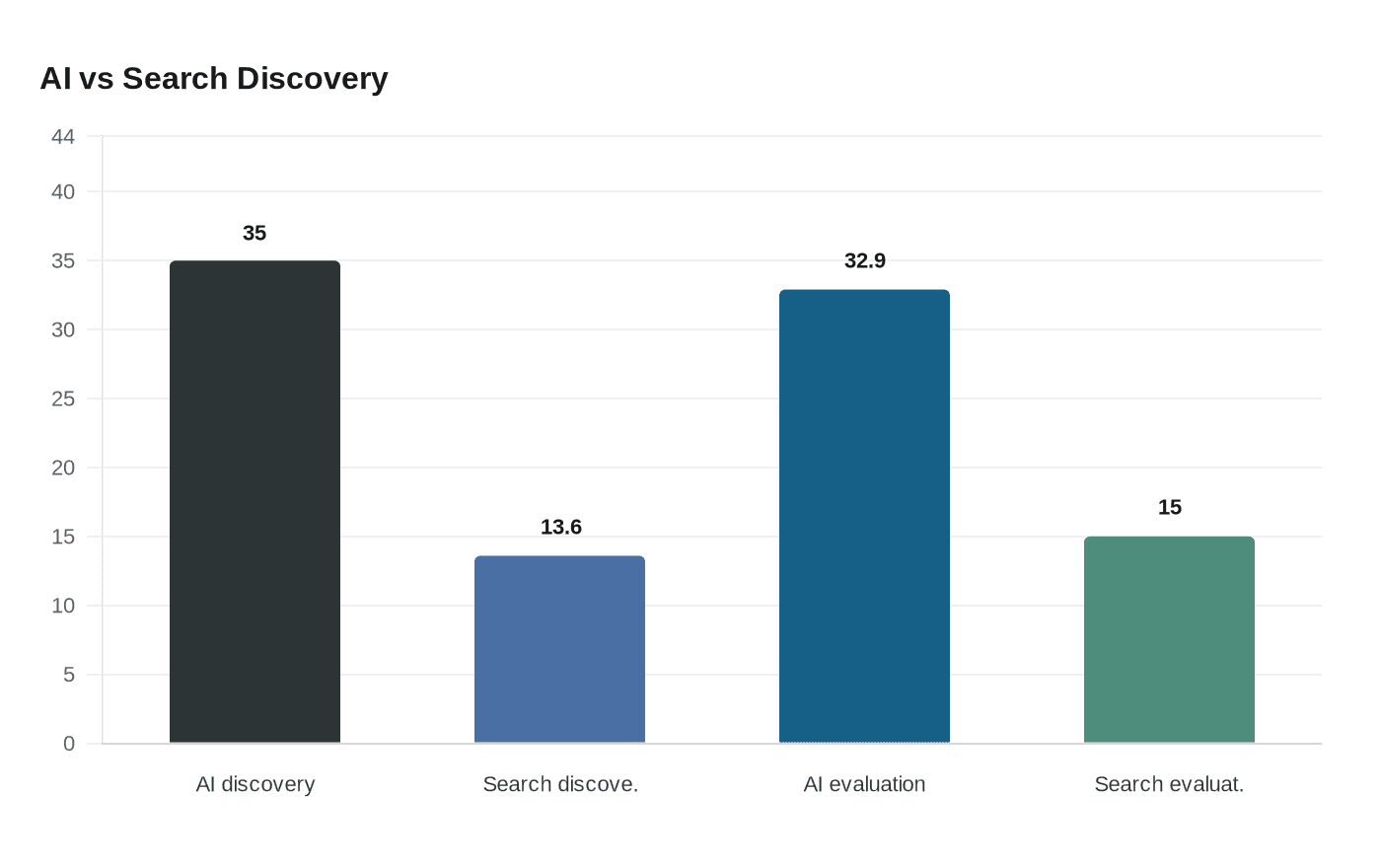
That framing matters because discovery is moving upstream. Similarweb says 35% of US consumers use AI at the product discovery stage, compared with 13.6% who use traditional search. At the evaluation stage, the gap is still striking: 32.9% use AI versus 15% using search. In practical terms, the shortlist is increasingly being formed inside AI interfaces before anyone ever lands on a familiar results page.
What the index measures
The report, published on March 3, 2026, benchmarks 113 brands across ChatGPT, Gemini, and Perplexity. Similarweb describes it as the first sector-level report of its kind, built to show which brands dominate AI-generated discovery and what patterns separate the winners from the laggards.
That sector view is the real breakthrough. Instead of treating AI visibility as a one-off SEO tactic or a vanity metric, the index treats it as a category benchmark. It gives teams a way to compare themselves with peers inside the same industry and ask a more useful question: not just whether a brand shows up, but whether it shows up more often, more favorably, and in more relevant contexts than competitors.
Why sector comparisons matter more than raw brand size
One of the most important takeaways from Similarweb’s reporting is that the biggest brands are not always the most visible brands in AI answers. The company says the brands accelerating in AI visibility across these sectors are often not the largest names in their categories, which is a direct challenge to the old assumption that scale alone guarantees discoverability.
That suggests AI systems may reward a different mix of signals than classic search does. Topical authority, source diversity, and cross-channel recognition appear to matter, especially when generative tools are trying to assemble an answer from multiple inputs rather than simply rank pages by links. For executives, that means the right benchmark is not just traffic or share of search. It is share of presence across AI answers, search, and other discovery surfaces.
The behavior shift behind the benchmark
The report lands alongside a broader consumer-behavior argument: AI is already reshaping how people discover and evaluate brands. Similarweb’s figures show a clear transition from search-first behavior to AI-assisted consideration, and that changes how visibility should be measured. A brand may still rank well in traditional search and yet be absent from the conversation where product and service decisions are increasingly being made.
External research reinforces that point. Pew Research Center found that 58% of U.S. adults encountered at least one Google search result with an AI-generated summary in March 2025, and users were less likely to click on links when an AI summary appeared than when it did not. Similarweb’s own analysis is even more direct: when an AI summary appeared, users clicked traditional search results only 8% of the time, compared with 15% without one, and clicked cited sources inside the summary just 1% of the time.
That is why AI visibility is not just a visibility story. It is a distribution story. If the answer is already being formed in the interface, the click is no longer the primary prize.
How to read overperformance in AI answers
The index is most useful when it is used like a diagnostic, not a trophy case. If a brand overperforms in AI visibility relative to its search footprint, that usually points to a healthier mix of signals than simple popularity. Similarweb’s framing suggests three likely advantages:
- Strong topical authority in the category
- Broad source recognition across the web
- A presence that generative systems can easily connect to user intent
That matters because AI tools such as ChatGPT, Gemini, and Perplexity are not just indexing pages. They are synthesizing answers. Brands that get mentioned repeatedly may be the ones with clearer category associations, stronger informational coverage, and more consistent presence across trusted sources.
Why marketers should benchmark before they act
The most practical message in the index is that strategy should start with comparison. A brand cannot improve AI visibility if it does not know where it stands against direct peers in its own sector. Similarweb’s cross-industry view makes that possible by turning a fuzzy problem into a measurable one, then asking which sectors are producing more favorable mentions and which brands are appearing with the right frequency and context.
This also explains why Similarweb’s earlier product work matters. The company launched its AI Brand Visibility tool in 2025 as part of its GenAI Intelligence toolkit, with the goal of showing how often a brand appears in generative AI tools, what topics drive those mentions, and whether the brand is cited as a source. The 2026 index builds on that foundation by moving from single-brand visibility tracking to sector-level benchmarking.
For leaders, that changes the playbook. The question is no longer whether the brand is “doing AI SEO.” The question is whether the brand is winning visibility where category decisions now begin.
What the strongest brands are likely doing differently
Similarweb’s broader commentary sharpens the point even further. The company has argued that AI visibility is now about whether “AI knows who you are,” a blunt but useful way of describing the new game. In category terms, the winners are the brands that generative systems can reliably recognize, classify, and surface when a consumer asks a question.
That usually means a few things are working at once:
- Clear association with specific needs, use cases, or product types
- Content that is easy for AI systems to interpret and reuse
- Mentions and citations across multiple credible sources
- Consistent visibility beyond one dominant channel
This is why the index matters to more than SEO teams. It gives brand, communications, and performance marketers a shared yardstick. If one category peer is showing up in AI-generated answers far more often, the gap may reflect messaging, content structure, source coverage, or brand authority, not just technical optimization.
The new standard for visibility
Similarweb’s Generative AI Brand Visibility Index is best understood as a warning and a blueprint. It warns that the old model of visibility, where rankings and clicks were enough, no longer captures how consumers actually discover brands. It also offers a blueprint for measuring the new reality: compare category peers, track presence across ChatGPT, Gemini, and Perplexity, and pay close attention to where AI systems choose to mention one brand over another.
The brands that adapt fastest will not be the ones chasing isolated prompts. They will be the ones treating AI visibility as a category-level benchmark, then building a strategy around what the benchmark reveals. In the AI-first funnel, being searchable is no longer enough. Being recognizable to the answer itself is the new competitive edge.
This article was produced by Prism’s automated news system from verified source data, official records, and press releases, then run through automated quality and moderation checks before publishing. The system is built and supervised by the people who set the standards it runs under. Read our full AI policy.
Did this article answer your question?