The Spruce shows publishers how to win visibility in AI search
The Spruce’s AI visibility is a survival lesson: narrow topical authority still earns mentions even as search clicks keep sliding.

The traffic bargain is breaking, and publishers can see it in the numbers
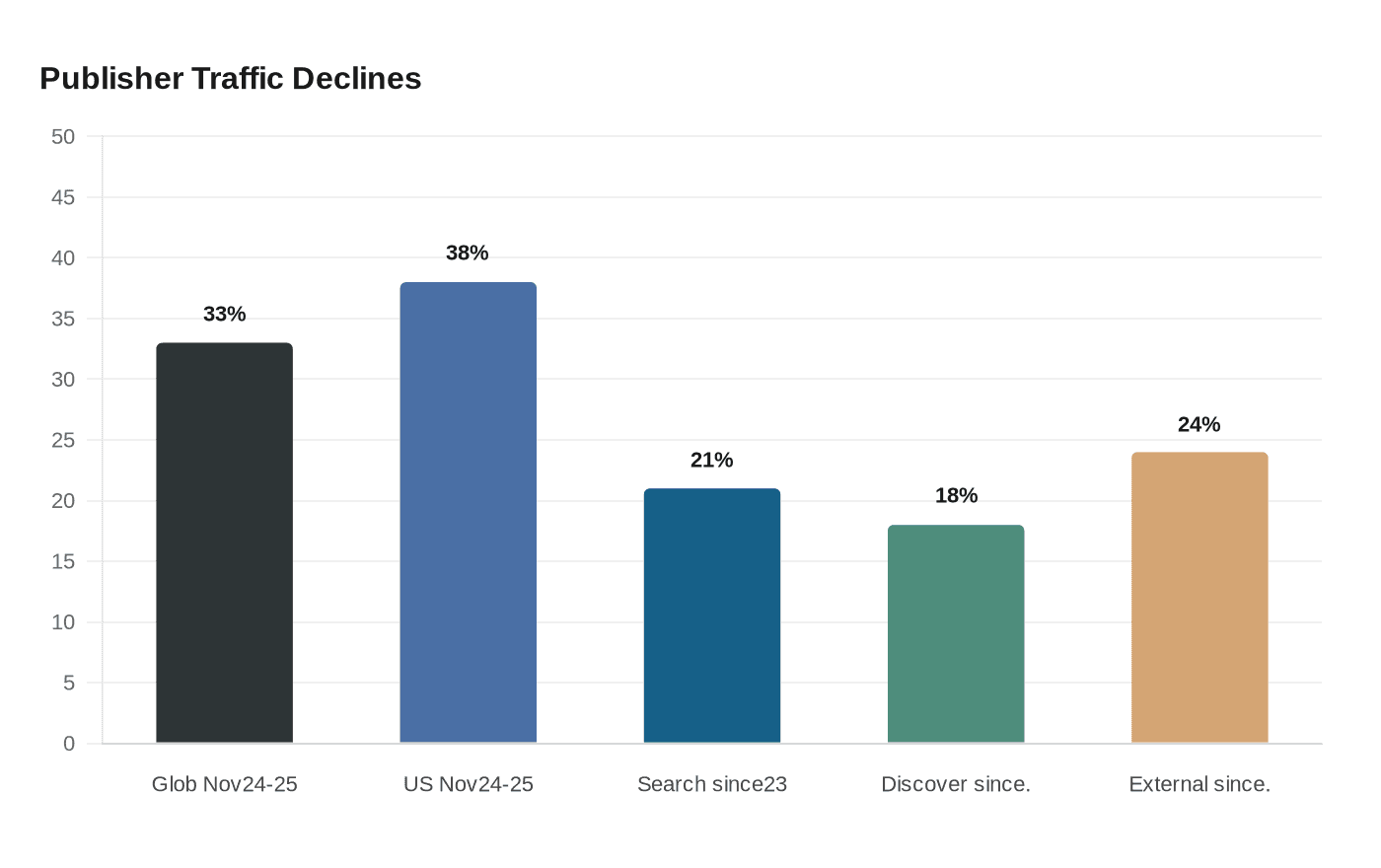
The old playbook built around blue-link clicks is getting thinner by the month. Reuters Institute’s 2026 Journalism and Technology Trends and Predictions report says Google search traffic to publishers fell 33% globally and 38% in the United States between November 2024 and November 2025. Since May 2023, Google search referrals were down 21% globally, Google Discover was down 18%, and all external referrals were down 24%. That is not a small adjustment. It is a structural squeeze on the way audiences reach publishers.

The scale of the Reuters study makes that warning hard to dismiss. It was based on Chartbeat data from more than 2,500 publisher websites and a survey of 280 news executives from 51 countries and territories, including 64 editors-in-chief, 64 CEOs or managing directors, and 51 heads of digital or innovation. The message from that crowd is blunt: this is not just a Google problem. It is an “answer engine” problem, because more users are getting what they need without ever making the click.
Why The Spruce matters in that environment
That is the backdrop for the Search Engine Land case study holding up The Spruce as an unusually strong performer in AI search. According to Semrush’s AI Visibility Toolkit, The Spruce is mentioned by large language models at rates comparable to heavy-hitters like CNET and Consumer Reports. It also performs strongly on share of voice relative to competitors. For a publisher trying to understand what visibility looks like when an AI system is doing the recommending, that is a useful benchmark.
The key detail is not that The Spruce is everywhere. It is that the brand shows up where it makes sense. Launched in February 2017 as part of the About.com and Dotdash family, The Spruce had years to build a tightly defined home-and-lifestyle authority base. That matters because AI systems do not reward vague usefulness in the abstract. They reward sources they can confidently map to a topic, an intent, and a likely answer path.
The real lesson is topical focus, not generic breadth
The case study’s central point is straightforward: The Spruce wins because it is sharply focused and because its content strategy aligns with the way AI systems interpret intent. It is not just publishing broadly useful material and hoping the model notices. It is building authority around specific topics that an LLM can connect to query fan-outs and recommendation contexts.
That distinction matters more than a lot of publishers want to admit. A broad general-interest site can be full of decent content and still be invisible in synthesized answers if it does not own a clear topic shape. The Spruce, by contrast, is the kind of brand that can repeatedly signal, through its structure and consistency, that it is the reliable answer for a defined set of home and lifestyle questions.
For publishers, that means the job is changing in three ways:
- Optimize for citation, not just traffic.
- Build trust signals that survive inside an AI answer.
- Keep your brand visible at the point where the user makes the decision, not only after the click.
That is the shift the Reuters report is really pointing toward. If AI systems answer the question directly, fewer people need to visit the source. If your publication is absent from the answer, you are absent from the buyer journey.
Measurement is part of the strategy now
One reason The Spruce is useful as a model is that its performance can be measured in the same frame publishers now need to use. Semrush’s AI Visibility Toolkit, the measurement framework cited in the case study, tracks brand visibility, competitors, prompts, and share of voice across AI platforms. That is the kind of reporting publishers need if they want to move beyond vanity metrics and understand whether their work is actually getting surfaced.
This is where old SEO instincts are not enough. Keyword rankings alone do not tell you whether an LLM is choosing your publication when it synthesizes an answer. A publisher can have decent organic visibility and still lose mindshare in AI-generated results. The toolkit’s value is that it forces the team to look at prompts and competitive visibility, not just page-level traffic.
People Inc. gives the story extra weight
The owner story matters too. Dotdash Meredith rebranded to People Inc. on July 31, 2025, and said it is the largest digital and print publisher in America, with more than 40 brands and more than 175 million monthly users. That scale helps explain why The Spruce is worth watching. It sits inside a publisher portfolio that has enough breadth, distribution, and operating muscle to invest in audience ownership over the long run.
That does not mean scale alone is the answer. In fact, the lesson here is the opposite. The Spruce works because it is not trying to be everything to everyone. It has a defined editorial identity inside a much larger company, and that focus is exactly what makes it legible to both users and AI systems.
What publishers should actually do next
If you strip away the buzz around LLMs, the practical takeaway is pretty old-fashioned: own something specific and own it consistently. The publishers that hold up in AI search will be the ones that can make a model think, with confidence, that their brand is the place to go for a particular kind of answer.
A workable checklist looks like this:
- Define one or more narrow topic areas where your brand can become the default source.
- Make sure the content around those areas is consistent enough for an AI system to recognize the pattern.
- Review where your brand appears in AI-generated answers, not just where it ranks in search.
- Track share of voice against close competitors, the way Semrush’s toolkit does.
- Treat trust and citation as core editorial outputs, not side effects of good traffic.
- Build for answerability, because the click is no longer guaranteed.
The Spruce is not a magic trick. It is proof that in a search environment where Google referrals are shrinking and AI answers are eating the front end of discovery, publishers can still win if they become the source models trust first. That is the survival playbook now, and it starts with being unmistakably good at one thing.
This article was produced by Prism’s automated news system from verified source data, official records, and press releases, then run through automated quality and moderation checks before publishing. The system is built and supervised by the people who set the standards it runs under. Read our full AI policy.
Did this article answer your question?