Webflow adds enterprise tools for tracking AI answer visibility
Webflow put AEO inside its Enterprise stack, with analytics, agents, and review-before-publish safeguards aimed at AI answer visibility.
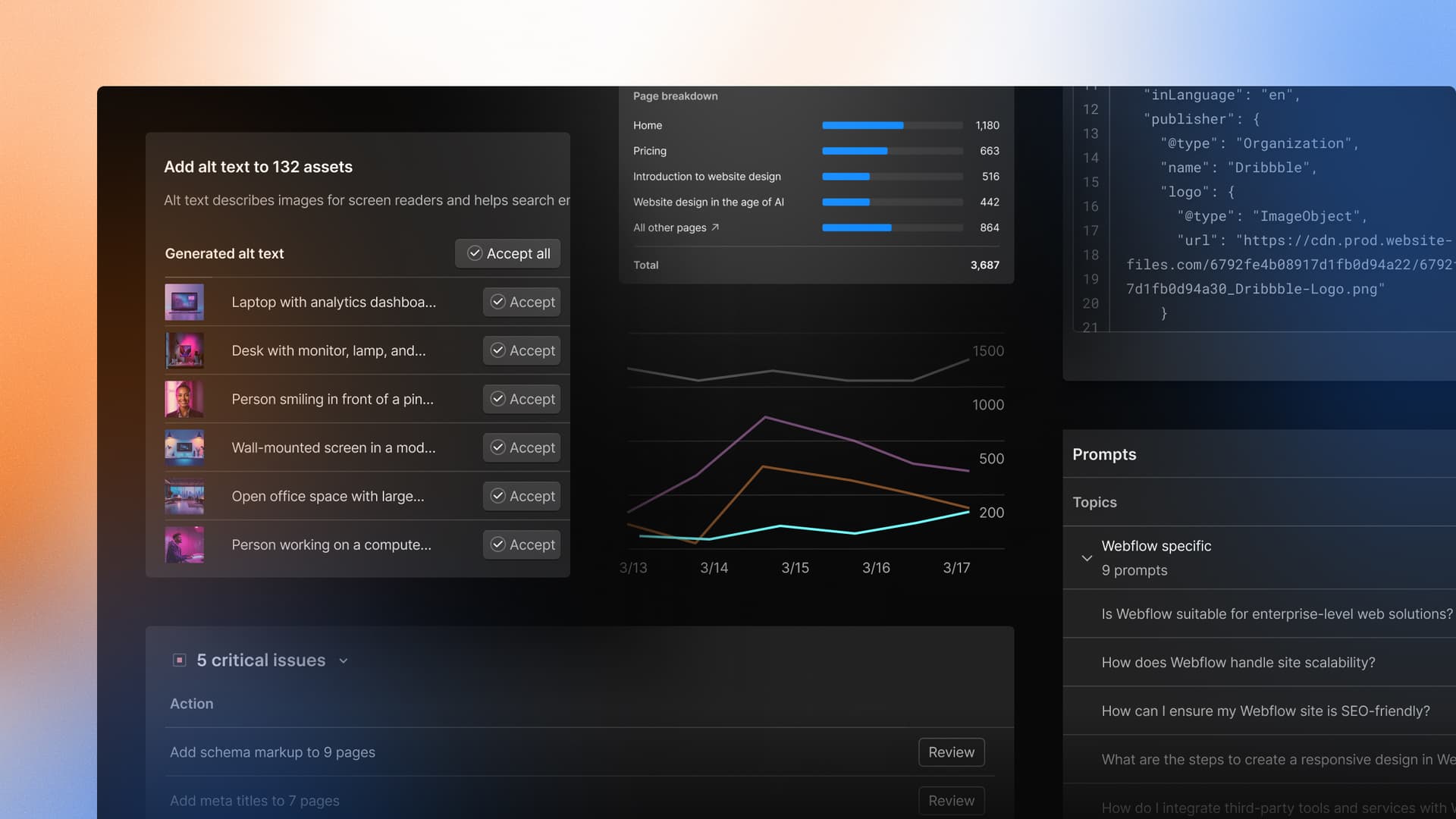
Webflow moved answer-engine optimization from a side project into the Enterprise stack, rolling out AEO tools that let teams track how brands appear in AI answers and push fixes back into the site workflow. The launch paired AEO analytics with AEO agents, giving marketers a closed-loop system for measuring visibility, spotting gaps, and preparing changes before anything goes live.
The company said AEO analytics are available in the latest version of Analyze for Enterprise, while all Enterprise customers get access to the AEO agents. Those agents surface prioritized issues such as broken links, outdated metadata, and missing schema markup, then prepare bulk changes for review. Teams can accept, modify, or dismiss the changes before publishing, which is the kind of safeguard enterprise content operations usually demand before they let automation anywhere near production.

Webflow said the feature is built around a framework that measures content, technical factors, authority, and measurement, and its public AEO pages name ChatGPT, Perplexity, Gemini, Claude, and Google AI Overviews as the answer engines it is targeting. That matters because it shifts AEO away from one-off consulting and into the same operating layer where teams already manage content, experimentation, and conversion. If AI-generated answers are becoming a discovery surface, Webflow is betting the response belongs inside the CMS, not bolted on later.

This release also built on a longer run of AEO bets. Webflow first announced Webflow AEO in private beta on April 13, 2026, and the Enterprise rollout followed earlier work on llms.txt, Markdown for agents, LLM-referred traffic insights, and an AI-assisted technical SEO auditing tool. Webflow said that auditing tool drove 75% more monthly organic traffic for customers who adopted it. The company has also made the case internally and externally that AI visibility is not a niche concern: in a June 2025 blog post, Webflow said its AI search signups grew 4x in six months, and that 8% of total new signups came from AI, up from 2% in October 2024.
The broader pitch is simple enough: answer engines are changing how people find products, and enterprise websites need infrastructure that can keep up. Webflow said a survey of more than 100 marketing leaders and 300-plus practitioners found 93% of marketing leaders believe AEO will be critical for brand success in the next two years. Its next-gen CMS Enterprise announcement pushed that logic further, saying all Enterprise sites had already been migrated to a modern CMS architecture built for higher content scale and richer data models, with visitors from answer engines converting 4.4X to 23X more than typical SEO traffic. Webflow is now treating AI search visibility as core website infrastructure, not a feature request.
This article was produced by Prism’s automated news system from verified source data, official records, and press releases, then run through automated quality and moderation checks before publishing. The system is built and supervised by the people who set the standards it runs under. Read our full AI policy.
Did this article answer your question?