Baby Shower Photography Guide Covers Consent, Privacy, and Legal Protections
Modern baby showers mix pro photographers, livestreams, and social sharing in ways that can create real legal exposure. Here's the consent-and-privacy checklist that keeps everyone protected.
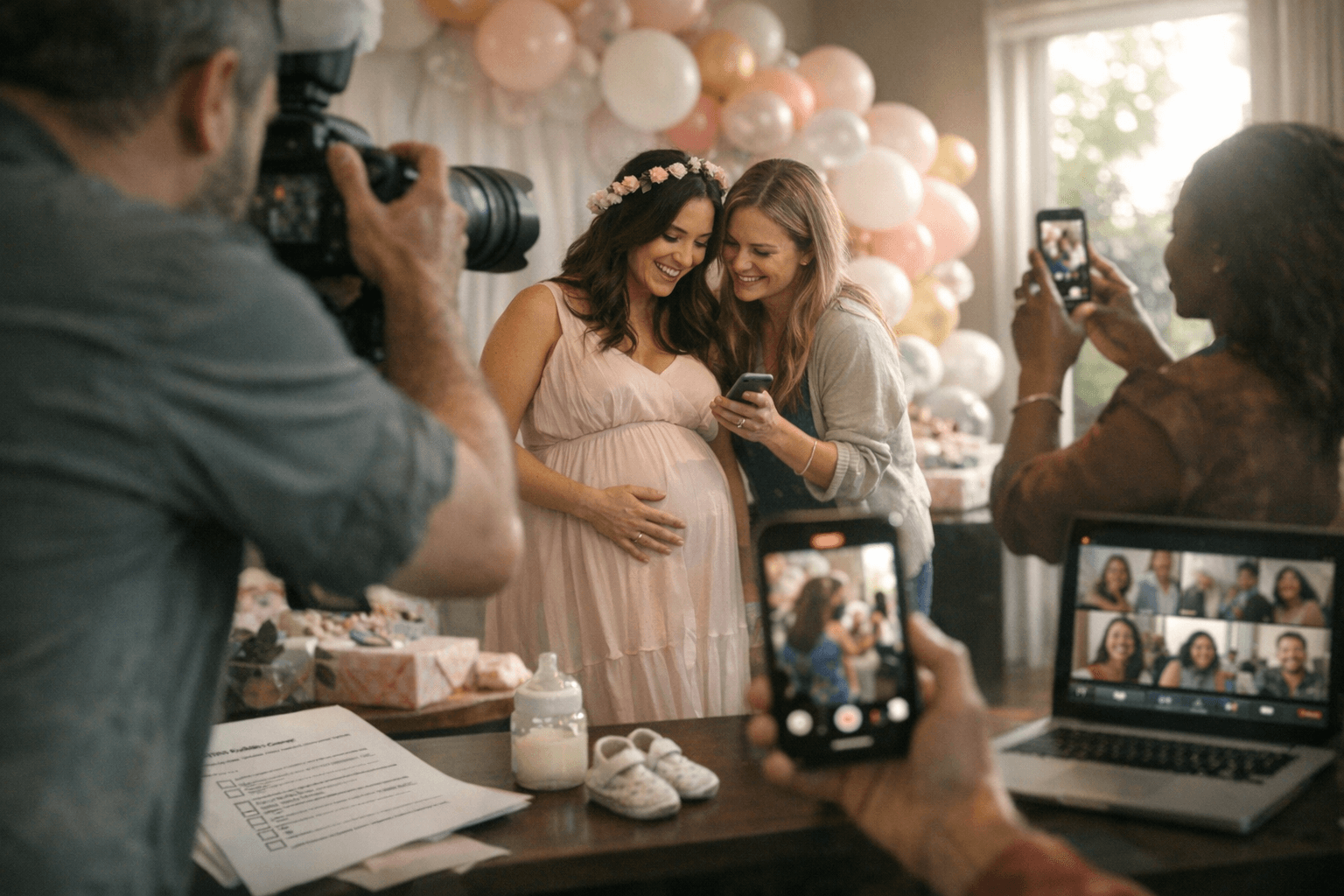
The average baby shower now involves at least three cameras: a hired photographer, a guest's phone pointed at the gift table, and someone's laptop streaming the whole thing to relatives overseas. That's not a problem until it is. Someone didn't want their face on Instagram. A photographer used a portrait in her marketing portfolio without asking. A parent discovers that a photo of their newborn is sitting in an unlocked, publicly searchable cloud folder. None of these situations are hypothetical, and all of them are preventable with a short set of pre-event decisions and about two pages of documentation.
Know the Legal Landscape Before You Book the Venue
Photography at private events isn't a free-for-all, and the law treats certain subjects with more caution than others. Adults attending a private event generally provide implied consent by showing up, but that consent has limits: it doesn't automatically extend to public posting, commercial use, or streaming. The moment a camera appears in a commercial context or an image is broadcast beyond the guest list, you're in release territory.
Children are the sharpest edge of this issue. Photographing minors at private events requires parental or guardian consent for any image that may be posted publicly, full stop. "Private family use only" is a narrower category, and even there, it's worth recording verbal consent and noting it on the guest list so you have a paper trail if questions come up later.
Venue rules add another layer. Many hotels and private event spaces have their own photography restrictions, particularly around professional equipment or commercial licensing. Pull these policies before signing the venue contract, not the morning of the shower. And in your written contract with the photographer, nail down three specifics upfront: photo-delivery timelines, usage rights, and who owns the final images.
The Three Forms That Cover Almost Every Scenario
General Photography Release for Adult Attendees
This is a short clause, not a lengthy legal document. It grants the host and the contracted photographer a non-exclusive license to use photos for personal, marketing, and social-media purposes. The critical negotiation point: specify whether the host may sell or license images. For private events, the standard answer is no, and that should be written explicitly rather than assumed.
Minor-Photo Consent Form
If any image of a child may be posted publicly, you need a signed consent form from the child's parent or guardian before that image goes anywhere. If the photos are strictly for private family use, verbal consent is acceptable, but note it on the guest list and keep that record. The distinction between "private family use" and "posted to the family Facebook group" is fuzzier than most people realize, so when in doubt, get it in writing.
Model Release for Commercial Use
If the photographer intends to use any images commercially, such as in a portfolio, on a studio website, or in advertising, a separate model release is required. This is distinct from the event photography release. Hosts should clarify in the initial contract who holds the right to grant and, importantly, rescind those commercial permissions. Leaving this undefined is how good working relationships become billing disputes six months after the event.
Building Consent Into the Event Before Anyone Arrives
The cleanest approach to consent is to make it visible and opt-in from the start, so nothing feels like a surprise on the day.
Include a brief photography note in every invitation. Something as simple as "We will have a photographer and may share photos publicly. Please contact the host if you prefer not to be photographed" is enough to set expectations and give guests a chance to flag concerns before they're standing in front of a camera.
At the entrance, post clear signage stating that photos and video may be taken and shared, and include instructions for guests who want to opt out. The sign doesn't need to be large or formal; it just needs to exist, because it closes the loop on informed consent in a way that an invitation note alone doesn't.
At the registration desk, make "no photos" stickers available for any guest who requests privacy. Keep a running list of those guests and hand it to the photographer before the event begins. This is the single most practical tool in the workflow: it takes the burden off the guest (who shouldn't have to wave off a photographer repeatedly throughout the afternoon) and gives the photographer clear operational guidance.
The Photographer Brief: More Than a Shot List
A standard shot list covers the must-have moments: cake cutting, gift opening, group portraits. The consent-aware brief goes further. Before the event, give the photographer three things: the shot list, the opt-out guest list, and explicit instructions about immediate social sharing versus delayed publishing. Some hosts want real-time Instagram stories; others want a 72-hour review window before anything goes public. Neither preference is wrong, but both need to be communicated clearly in advance.
Secure Storage and a Retention Policy That's Actually Enforced
Raw image files sitting in an unlocked, publicly accessible folder are a privacy violation waiting to happen. Deliver gallery access through vetted platforms with password-protected links, not shared Google Drive folders with open permissions. Agree on a retention timeline with the photographer before the event: a window of one to three years for raw files and published galleries is standard practice. That timeline should be written into the vendor contract and communicated to the family, not just stored in the photographer's internal notes.
On the metadata front: instruct the photographer to strip GPS data from photos before any public posting if location privacy is a concern. Most professional editing software handles this in batch export, so it's a low-effort step with meaningful privacy upside.
Social Sharing, Commercial Use, and the Line Between Them
Personal use and commercial use are not the same category, and the law doesn't treat them identically. If a photographer sells prints, licenses images to a stock agency, or uses event photos in studio marketing, separate written permission from the subjects is required. This applies even when the original event photography contract was signed and paid in full. Hosts negotiating with photographers should ask this question directly: "Do you intend to use any of these images commercially?" and get the answer in writing.
Dispute Resolution and Takedown Protocols
Designate a named contact, either the host or the photographer, as the point person for takedown or privacy concerns before the event happens. Agree on a response window: 48 to 72 hours is the workable standard for removal requests. Having this structure in place before a dispute arises means you're not scrambling to figure out who's responsible when someone calls upset.
Maintain physical or digital records of all signed releases and opt-out lists. These records are your primary defense if a dispute escalates. A guest who later claims they never consented to being photographed is a manageable situation when you have a signed release; it's a much more complicated conversation when you don't.
Cross-Border and Platform-Specific Considerations
If any attendees are EU citizens, or if event content will be shared on platforms with European audiences, GDPR applies and the consent language in your releases needs to be narrower and more explicit than a general U.S.-style clause. This isn't a niche edge case at events with international guest lists. When in doubt, consult local data-protection requirements and draft consent language accordingly. Erring toward more specific consent language costs nothing and protects everyone.
A Decision Tree for Hosts and Photographers
Run through this sequence before every event:
1. Will any photos include children? If yes, prepare a minor-photo consent form for each child's parent or guardian.
2. Will the event be livestreamed or recorded for later distribution? If yes, disclose in the invitation and post entrance signage; offer an opt-out zone.
3. Will the photographer use any images commercially? If yes, prepare a separate model release.
4. Have all adult attendees been informed of photography? If yes via invitation disclosure, provide opt-out stickers at registration as a secondary layer.
5. Is the image delivery method secure? If not, switch to a password-protected gallery platform before delivery.
6. Has a retention timeline been agreed in writing? If not, add it to the vendor contract before the event date.
The paperwork involved here amounts to one page of release language, one consent form for minor subjects, a photographer brief that takes fifteen minutes to write, and two signs at the entrance. That's a small investment for the legal clarity and guest trust it buys. The goal isn't to turn a baby shower into a legal proceeding; it's to handle the administrative side quickly enough that no one has to think about it during the party itself.
This article was produced by Prism’s automated news system from verified source data, official records, and press releases, then run through automated quality and moderation checks before publishing. The system is built and supervised by the people who set the standards it runs under. Read our full AI policy.
Know something we missed? Have a correction or additional information?
Submit a Tip