Office baby showers turn to short, optional screen-based games
The smartest office baby showers now feel like a break, not a trap: short, optional screen games keep the ritual warm without putting anyone on the spot.
Why the office version needs rules
The old office baby shower script is overdue for a reset. In a mixed workplace, the point is not to manufacture forced fun, it is to mark a life event without turning the room into a pressure cooker of awkward questions, public guesses, and half-interested applause. Workplace etiquette exists for a reason: it keeps behavior respectful, collaborative, and suited to the setting, and a baby shower in the office should follow that same logic.
That is where the best modern versions get sharper. SHRM’s guidance on inclusive workplaces ties inclusion to morale, productivity, retention, and belonging, and its civility framework makes the case plainly: people do better when they feel safe sharing openly and respectfully. An office baby shower that respects those conditions is not cold. It is considerate, and in a workplace, that matters more than staging a big reveal or squeezing every last laugh out of a game round.
Keep the game block short
The most useful rule is also the simplest: do not let the games take over the event. The sweet spot is two or three games total, with each round running five to seven minutes, and the full game block capped at about 15 to 20 minutes. That keeps the shower feeling like a break from the workday instead of an extra meeting with balloons.
This time discipline is doing more than protecting everyone’s attention span. It also reduces the social drag that comes with office events, where people are often balancing politeness, hierarchy, and their actual workload. A short game block gives the guest of honor a moment, gives coworkers something to do, and then gets everyone back to normal without overstaying its welcome.
Use screen-based games that do not need props
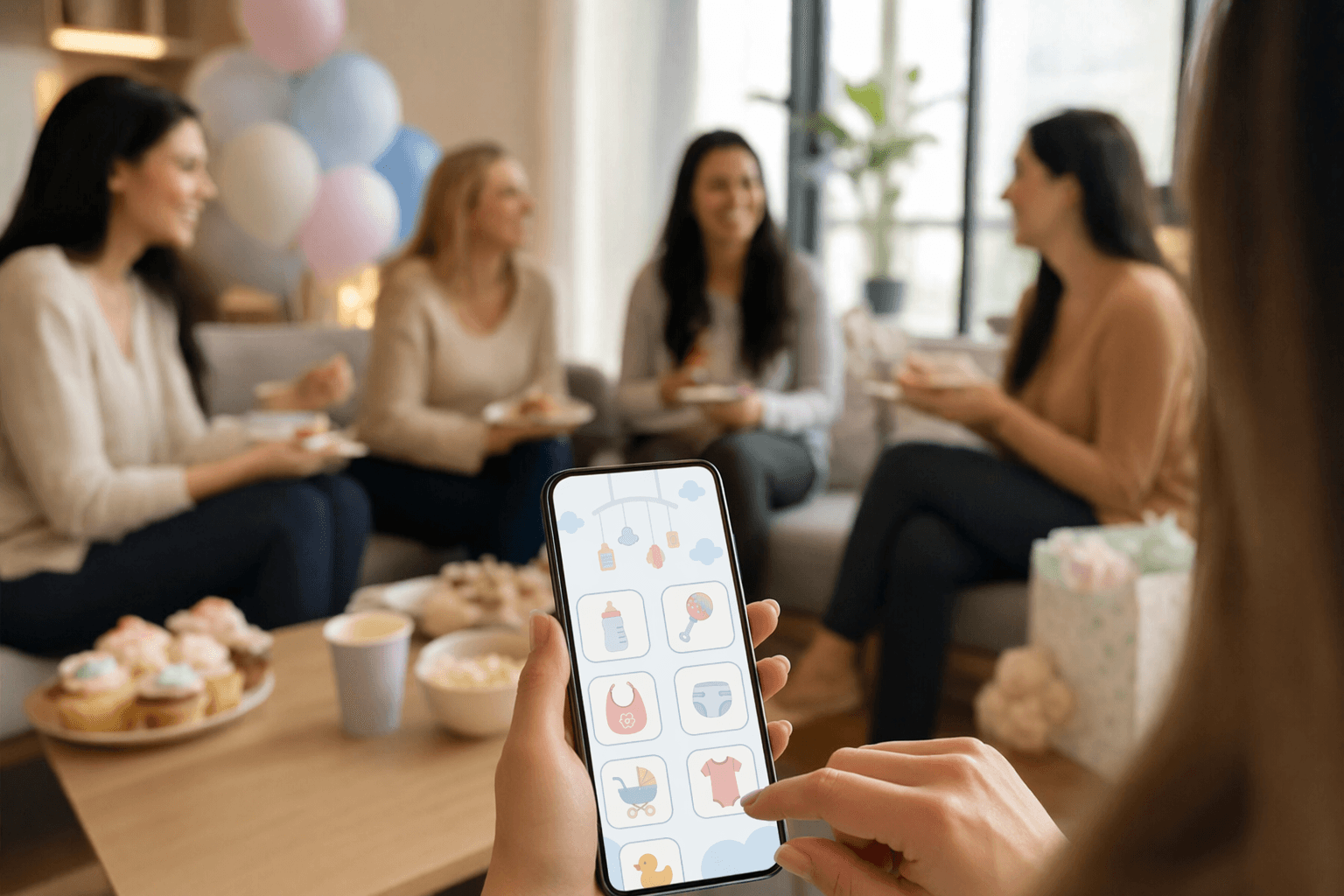
If you want the games to work in a workplace, make them easy to join and easy to ignore. The strongest formats here are digital trivia, emoji pictionary, and price guessing, all of which can run from a single shared screen with no printing, no app downloads, and no clipboard parade around the room. That matters because the screen becomes the shared surface, not the person at the table who gets singled out.
This is where office showers get smarter than the old-fashioned party templates. A screen-based format is lighter on setup, easier to keep moving, and less likely to create the kind of awkward pause that happens when someone is asked to hold up a guess in front of the whole team. It also plays better with hybrid gatherings, where a few people may be on video and others are in the room, because the game lives in the shared view rather than in a stack of paper passed hand to hand.
Skip the formats that create pressure
A workplace shower should not wander into body talk, food tasting, or personal oversharing. Those formats can create HR headaches fast, and they can make introverts, or anyone who is simply trying to get through the afternoon, feel cornered. The goal is warmth without intrusion, not a forced confessional wrapped in pastel paper.
That caution lines up with the broader legal backdrop around pregnancy and nursing in the workplace. The U.S. Department of Labor says the Pregnant Workers Fairness Act requires covered employers with at least 15 employees to provide reasonable accommodations for known pregnancy-related limitations unless doing so would create an undue hardship. The same department says the PUMP Act requires reasonable break time and a private space, not a bathroom, for expressing breast milk for up to one year after a child’s birth. Those rules are not about party planning, but they explain why a workplace celebration should be especially careful about privacy and personal boundaries.
Make participation optional by design
The cleanest office shower is one where nobody has to fake enthusiasm to be polite. An opt-in setup works best: people can play if they want to, or simply watch without becoming the subject of a quiet interrogation. That small shift changes the tone immediately, because participation becomes an invitation rather than a test of collegiality.
Screens help here too. When games are projected or shared digitally, nobody needs to be called out with a marker in hand or asked to move to the front of the room. That makes the event feel more relaxed and less performative, which is exactly what you want when coworkers may be friends, acquaintances, managers, direct reports, or all three at once.
Remember what kind of ritual this is
Baby showers are not a brand-new invention. Britannica places them within the larger family of life-cycle ceremonies that celebrate childbirth across cultures, which is a useful reminder that the ritual has always been about marking a transition. The office version is newer, though, and it has to adapt to mixed audiences, hierarchy, and professional boundaries in a way a home gathering often does not.
That is why the strongest office shower format is not the loudest one. It is the one that understands who is in the room, what the room is for, and how easy it is for a celebration to tip from generous into invasive. A coworker-first, friend-second crowd needs a different rhythm than a close circle of relatives, and the best hosts are building around that reality instead of fighting it.
What the new office shower actually looks like
The broader shift is toward hybrid, audience-aware programming that fits the setting, the guest list, and the guest of honor instead of recycling games that only worked in smaller, less mixed groups. In practice, that means fewer gimmicks and more judgment: keep it short, keep it easy to join, and keep the social temperature low enough that everyone can relax.
- two or three short games, not a marathon
- five to seven minutes per round
- 15 to 20 minutes total for games
- trivia, emoji pictionary, or price guessing on one shared screen
- no printing, no app downloads, no public spotlight on individual players
- an opt-in structure that lets people observe without pressure
- no body talk, food-tasting prompts, or oversharing exercises
A good office shower now looks like this:
That formula works because it respects the workplace for what it is. The celebration still feels human, but it no longer relies on rituals that put people on the spot. In offices that care about morale, engagement, and retention, that is not a compromise. It is the upgrade.
This article was produced by Prism’s automated news system from verified source data, official records, and press releases, then run through automated quality and moderation checks before publishing. The system is built and supervised by the people who set the standards it runs under. Read our full AI policy.
Did this article answer your question?